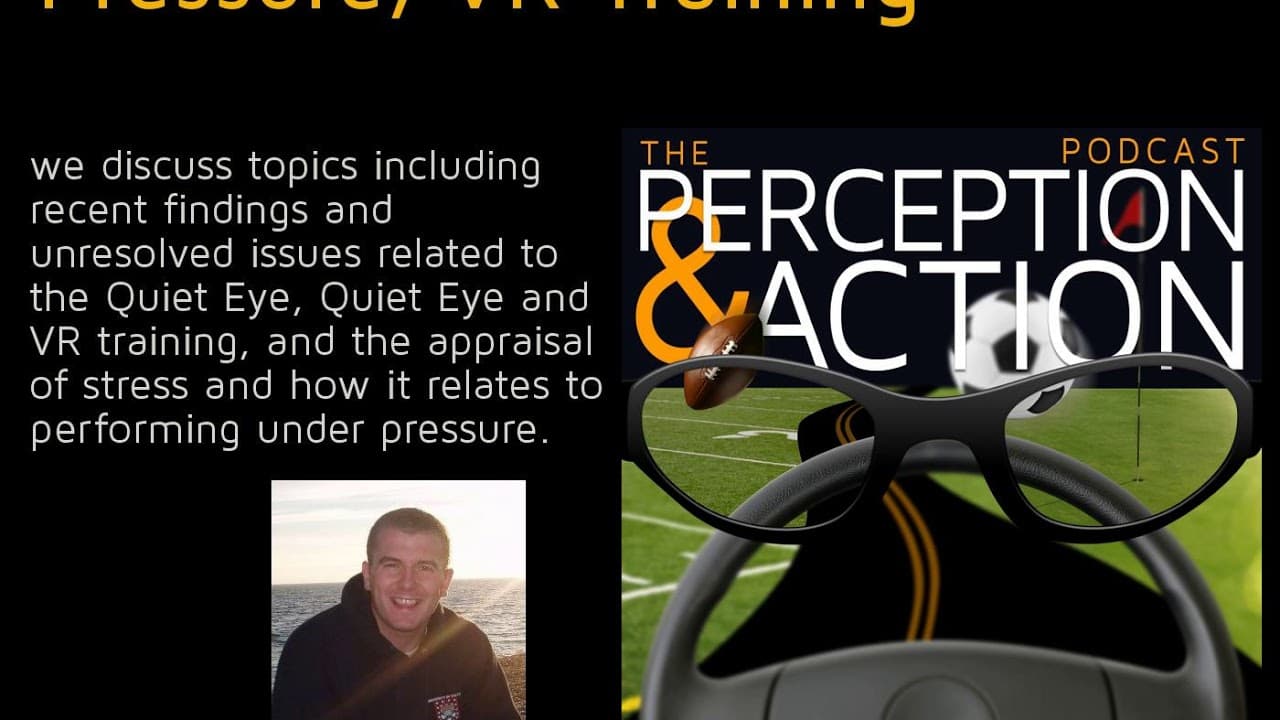
74 – Interview with Sam Vine, Exeter, Quiet Eye, Pressure, VR Training
TL;DR
Interview with Sam Vine on Quiet Eye and VR training.
Transcript
this is Rob gray from ASU in perception action calm today on the perception and action podcast my interview with Sam vine senior lecturer of psychology and human movement science at the University of Exeter hi everyone welcome to the perception and action podcast where I discuss how psychological research can be applied to improving performance acc... Read More
Key Insights
- Sam Vine's research focuses on understanding performance psychology from theoretical to applied aspects, including VR training for safety-critical jobs.
- The Quiet Eye technique is a significant area of study, with recent findings on its role in error recovery and the influence of sports performance.
- Vine's work extends beyond sports, applying psychological principles to fields like surgery, aviation, and military training.
- The appraisal of stress and threat is crucial in performance under pressure, with research indicating that reappraising physiological symptoms can improve performance.
- VR training, particularly with Cineon Training, aims to provide evidence-based human factors training using immersive environments.
- Simulation training's effectiveness is often questioned, and Vine's work seeks to establish its validity through rigorous research.
- New research projects are exploring gaze markers in prosthetic arm use and visual-motor control deficits in autistic children.
- The integration of Quiet Eye and flow studies suggests potential overlaps in mechanisms, warranting further exploration.
Install to Summarize YouTube Videos and Get Transcripts
Explore YouTube Video Summarizer or Get YouTube Transcript Extractor
Questions & Answers
Q: What is the Quiet Eye technique, and why is it significant?
The Quiet Eye technique involves maintaining a steady gaze on a target before executing a motor skill. It is significant because it is linked to improved performance across various sports and tasks. Research suggests that it helps in planning and executing movements by facilitating better attentional control.
Q: How does Sam Vine's research apply to fields outside of sports?
Vine applies psychological principles to fields like surgery, aviation, and military training by using concepts like the Quiet Eye to improve performance. His research aims to understand and enhance human movement and performance in safety-critical environments, leveraging insights from sports psychology.
Q: What are the challenges in Quiet Eye research according to Sam Vine?
Vine identifies the need to understand the task-specific mechanisms behind the Quiet Eye and to develop a theoretical framework that accounts for differences in skills and populations. He emphasizes the importance of distinguishing mechanisms across various tasks and environments to advance the field.
Q: How does VR training fit into Sam Vine's research agenda?
VR training, particularly through Cineon Training, is a key focus for Vine. It aims to provide evidence-based training solutions for high-risk industries. By focusing on psychological fidelity, VR training seeks to replicate the mental processes involved in real-world tasks, thus enhancing learning and performance.
Q: What is the role of stress appraisal in performance under pressure?
Stress appraisal plays a critical role in determining performance outcomes under pressure. Vine's research shows that reappraising physiological symptoms of stress as positive can shift individuals from a threat to a challenge state, leading to improved performance and better management of pressure situations.
Q: What are the recent findings on Quiet Eye in error recovery?
Recent studies indicate that Quiet Eye durations increase following an error, suggesting a strategy to enhance focus and effort to recover from mistakes. This finding highlights the adaptive role of Quiet Eye in managing performance errors and optimizing subsequent actions.
Q: How does Sam Vine address the validity of simulation training?
Vine addresses simulation training validity by focusing on perceptual and psychological fidelity rather than just physical realism. His research aims to establish the effectiveness of simulations by ensuring they replicate the cognitive and emotional demands of real-world tasks, thus providing a robust training platform.
Q: What future research directions does Sam Vine foresee?
Vine foresees continuing research in VR training, exploring gaze markers in prosthetic arm use, and understanding visual-motor control in autistic children. He aims to deepen the theoretical understanding of these areas while ensuring practical applications that enhance learning and performance across diverse fields.
Summary & Key Takeaways
-
Sam Vine discusses his diverse research interests, focusing on the Quiet Eye technique and its application across various domains beyond sports, like surgery and military training. His work aims to bridge theoretical understanding with applied training solutions.
-
The interview highlights the importance of understanding how stress appraisal affects performance under pressure. Vine's research shows that reappraising physiological responses can shift individuals from a threat to a challenge state, potentially enhancing performance.
-
Vine's latest venture, Cineon Training, explores the use of VR for evidence-based training in high-risk industries. This initiative seeks to improve the validity and effectiveness of simulation training by focusing on psychological fidelity rather than mere physical realism.
Read in Other Languages (beta)
Share This Summary 📚
Summarize YouTube Videos and Get Video Transcripts with 1-Click
Try YouTube Summary with ChatGPT & Claude or YouTube Transcript Generator
Explore More Summaries from Rob Gray 📚
Summarize YouTube Videos and Get Video Transcripts with 1-Click
Try YouTube Summary with ChatGPT & Claude or YouTube Transcript Generator