Curvature Demonstrated + Comments | Space Time | PBS Digital Studios
TL;DR
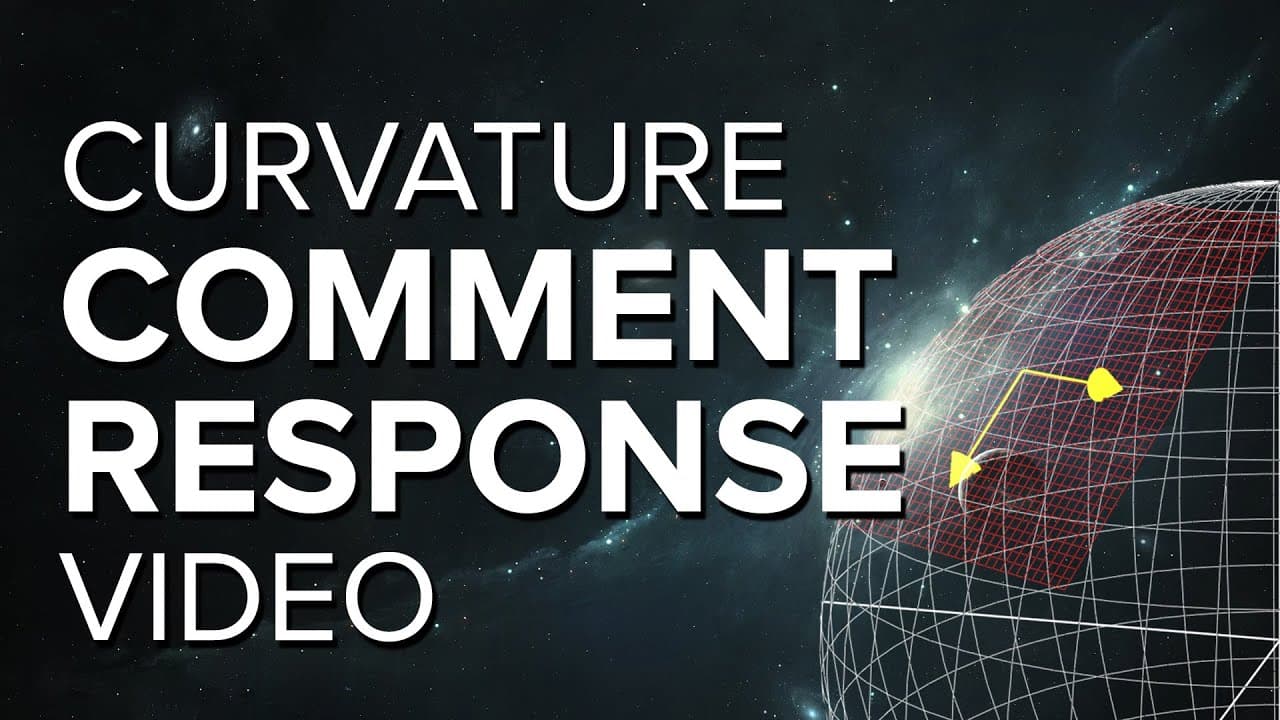
Explains tangency, parallel transport, and geodesics on spheres.
Transcript
Hey, everybody. You guys had a lot of questions and comments regarding last week's episode about straight lines and curved spaces. That material is really important to get down visually before we move on to the rest of the relativity series. So today, I'm going to step back and take some time to address your questions, hopefully in a way that clear... Read More
Key Insights
- Tangency on a sphere involves vectors that do not lie on the sphere's surface but are tangent at a point. This distinction is crucial for understanding curved spaces.
- Geodesics are curves that maintain tangency of vectors when parallel transported, exemplified by great circles on a sphere.
- Parallel transport involves moving a vector along a curve on a sphere, maintaining its direction relative to the curve, revealing whether the curve is a geodesic.
- The dimensionality of ambient space does not affect curvature discussions on the sphere; curvature is intrinsic to the sphere itself.
- Parallel transport in 3D space can determine if the space around Earth is flat or curved by checking if a transported vector returns unchanged.
- Converging or diverging geodesics indicate curvature; on Earth, initially parallel geodesics at the equator converge at the poles.
- Understanding curved spaces is foundational for later discussions on flat spacetime geometry and Newtonian gravity.
- The episode aims to clarify viewer confusion about geodesics and curved spaces before progressing in the relativity series.
Install to Summarize YouTube Videos and Get Transcripts
Explore YouTube Video Summarizer or Get YouTube Transcript Extractor
Questions & Answers
Q: What does tangency mean on a sphere?
Tangency on a sphere involves vectors that are tangent to a point on the sphere's surface but do not lie on the surface itself. This concept is crucial for understanding how vectors behave on curved surfaces, as it distinguishes between being tangent to the sphere and being tangent to a curve on the sphere.
Q: How is parallel transport demonstrated on a sphere?
Parallel transport on a sphere is demonstrated by moving a vector along a curve while maintaining its direction relative to the curve. This process involves imagining the vector as very short and moving it in small steps, projecting it onto a tangent plane, and repeating this to reveal if the curve is a geodesic.
Q: Does the ambient space affect curvature discussions on a sphere?
No, the ambient space does not affect curvature discussions on a sphere. Curvature is intrinsic to the sphere itself, meaning it can be determined by examining the sphere's properties without reference to the surrounding space. The ambient space serves merely as a visual aid.
Q: How can you determine if 3D space around Earth is curved?
To determine if 3D space around Earth is curved, you can parallel transport a vector around a circular path. If the vector returns unchanged, the space is flat. If it does not, the space is curved. This method uses Euclidean rules to assess the curvature of the surrounding space.
Q: What indicates curvature in geodesics on Earth?
Curvature in geodesics on Earth is indicated by the convergence or divergence of initially parallel geodesics. For example, two lines at the equator pointing north, which are initially parallel, will converge at the North Pole, demonstrating the curvature of Earth's surface.
Q: Why is understanding curved spaces important for future topics?
Understanding curved spaces is important for future topics because it lays the groundwork for discussing flat spacetime geometry and Newtonian gravity. These concepts are essential for comprehending how gravity and spacetime interact in the framework of general relativity, which will be explored in upcoming episodes.
Q: What is the main goal of this episode?
The main goal of this episode is to address viewer questions and clarify concepts related to tangency, parallel transport, and geodesics on spheres. By providing a clearer understanding of these topics, the episode aims to resolve confusion before advancing to more complex topics in the relativity series.
Q: How do geodesics behave on a sphere compared to a flat plane?
On a sphere, geodesics, such as great circles, maintain tangency of vectors when parallel transported, unlike curves on a flat plane. This behavior highlights the intrinsic curvature of the sphere, as geodesics on a sphere may converge or diverge, unlike straight lines on a flat plane, which remain parallel.
Summary & Key Takeaways
-
This episode addresses viewer questions about tangency, parallel transport, and geodesics on spheres. It clarifies that tangency involves vectors tangent to points on the sphere, not lying on the surface. Geodesics maintain vector tangency during parallel transport, exemplified by great circles.
-
Parallel transport is demonstrated by moving vectors along curves on a sphere, revealing whether they are geodesics. Ambient space dimensionality is irrelevant to curvature discussions, which are intrinsic to the sphere. The episode aims to clear up confusion before advancing in the series.
-
Converging geodesics indicate curvature; on Earth, initially parallel geodesics converge at the poles. Understanding curved spaces is crucial for future topics on flat spacetime geometry and Newtonian gravity, setting the stage for upcoming episodes in the relativity series.
Read in Other Languages (beta)
Share This Summary 📚
Summarize YouTube Videos and Get Video Transcripts with 1-Click
Try YouTube Summary with ChatGPT & Claude or YouTube Transcript Generator
Explore More Summaries from PBS Space Time 📚
Summarize YouTube Videos and Get Video Transcripts with 1-Click
Try YouTube Summary with ChatGPT & Claude or YouTube Transcript Generator