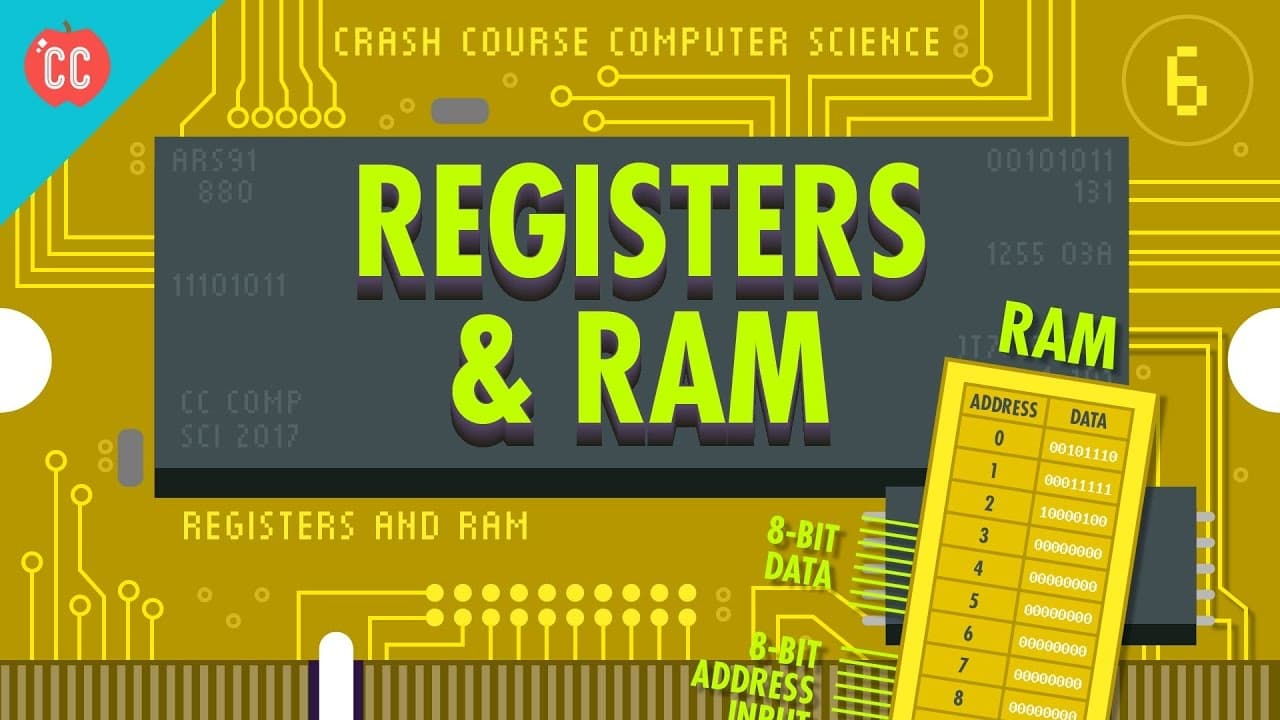
Registers and RAM: Crash Course Computer Science #6
TL;DR
This video explains how computer memory works, starting from a single bit storage circuit and scaling up to the use of matrices to create larger memory modules.
Transcript
Hi, I’m Carrie Anne and welcome to Crash Course Computer Science. So last episode, using just logic gates, we built a simple ALU, which performs arithmetic and logic operations, hence the ‘A’ and the ‘L’. But of course, there’s not much point in calculating a result only to throw it away - it would be useful to store that value somehow, and maybe e... Read More
Key Insights
- 💁 Computer memory is essential for storing information and performing operations on data.
- 🫦 Simple circuits like the AND-OR Latch can store a single bit of information permanently.
- 🫦 By combining latches, registers can be created to store multi-bit numbers.
- 👻 A matrix approach reduces the number of wires required, allowing for scalable memory.
- 🐏 Different types of memory, such as RAM and persistent memory, serve different purposes.
- 🖱️ Modern computers use nested matrices of memory cells to store vast amounts of data.
- ❓ The fundamental operation of memory is relatively simple, but the layers of abstraction make it complex.
Install to Summarize YouTube Videos and Get Transcripts
Explore YouTube Video Summarizer or Get YouTube Transcript Extractor
Questions & Answers
Q: How does a single bit storage circuit like the AND-OR Latch work?
The AND-OR Latch uses set and reset inputs to remember a single bit of information. When set is 1, the output becomes 1, and when reset is 1, the output becomes 0. If both inputs are 0, the circuit retains the last value.
Q: How can multiple latches be combined to create registers for storing multi-bit numbers?
Multiple latches can be placed side-by-side to form a register. Each latch stores one bit, and by enabling all latches simultaneously, an 8-bit number can be stored in the register.
Q: Why is a matrix approach used to scale up memory?
A matrix arrangement of latches reduces the number of wires needed. By using row and column wires, only one latch can be enabled at a time, allowing the sharing of common wires for writing and reading data.
Q: What is the difference between RAM and persistent memory?
RAM can store and retrieve data as long as the power is on, but loses information when power is lost. Persistent memory, on the other hand, can retain data without power and is used for different purposes.
Key Insights:
- Computer memory is essential for storing information and performing operations on data.
- Simple circuits like the AND-OR Latch can store a single bit of information permanently.
- By combining latches, registers can be created to store multi-bit numbers.
- A matrix approach reduces the number of wires required, allowing for scalable memory.
- Different types of memory, such as RAM and persistent memory, serve different purposes.
- Modern computers use nested matrices of memory cells to store vast amounts of data.
- The fundamental operation of memory is relatively simple, but the layers of abstraction make it complex.
- Memory technology has evolved, using different circuits and components to store and retrieve data efficiently.
Summary & Key Takeaways
-
Computer memory stores information and allows for running multiple operations. Random Access Memory (RAM) is used to store data as long as power is on, while persistent memory can survive without power.
-
A single bit of information can be stored using circuits like the AND-OR Latch, which has two inputs (set and reset) to remember a single bit.
-
By combining multiple latches, registers can be created to store multi-bit numbers. To scale up memory, a matrix approach is used to reduce the number of wires needed.
Read in Other Languages (beta)
Share This Summary 📚
Summarize YouTube Videos and Get Video Transcripts with 1-Click
Try YouTube Summary with ChatGPT & Claude or YouTube Transcript Generator
Explore More Summaries from CrashCourse 📚






Summarize YouTube Videos and Get Video Transcripts with 1-Click
Try YouTube Summary with ChatGPT & Claude or YouTube Transcript Generator