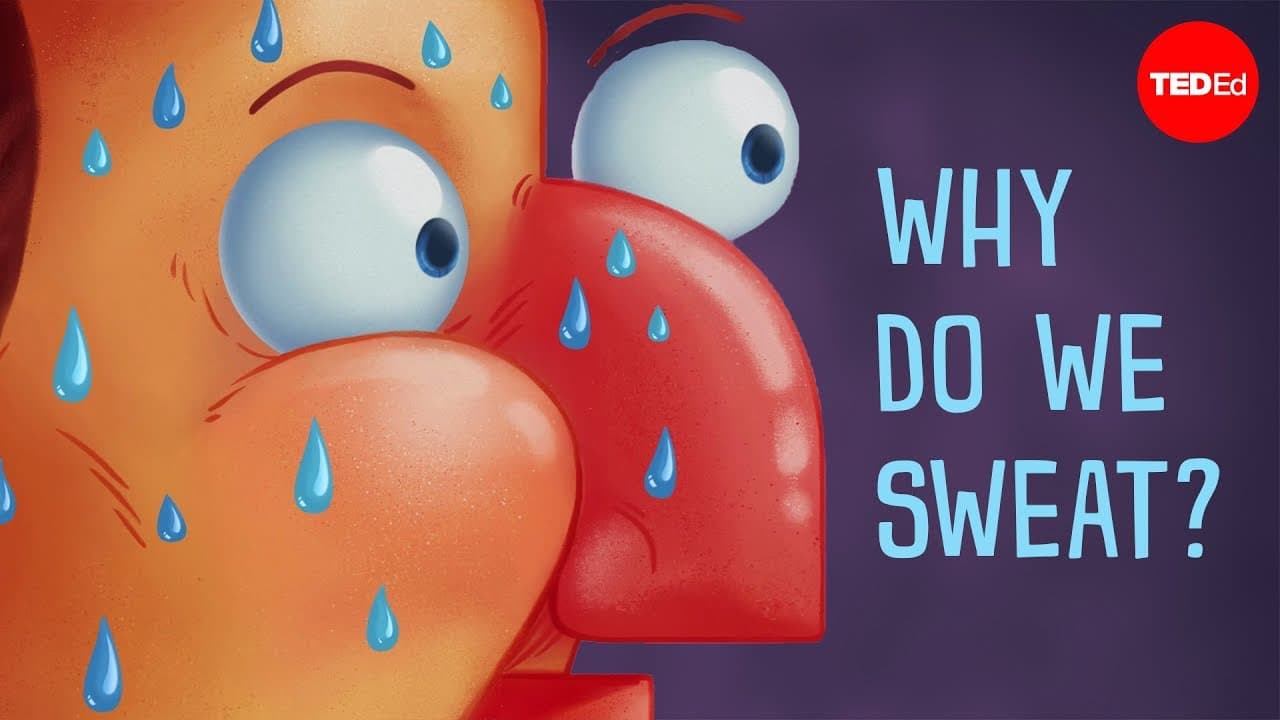
Why do we sweat? - John Murnan
TL;DR
Sweat is produced during exercise, spicy food consumption, stress, and illness to regulate body temperature.
Transcript
The finish line's in sight and you put on an extra burst of speed. As your legs pick up the pace, your breathing gets deeper, your heart pounds faster, and sweat pours over your skin. How does this substance suddenly materialize and what exactly is its purpose? There are a number of scenarios that can make us sweat: eating spicy foods, nervousness,... Read More
Key Insights
- 😋 Sweating is a natural response to regulate body temperature during exercise, stress, illness, and spicy food consumption.
- 🥵 Process of cellular respiration in mitochondria produces ATP, releasing heat that triggers sweating.
- 🥵 Sweating removes excess heat from the body through evaporative cooling, helping to maintain a stable internal temperature.
- 😅 Hypothalamus regulates body temperature and sweating response, signaling when to stop sweating.
- 🥵 Sweat glands distributed throughout the body produce sweat containing sodium and chloride, aiding in heat regulation.
- 😋 Sweating can be triggered by various factors like increased muscle activity, spicy food consumption, and stress.
- 😅 Sweating during illness helps raise body temperature to combat infections, making the body less habitable for infectious agents.
Install to Summarize YouTube Videos and Get Transcripts
Explore YouTube Video Summarizer or Get YouTube Transcript Extractor
Questions & Answers
Q: How does sweating help regulate body temperature during exercise?
Sweating during exercise is a physiological response triggered by increased muscle activity and heat production. As the body's temperature rises, sweat is produced to aid in evaporative cooling, effectively lowering body temperature.
Q: What other scenarios besides exercise trigger sweating?
Besides exercise, sweating can be triggered by consuming spicy foods, feeling nervous or stressed, and during illness to help regulate body temperature and remove excess heat from the body.
Q: How does the body know when to stop sweating?
The hypothalamus in the brain regulates body temperature and sweating response. Once the body's temperature decreases or the stressor is removed, the hypothalamus signals the body to stop sweating.
Q: Is sweating only beneficial during exercise?
Sweating is a crucial adaptation for humans as it helps cool the body not just during exercise but also in response to stress, illness, and consuming spicy foods, aiding in maintaining a stable internal temperature.
Summary & Key Takeaways
-
Sweating is a response triggered inside cells during exercise to release heat.
-
Process of cellular respiration in mitochondria produces ATP for energy.
-
Sweating helps regulate body temperature by evaporative cooling.
Read in Other Languages (beta)
Share This Summary 📚
Summarize YouTube Videos and Get Video Transcripts with 1-Click
Try YouTube Summary with ChatGPT & Claude or YouTube Transcript Generator
Explore More Summaries from TED-Ed 📚





Summarize YouTube Videos and Get Video Transcripts with 1-Click
Try YouTube Summary with ChatGPT & Claude or YouTube Transcript Generator