Products
Features
YouTube Video Summarizer
Summarize YouTube videos
Web & PDF Highlighter
Highlight web pages & PDFs
Chat with PDF
Ask any PDF questions with AI
Ask AI Clone
Chat with your highlights & memories
Audio Transcriber
Transcribe audio files to text
Glasp Reader
Read and highlight articles
Kindle Highlight Export
Export your Kindle highlights
Idea Hatch
Hatch ideas from your highlights
Integrations
Obsidian Plugin
Notion Integration
Pocket Integration
Instapaper Integration
Medium Integration
Readwise Integration
Snipd Integration
Hypothesis Integration
Apps & Extensions
Chrome Extension
Safari Extension
Edge Add-ons
Firefox Add-ons
iOS App
Android App
Discover
Discover
Ideas
Discover new ideas and insights
Articles
Curated articles and insights
Books
Book recommendations by great minds
Posts
Essays and notes from readers
Quotes
Inspiring quotes collection
Videos
Curated videos and summaries
Explore Glasp
Glasp Story
How we grew from 0 to 3 million users
Glasp Newsletter
Weekly insights and updates
Glasp Talk
Interview series with great minds
Glasp Blog
Latest news and articles
Glasp Use Cases
Learn how others use Glasp
Build & Support
Glasp API
Access Glasp's API for developers
MCP Connector
Connect Glasp to Claude & ChatGPT
Community
Glasp Reddit Community
Students
Student discount and benefits
FAQs
Frequently Asked Questions
AboutPricing
DashboardLog inSign up

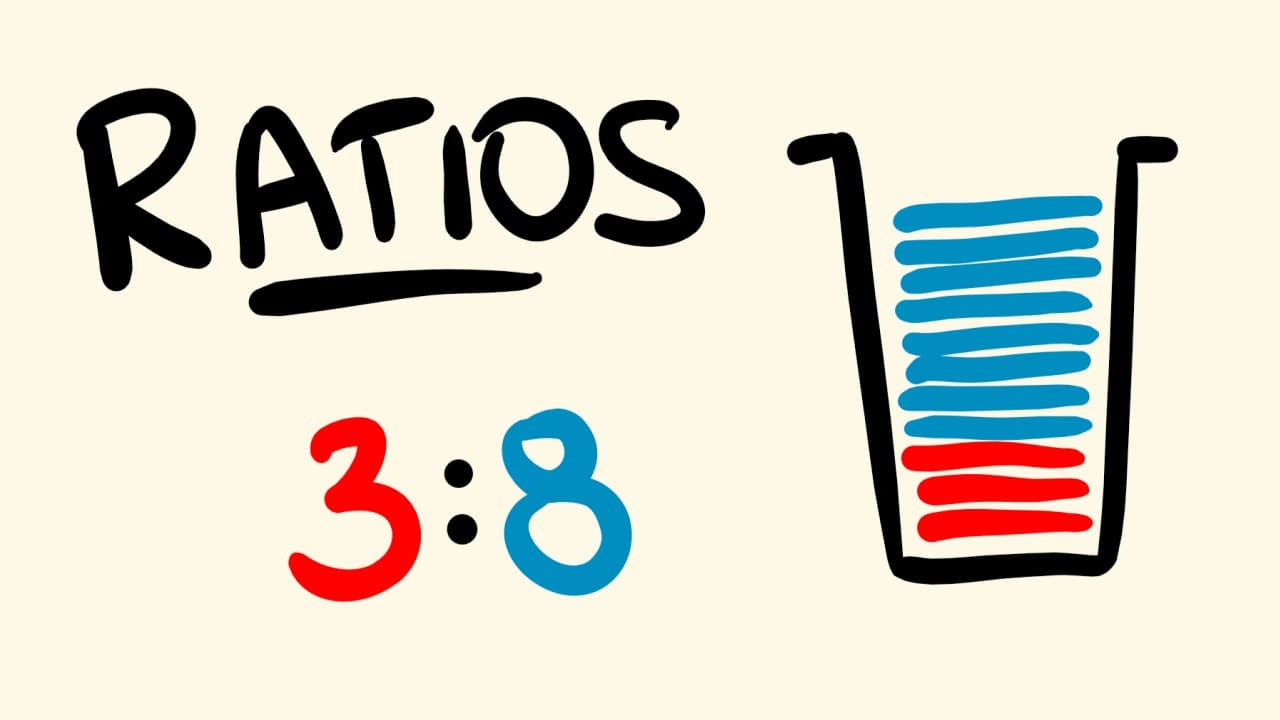
What Are Ratios and How Do You Use Them?
7.2K views
•
October 23, 2023
by
tecmath
YouTube video player
What Are Ratios and How Do You Use Them?

TL;DR

Ratios are a method for comparing two or more quantities using the same units, such as measuring cordial to water. They can be expressed as fractions and simplified by dividing both terms by a common factor. Ratios are also useful for dividing quantities into specific proportions, ensuring fair distribution.

Transcript

good day welcome to Tech math Channel I'm Josh today we're going to be having a look at ratios so what is a ratio well a ratio is a way of comparing two or more sets of quantities let me give you an example of that so say we were filling up a glass with cordial with some Kool-Aid and you can see here that what we do is we add The Cordial to the bot... Read More

Key Insights

  • 😑 Ratios are a way of comparing quantities and can be expressed as fractions.
  • 🥳 Measurements must have the same units for accurate ratio comparison.
  • 🤪 Ratios can be simplified by finding a number that goes into both values and dividing them.

Install to Summarize YouTube Videos and Get Transcripts

Explore YouTube Video Summarizer or Get YouTube Transcript Extractor

Questions & Answers

Q: What is a ratio and how is it used?

A ratio is a way of comparing two or more sets of quantities. It can be expressed as a fraction and is used to understand the relationship between different amounts.

Q: Why is it important to have the same units when using ratios?

Having the same units is crucial in ratios because it allows for accurate comparison. Different units would result in an incorrect ratio.

Q: How can ratios be simplified?

Ratios can be simplified by finding a number that evenly divides both values. By dividing both parts of the ratio by this number, the ratio is reduced to its simplest form.

Q: How can ratios be used to divide quantities?

Ratios can be used to divide quantities into a given proportion. By determining the total number of parts in the ratio and dividing the total amount by that number, the value of each part can be found. Multiplying this value by the respective part of the ratio gives the amount each person receives.

Summary & Key Takeaways

  • Ratios are a method of comparing two or more sets of quantities, such as the amount of cordial to water in a glass.

  • Measurements need to have the same units when using ratios. If they do not, conversion is necessary.

  • Ratios can be simplified by finding a number that goes into both values and dividing them. Simplification reduces the ratio to its simplest form.

  • Ratios can be used to divide quantities into a given proportion, ensuring each part receives its fair share.


Read in Other Languages (beta)

English

Share This Summary 📚

Summarize YouTube Videos and Get Video Transcripts with 1-Click

Download browser extensions on:

Try YouTube Summary with ChatGPT & Claude or YouTube Transcript Generator

Explore More Summaries from tecmath 📚
Pythagorus' Theorum - Math Problems thumbnail
Pythagorus' Theorum - Math Problems
tecmath
How to Perform Basic Short Division Step by Step thumbnail
How to Perform Basic Short Division Step by Step
tecmath
Subtract Fractions with Different Demoninators trick - mentally minus fractions instantly! thumbnail
Subtract Fractions with Different Demoninators trick - mentally minus fractions instantly!
tecmath
How to Solve Algebra Equations with Both Sides Easily? thumbnail
How to Solve Algebra Equations with Both Sides Easily?
tecmath
Easy Addition trick to add large numbers instantly! thumbnail
Easy Addition trick to add large numbers instantly!
tecmath
Least Common Multiple LCM thumbnail
Least Common Multiple LCM
tecmath

Summarize YouTube Videos and Get Video Transcripts with 1-Click

Download browser extensions on:

Try YouTube Summary with ChatGPT & Claude or YouTube Transcript Generator

Apps & Extensions

  • Chrome Extension
  • Safari Extension
  • Edge Add-ons
  • Firefox Add-ons
  • iOS App
  • Android App

Key Features

  • YouTube Video Summarizer
  • Web & PDF Summarizer
  • Web & PDF Highlighter
  • Chat with PDF
  • Ask AI Clone
  • Audio Transcriber
  • Glasp Reader
  • Kindle Highlight Export
  • Idea Hatch

Integrations

  • Obsidian Plugin
  • Notion Integration
  • Pocket Integration
  • Instapaper Integration
  • Medium Integration
  • Readwise Integration
  • Snipd Integration
  • Hypothesis Integration

More Features

  • APIs
  • MCP Connector
  • Blog & Post
  • Embed Links
  • Image Highlight
  • Personality Test
  • Quote Shots
  • Open Graph Checker

Company

  • About us
  • Our Story
  • Blog
  • Community
  • FAQs
  • Job Board
  • Newsletter
  • Pricing
Terms

•

Privacy

•

Guidelines

© 2026 Glasp Inc. All rights reserved.