Black Hole Harmonics
TL;DR
Black holes merge, creating detectable gravitational waves revealing spacetime secrets.
Transcript
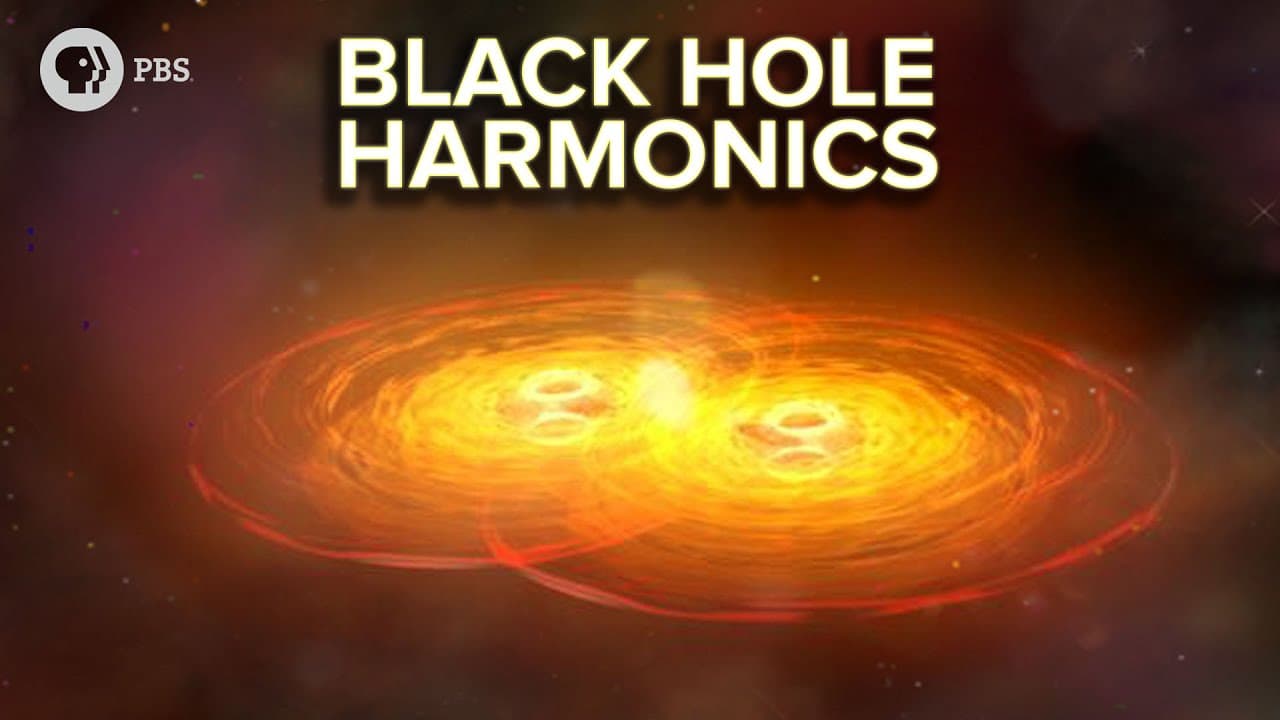
Thank you to Brilliant.org for supporting PBS Digital Studios. Black holes are crazy enough on their own – but crash two together and you end up with this roiling blob of inescapable space that vibrates like a beaten drum. And the rich harmonics of those vibrations, seen through gravitational waves, could hold the secrets to the nature of the fabri... Read More
Key Insights
- Merging black holes create gravitational waves, which vibrate like a drum, revealing spacetime's nature.
- Real black holes differ from theoretical models; they're chaotic, especially after merging.
- Gravitational wave observatories like LIGO and VIRGO detect these waves, providing insights into black hole physics.
- The 'ring-down' phase of a black hole merger is analogous to a bell's vibrations, showing rich harmonic structures.
- Giesler et al.'s study suggests overtones are detectable at merger onset, challenging prior assumptions.
- Gravitational wave spectroscopy, analyzing these vibrations, can determine black hole mass and spin.
- Analyzing real merger events, researchers confirmed overtones and calculated black hole properties.
- LIGO's ongoing observations continue to reveal numerous black hole and neutron star mergers.
Install to Summarize YouTube Videos and Get Transcripts
Explore YouTube Video Summarizer or Get YouTube Transcript Extractor
Questions & Answers
Q: What happens when two black holes merge?
When two black holes merge, they create a new black hole that initially appears chaotic and non-spherical. This process generates gravitational waves, which are ripples in spacetime that can be detected by observatories like LIGO and VIRGO. The merger results in a 'ring-down' phase, where the new black hole vibrates, similar to a bell, before settling into a stable state.
Q: Why are the harmonics of black holes important?
The harmonics of black holes are crucial because they offer insights into the properties of black holes, such as mass and spin. By analyzing the harmonic frequencies generated during the 'ring-down' phase of a merger, scientists can determine these properties with greater precision. This process, known as gravitational wave spectroscopy, enhances our understanding of black hole physics and spacetime.
Q: What did the recent study by Giesler et al. reveal?
The study by Giesler et al. challenged previous assumptions about black hole mergers, revealing that overtones are detectable right at the onset of the merger. This finding contradicts the belief that the initial phase is too chaotic for such detection. The study used simulations to demonstrate that spherical harmonic oscillations are present from the point of merger, allowing for more accurate predictions of black hole properties.
Q: How does gravitational wave spectroscopy work?
Gravitational wave spectroscopy involves analyzing the frequencies of gravitational waves produced during black hole mergers. By studying the harmonics in these waves, scientists can determine the mass and spin of the resulting black hole. This technique is akin to spectroscopy in astronomy, where different light frequencies are analyzed to understand celestial objects. It provides a new method for studying the fundamental nature of extreme spacetime.
Q: What are the implications of detecting overtones in black hole mergers?
Detecting overtones in black hole mergers has significant implications for astrophysics. It allows scientists to determine black hole properties more precisely, enhancing our understanding of these cosmic phenomena. The ability to detect overtones also supports the development of gravitational wave spectroscopy, offering a new way to study spacetime's fabric. These findings could lead to further tests of Einstein's theories and the no-hair theorem.
Q: What is the no-hair theorem, and how does it relate to black holes?
The no-hair theorem posits that black holes are defined by only three properties: mass, spin, and electric charge. This means that all other information about the matter that formed the black hole is lost. In the context of black holes, this theorem suggests that the oscillations during the 'ring-down' phase should be consistent with a black hole defined solely by mass and spin. Recent studies support this theorem, though more observations are needed for confirmation.
Q: What recent updates have been made in gravitational wave detection?
Recent updates in gravitational wave detection include ongoing observations by LIGO and VIRGO, which have been in their third observing run since April. These observatories have detected numerous black hole and neutron star mergers, with new events occurring roughly every five days. The increased sensitivity of these observatories has led to a better understanding of these cosmic events, supporting the development of gravitational wave astronomy.
Q: How does LIGO's alert system benefit astronomers?
LIGO's alert system benefits astronomers by providing real-time notifications of gravitational wave detections. This allows astronomers to coordinate follow-up observations with other telescopes, enhancing the study of cosmic events. The system increases transparency and collaboration within the scientific community, leading to more comprehensive analyses of black hole and neutron star mergers and advancing our understanding of the universe.
Summary & Key Takeaways
-
Black holes, when merged, create gravitational waves that vibrate like a drum, providing insights into spacetime's nature. The 'ring-down' phase, akin to a bell's vibrations, reveals rich harmonic structures that help determine black hole properties.
-
Recent studies challenge previous assumptions, suggesting that overtones are detectable at the onset of black hole mergers. This discovery allows for more precise calculations of black hole properties using gravitational wave spectroscopy.
-
LIGO and VIRGO observatories continue to detect numerous black hole and neutron star mergers, advancing our understanding of these cosmic events. The ongoing research supports Einstein's theories and the no-hair theorem, though further observations are needed.
Read in Other Languages (beta)
Share This Summary 📚
Summarize YouTube Videos and Get Video Transcripts with 1-Click
Try YouTube Summary with ChatGPT & Claude or YouTube Transcript Generator
Explore More Summaries from PBS Space Time 📚
Summarize YouTube Videos and Get Video Transcripts with 1-Click
Try YouTube Summary with ChatGPT & Claude or YouTube Transcript Generator