The British-Boer War 1899-1902 (Documentary)
TL;DR
The Second Boer War was a brutal conflict showcasing early 20th-century warfare.
Transcript
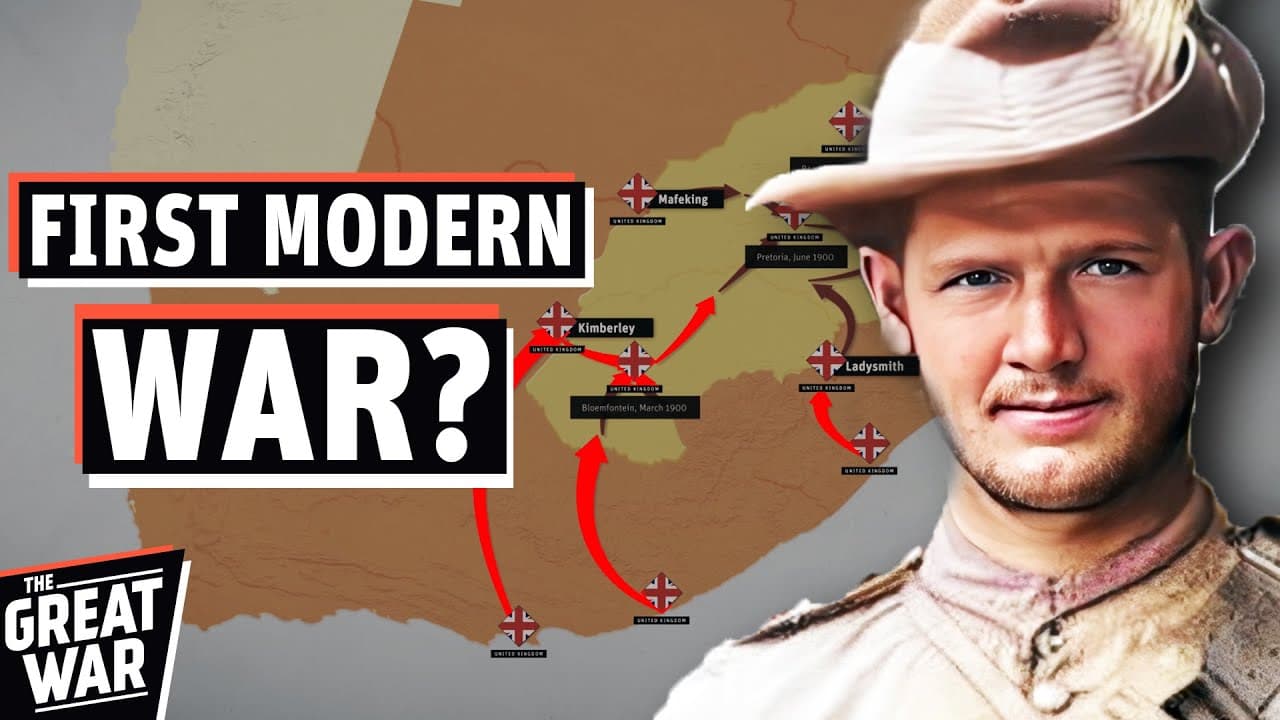
War has broken out in South Africa and British commanders are confident they will soon crush the upstart Boer republics who have dared to defy them General White's troops facing boar positions on The High Ground near Ladysmith went nervously as British and poor artillery duel overhead but the neighboring British units have gone silent and the order... Read More
Key Insights
- The Second Boer War was marked by the British Empire's use of scorched earth tactics and concentration camps, foreshadowing the brutalities of modern warfare.
- The Boer republics, despite lacking a standing army, effectively utilized guerrilla tactics and their knowledge of the terrain to challenge British forces.
- The discovery of gold in Transvaal attracted British interest, leading to increased tensions and eventual conflict with the Boer republics.
- The British military faced unexpected challenges due to the Boers' effective use of modern rifles and artillery, leading to significant early defeats.
- Black Africans played a complex role in the war, with both sides utilizing their labor and services despite declaring the conflict a 'white man's war.'
- The British response to Boer guerrilla tactics included the construction of blockhouses and the implementation of a scorched earth policy, devastating the Boer civilian population.
- The establishment of concentration camps for Boer civilians resulted in high mortality rates, particularly among children, causing international outrage.
- The war concluded with the Treaty of Vereeniging in 1902, which ended Boer independence but promised eventual self-government and protection of the Dutch language.
Install to Summarize YouTube Videos and Get Transcripts
Explore YouTube Video Summarizer or Get YouTube Transcript Extractor
Questions & Answers
Q: What were the main causes of the Second Boer War?
The main causes of the Second Boer War included the discovery of gold in Transvaal, which attracted British interest, and the existing tensions between the British Empire and the Boer republics over issues such as sovereignty, language, and cultural differences. The Boers' desire for independence clashed with British imperial ambitions, ultimately leading to war.
Q: How did the Boers manage to challenge the British military?
The Boers managed to challenge the British military by utilizing guerrilla tactics, leveraging their superior knowledge of the local terrain, and possessing excellent marksmanship skills. They relied on a militia system where citizens provided their own rifles and horses, allowing for rapid, mobile operations that caught the more traditional British forces off guard.
Q: What role did black Africans play in the Second Boer War?
Black Africans played a complex role in the Second Boer War, despite both sides declaring it a 'white man's war.' They were utilized by both the British and the Boers for labor and logistics support. Some Africans worked as scouts and trackers for the British, while others were forced into labor by the Boers, highlighting the conflict's racial dynamics.
Q: What were the consequences of the British scorched earth policy?
The British scorched earth policy led to the destruction of thousands of Boer farms, creating a humanitarian crisis that resulted in the displacement of approximately 150,000 Boer civilians. This policy, combined with the establishment of concentration camps, caused widespread suffering and high mortality rates, particularly among children, drawing international condemnation.
Q: How did the British military adapt to Boer guerrilla tactics?
In response to Boer guerrilla tactics, the British military adapted by implementing a blockhouse system to restrict Boer mobility and conducting large-scale sweeps of the countryside. They also adopted a scorched earth policy, destroying Boer farms to deny guerrillas supplies, and eventually improved the management of concentration camps to address humanitarian concerns.
Q: What impact did the concentration camps have on Boer civilians?
The concentration camps had a devastating impact on Boer civilians, with overcrowding, inadequate sanitation, and insufficient resources leading to outbreaks of disease. Approximately 27,000 Boer civilians died in the camps, including 22,000 children under the age of 16. The camps' conditions caused international outrage and were a dark chapter in the war's history.
Q: What were the terms of the Treaty of Vereeniging?
The Treaty of Vereeniging, which ended the Second Boer War in May 1902, required the Boers to surrender and accept British sovereignty. However, it also promised amnesty for Boer fighters, protection of the Dutch language, and eventual self-government for the former Boer republics. The issue of black African voting rights was deferred until self-government was established.
Q: How did the Second Boer War influence future military conflicts?
The Second Boer War influenced future military conflicts by highlighting the effectiveness of guerrilla tactics and modern firepower, prompting military reforms in Britain. It also foreshadowed the use of concentration camps and scorched earth policies, which would reappear in later conflicts. The war served as a precursor to the more widespread horrors of 20th-century warfare.
Summary & Key Takeaways
-
The Second Boer War was a conflict between the British Empire and the Boer republics in South Africa from 1899 to 1902. It was characterized by the use of scorched earth tactics and concentration camps, highlighting the brutal nature of 20th-century warfare.
-
Despite lacking a formal army, the Boers effectively utilized guerrilla warfare, leveraging their knowledge of the terrain and superior marksmanship to challenge the British military, leading to significant early victories.
-
The war ended with the Treaty of Vereeniging, which saw the Boer republics absorbed into the British Empire but promised eventual self-government and protection of the Dutch language, marking a complex end to a devastating conflict.
Read in Other Languages (beta)
Share This Summary 📚
Summarize YouTube Videos and Get Video Transcripts with 1-Click
Try YouTube Summary with ChatGPT & Claude or YouTube Transcript Generator
Explore More Summaries from The Great War 📚
Summarize YouTube Videos and Get Video Transcripts with 1-Click
Try YouTube Summary with ChatGPT & Claude or YouTube Transcript Generator