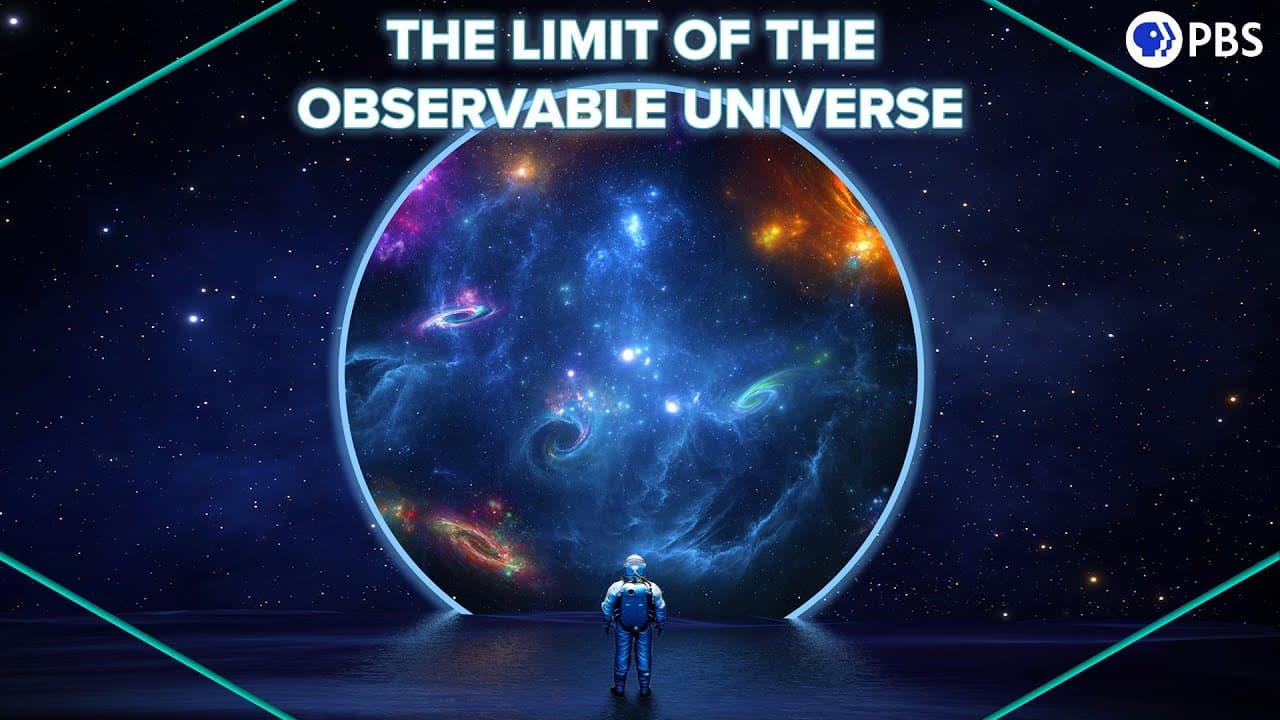
How Much of the Universe Can We Actually See?
TL;DR
Humanity can currently observe the universe up to approximately 46.5 billion light years, primarily limited by the cosmic microwave background. Dark energy will eventually restrict our view further, merging the cosmological event horizon with the Hubble horizon in about 10 billion years, reducing our observable universe to 63 billion light years and leading to a progressively darker sky.
Transcript
Thank you to Brilliant for supporting PBS. Space is big. Really big. You just won't believe how vastly hugely mind-bogglingly big it is. In fact, the near 100 billion light year wide observable universe is only a tiny fraction of the greater bigness of space beyond. And for a little while, we will see more and more of that universe beyond until ... Read More
Key Insights
- The observable universe is vast, with a radius of approximately 46.5 billion light years, but it is only a fraction of the entire universe.
- The cosmic microwave background (CMB) is the farthest light we can currently observe, emitted about 13.7 billion years ago.
- The universe's expansion affects our observable limits; as it expands, the observable universe increases, but dark energy imposes a final limit.
- The Hubble horizon marks the boundary where galaxies recede at light speed due to universal expansion, currently at 14.5 billion light years.
- Photons from beyond the Hubble horizon can still reach us due to the universe's past expansion, which allowed light to enter the horizon.
- The cosmological event horizon defines the ultimate limit of observable events, beyond which signals can never be received.
- In about 10 billion years, the cosmological event horizon will merge with the Hubble horizon, limiting our view to 63 billion light years.
- Over time, light from beyond the cosmological event horizon will become increasingly redshifted, eventually making the universe appear dark.
Install to Summarize YouTube Videos and Get Transcripts
Explore YouTube Video Summarizer or Get YouTube Transcript Extractor
Questions & Answers
Q: What is the cosmic microwave background (CMB)?
The cosmic microwave background (CMB) is the oldest light we can observe, emitted about 300,000 years after the Big Bang. It marks the time when the universe cooled enough for atoms to form, allowing photons to travel freely. This light has been traveling for approximately 13.7 billion years, providing a snapshot of the early universe.
Q: How does the universe's expansion affect our observable limits?
The universe's expansion affects our observable limits by increasing the distance that light from distant objects must travel to reach us. As the universe expands, the observable universe grows, allowing us to see more distant objects over time. However, the acceleration of this expansion due to dark energy imposes a final limit on how much of the universe we can ultimately observe.
Q: What is the significance of the Hubble horizon?
The Hubble horizon represents the boundary where galaxies recede from us at the speed of light due to the universe's expansion. It is currently about 14.5 billion light years away. This horizon is significant because it marks the limit at which light from receding galaxies can still reach us, despite the galaxies moving away faster than light due to the expansion of space itself.
Q: How can we observe light from beyond the Hubble horizon?
We can observe light from beyond the Hubble horizon because, in the early universe, the Hubble horizon was smaller and expanding. This expansion allowed light from more distant objects to enter the horizon and eventually reach us. As the universe continued to expand, the Hubble horizon grew, enabling us to see light from regions that were initially beyond it.
Q: What is the cosmological event horizon?
The cosmological event horizon is the ultimate boundary beyond which no signals can ever reach us, no matter how long we wait. It is currently about 16 billion light years away. This horizon shrinks over time as the universe expands, limiting the regions from which we can receive new information. In about 10 billion years, it will merge with the Hubble horizon, defining the final extent of our observable universe.
Q: What will happen when the cosmological event horizon merges with the Hubble horizon?
When the cosmological event horizon merges with the Hubble horizon, it will mark the limit of the observable universe. At this point, we will be able to see regions that are currently 63 billion light years away. However, beyond this merger, no new information from outside this boundary will reach us, and the universe will gradually appear darker as the light becomes increasingly redshifted.
Q: How does dark energy influence the future observable universe?
Dark energy influences the future observable universe by accelerating its expansion, which imposes a limit on how much of the universe we can ultimately observe. As dark energy drives the expansion, the cosmological event horizon shrinks, reducing the regions from which we can receive new signals. This acceleration ensures that only a finite portion of the universe will ever be visible to us.
Q: What will the universe look like in the distant future?
In the distant future, the universe will appear increasingly dark as light from beyond the cosmological event horizon becomes more redshifted and loses energy. Over time, even the most energetic photons will stretch to wavelengths that are difficult to detect, eventually rendering the universe invisible to our current observational capabilities. This gradual darkening will occur as the universe continues to expand and the observable boundaries contract.
Summary & Key Takeaways
-
The observable universe is currently limited by the cosmic microwave background, a relic from 13.7 billion years ago, marking the edge of what we can see. As the universe expands, this observable boundary increases, but dark energy imposes a final limit on our view.
-
The Hubble horizon, at 14.5 billion light years, marks where galaxies recede at light speed. Despite this, we can still observe light from beyond due to past expansion, which allowed photons to enter the observable universe.
-
The cosmological event horizon, currently at 16 billion light years, defines the ultimate observable boundary. In 10 billion years, it will merge with the Hubble horizon, limiting our view to 63 billion light years and gradually darkening the universe due to redshifting.
Read in Other Languages (beta)
Share This Summary 📚
Summarize YouTube Videos and Get Video Transcripts with 1-Click
Try YouTube Summary with ChatGPT & Claude or YouTube Transcript Generator
Explore More Summaries from PBS Space Time 📚
Summarize YouTube Videos and Get Video Transcripts with 1-Click
Try YouTube Summary with ChatGPT & Claude or YouTube Transcript Generator