What Are the Drawbacks of Classful Addressing?
TL;DR
Classful addressing is inefficient because it often leads to wasted IP addresses and lacks flexibility for large organizations. Its rigid structure results in significant address space waste and an overload of routing table entries, making it difficult to manage as internet demands grow. Consequently, transitioning to classless addressing is essential for better IP address utilization.
Transcript
in the previous lectures we have seen classful addressing and today we will see classless addressing part one what we are going to deal in part one upon the completion of this session the learner will be able to outcome number one we will know the drawbacks of classful addressing and outcome number two we will understand the need for classless addr... Read More
Key Insights
- 😷 Classful addressing's rigid structure and fixed subnet masks often result in wasted IP addresses.
- 🖤 The lack of internal address flexibility hinders the alignment of assigned IP address blocks with internal networks of organizations.
- 🤢 Inefficient use of address space arises from the three classes (A, B, and C) designated for general use, leading to wasted IP address ranges.
- 🍵 The proliferation of routing table entries is a consequence of the growth of the internet and the need for routers to handle more IP datagrams.
- 😷 Classless addressing offers a solution by allowing for more flexibility in IP address allocation through the creation of custom subnet masks.
- 🗑️ Classless addressing enables organizations to optimize IP address usage, reducing waste and improving efficiency.
- ❓ Migration from classful addressing to classless addressing is necessary to address the drawbacks of the former.
Install to Summarize YouTube Videos and Get Transcripts
Explore YouTube Video Summarizer or Get YouTube Transcript Extractor
Questions & Answers
Q: What are the main drawbacks of classful addressing?
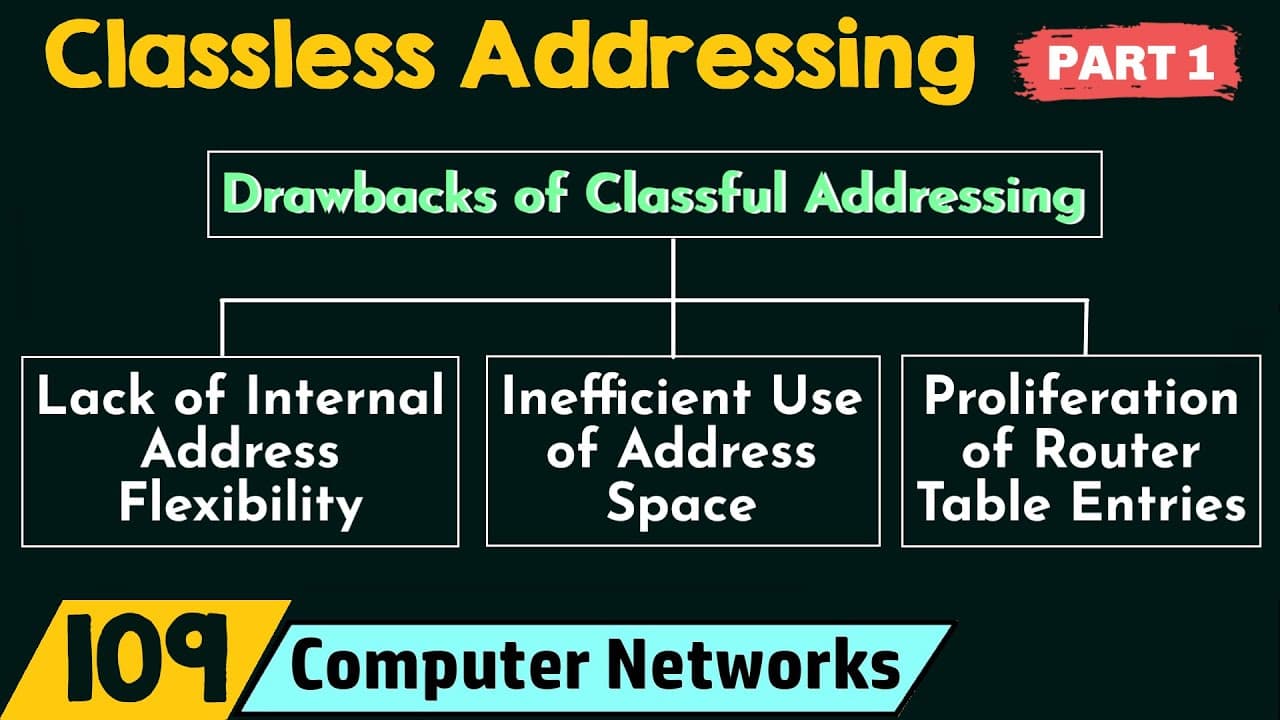
The main drawbacks of classful addressing are the lack of internal address flexibility, inefficient use of address space, and the proliferation of routing table entries.
Q: Why does classful addressing result in wasted IP addresses?
Classful addressing assigns fixed subnet masks based on predefined classes, leading to situations where the allocated IP address ranges are larger than necessary for specific network requirements, resulting in wasted addresses.
Q: How does classful addressing impact routing tables?
With the existence of five classes in classful addressing, routers require more entries in their routing tables to handle the routing of IP datagrams, causing performance problems and increased memory usage.
Q: How does classless addressing address the drawbacks of classful addressing?
Classless addressing allows for more flexibility in IP address allocation, enabling organizations to optimize address space usage by creating bespoke subnet masks based on their specific needs, thus reducing waste and improving efficiency.
Key Insights:
- Classful addressing's rigid structure and fixed subnet masks often result in wasted IP addresses.
- The lack of internal address flexibility hinders the alignment of assigned IP address blocks with internal networks of organizations.
- Inefficient use of address space arises from the three classes (A, B, and C) designated for general use, leading to wasted IP address ranges.
- The proliferation of routing table entries is a consequence of the growth of the internet and the need for routers to handle more IP datagrams.
- Classless addressing offers a solution by allowing for more flexibility in IP address allocation through the creation of custom subnet masks.
- Classless addressing enables organizations to optimize IP address usage, reducing waste and improving efficiency.
- Migration from classful addressing to classless addressing is necessary to address the drawbacks of the former.
- Classless addressing still involves some IP address waste but allows for better allocation based on specific needs.
Summary & Key Takeaways
-
Classful addressing, based on five classes (A, B, C, D, and E), caters to different network sizes but often results in wasted IP addresses.
-
Organizations face a lack of internal address flexibility with classful addressing, as assigned blocks of addresses may not align well with the structure of their internal networks.
-
Inefficient use of address space is another drawback, with only three classes (A, B, and C) designated for general use, leading to wasted IP address space.
-
The proliferation of routing table entries is a further challenge, as the internet's growth requires more entries, causing performance problems and inefficient address space allocation.
Read in Other Languages (beta)
Share This Summary 📚
Summarize YouTube Videos and Get Video Transcripts with 1-Click
Try YouTube Summary with ChatGPT & Claude or YouTube Transcript Generator
Explore More Summaries from Neso Academy 📚





Summarize YouTube Videos and Get Video Transcripts with 1-Click
Try YouTube Summary with ChatGPT & Claude or YouTube Transcript Generator