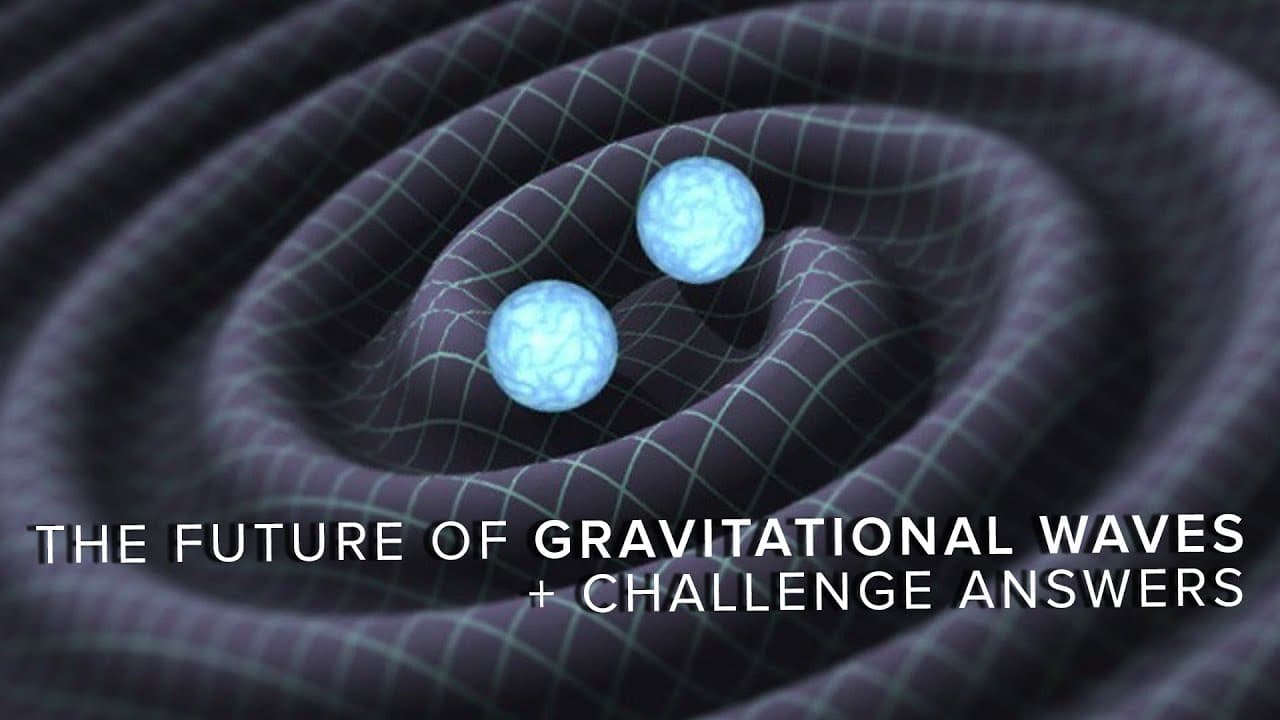
The Future of Gravitational Waves
TL;DR
LIGO's detection of gravitational waves confirms black hole theories.
Transcript
On June 15, the LIGO team announced their second detection of a gravitational wave. It got some press but certain questions were not well-covered. That's what I'm going to do now and following that, I'll get to the solution to the nuclear physics challenge question. On September 14, 2015, the Laser Interferometer Gravitational Wave Observatory, LIG... Read More
Key Insights
- LIGO's second gravitational wave detection confirms the merger of two smaller black holes, reinforcing the reliability of gravitational wave astronomy.
- The first detection in September was unmistakable, showing a clear waveform that matched theoretical predictions, with a minimal chance of being random noise.
- The December detection, though weaker, was still highly certain due to prolonged signal duration and sophisticated signal processing technology.
- LIGO's careful analysis and exhaustive simulations ensure a high level of confidence in their detections, with a rigorous standard for declaring a detection.
- The observations validate general relativity's predictions, enhancing our understanding of space-time around black holes and the frequency of black hole mergers.
- Future detections may include neutron star mergers and supernovae, although these require closer proximity due to LIGO's current sensitivity limits.
- The addition of European Virgo will improve LIGO's ability to pinpoint the source of gravitational waves, allowing for more precise astronomical observations.
- The nuclear physics challenge question involves calculating the probability of alpha particle tunneling, illustrating quantum mechanics principles in nuclear decay.
Install to Summarize YouTube Videos and Get Transcripts
Explore YouTube Video Summarizer or Get YouTube Transcript Extractor
Questions & Answers
Q: What was significant about LIGO's second detection of gravitational waves?
LIGO's second detection confirmed the merger of two smaller black holes, reinforcing the reliability of gravitational wave astronomy. This detection, though weaker than the first, was highly certain due to the prolonged signal duration and advanced signal processing technology. It further validated the predictions of general relativity and our understanding of black holes.
Q: Why was the first detection in September considered unmistakable?
The first detection was unmistakable because the waveform closely matched theoretical predictions, showing a periodic change in the interferometer arm lengths that increased in amplitude and frequency. The same signal was observed in both LIGO detectors, with a minimal chance of being random noise, providing strong evidence for the detection.
Q: How does LIGO ensure the certainty of its detections?
LIGO ensures the certainty of its detections through sophisticated signal processing technology and exhaustive computer simulations. These simulations test how often the signal processing tech might falsely report a detection, and the results show an extremely low probability of error, providing confidence in the reliability of the detections.
Q: What do the observations of gravitational waves tell us about general relativity?
The observations of gravitational waves provide strong validation for the predictions of general relativity, particularly regarding the behavior of space-time around black holes. The signals observed matched theoretical expectations, confirming our understanding of the dynamics of black hole mergers and the frequency of such events in the universe.
Q: What future observations are expected with gravitational wave astronomy?
Future observations in gravitational wave astronomy may include mergers of neutron stars or neutron star-black hole systems, as well as supernova explosions. However, these events need to be closer to be detectable by LIGO due to current sensitivity limits. The addition of European Virgo will enhance detection capabilities and source localization.
Q: How will the addition of European Virgo improve gravitational wave detections?
The addition of European Virgo will significantly improve LIGO's ability to pinpoint the source of gravitational waves. By providing another detection point, Virgo will help triangulate the direction of incoming waves, allowing astronomers to more accurately locate the source and conduct targeted observations with telescopes.
Q: What is the nuclear physics challenge question about?
The nuclear physics challenge question involves calculating the probability of an alpha particle tunneling out of a polonium-212 nucleus, causing radioactive decay. This requires understanding the particle's velocity, nucleus size, and the quantum mechanics of tunneling, illustrating the principles of quantum mechanics in nuclear processes.
Q: What does the challenge question reveal about alpha particle tunneling?
The challenge question reveals that alpha particle tunneling is a probabilistic process governed by quantum mechanics. By calculating the particle's velocity and the nucleus's size, one can determine the number of tunneling chances and the probability of decay, highlighting the quantum nature of nuclear decay processes.
Summary & Key Takeaways
-
LIGO's second detection of gravitational waves from black hole mergers confirms the dawn of gravitational wave astronomy, validating general relativity and enhancing our understanding of black hole dynamics.
-
The December detection was weaker than the first but still highly certain, showcasing LIGO's advanced signal processing and rigorous standards for declaring detections.
-
Future advancements, including the European Virgo, will improve the ability to locate gravitational wave sources, potentially revealing more about the universe's astrophysical phenomena.
Read in Other Languages (beta)
Share This Summary 📚
Summarize YouTube Videos and Get Video Transcripts with 1-Click
Try YouTube Summary with ChatGPT & Claude or YouTube Transcript Generator
Explore More Summaries from PBS Space Time 📚
Summarize YouTube Videos and Get Video Transcripts with 1-Click
Try YouTube Summary with ChatGPT & Claude or YouTube Transcript Generator