RLC Circuits (18 of 19) Parallel RL; An Example Problem; Current, Impedance and Admittance
TL;DR
Solving an RL parallel circuit with calculations on inductive reactance, current, phasor diagram, impedance, and admittance.
Transcript
so today we are gonna be going over an example problem for our arrow parallel circuits I've already made an explanation for RL parallel circuits I've made some videos for RC parallel circuits and I made a whole series of videos for RLC series circuit you can link to those in the upper right hand corner but in today's video it's an example for RL pa... Read More
Key Insights
- 💐 Inductive reactance calculation is essential in determining the inductor's opposition to alternating current flow.
- 👮 Currents through resistor and inductor branches are calculated using Ohm's law based on source voltage and element values.
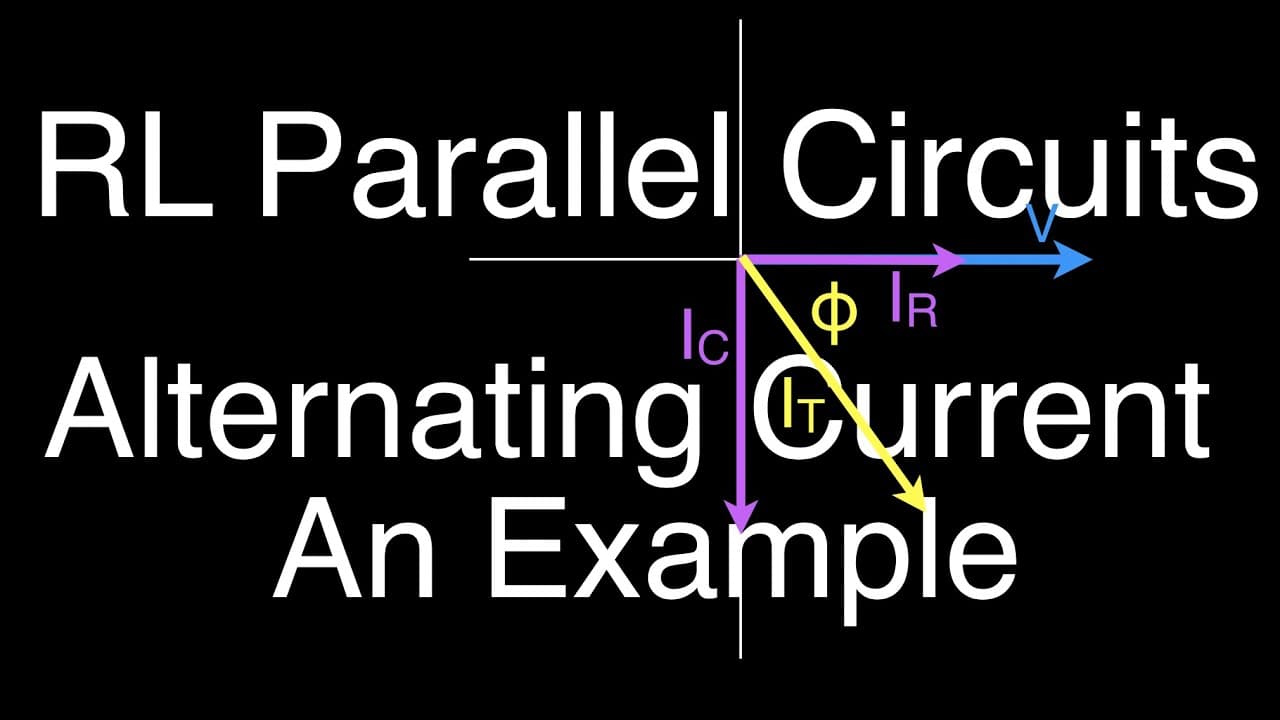
- 🦻 Phasor diagram aids in visualizing the relationship between voltage and current in the circuit.
- 💁 Impedance and admittance calculations offer valuable information on total opposition to current flow and circuit's permissiveness to current.
- 🔺 Utilizing Pythagorean theorem and trigonometric functions to calculate total current and phase angles.
- 👻 Admittance represents how much current a circuit allows, while impedance quantifies total opposition to current flow.
- ⏫ Double-checking calculations for consistency and accuracy ensures correct results in circuit analysis.
Install to Summarize YouTube Videos and Get Transcripts
Explore YouTube Video Summarizer or Get YouTube Transcript Extractor
Questions & Answers
Q: What is the significance of calculating inductive reactance in an RL parallel circuit?
Inductive reactance is crucial as it helps determine the opposition to the flow of alternating current through the inductor branch and plays a vital role in analyzing the circuit's behavior.
Q: How are the current values calculated for the resistor and inductor branches in a parallel circuit?
The current values are calculated using Ohm's law, dividing the source voltage by the resistance and inductive reactance values of the respective branches to obtain the currents flowing through each element.
Q: Explain the process of drawing a current phasor diagram and determining the total current in an RL parallel circuit.
The phasor diagram represents the relationship between voltage and current, and the total current is calculated by vectorially adding the currents through the resistor and inductor branches, resulting in the total current as the hypotenuse.
Q: Why is determining impedance and admittance essential in analyzing RL parallel circuits?
Impedance and admittance calculations provide insight into how the circuit responds to alternating current, showcasing the total opposition to current flow and how easily the circuit allows current to flow, respectively.
Summary & Key Takeaways
-
Example problem for an RL parallel circuit solving inductive reactance, current calculations, phasor diagram, impedance, and admittance.
-
Calculation of inductive reactance, current through resistor and inductor branches, phasor diagram, total current and phase angle.
-
Determination of impedance, drawing of admittance triangle, and calculation of total current using admittance.
Read in Other Languages (beta)
Share This Summary 📚
Summarize YouTube Videos and Get Video Transcripts with 1-Click
Try YouTube Summary with ChatGPT & Claude or YouTube Transcript Generator
Explore More Summaries from Step by Step Science 📚




Summarize YouTube Videos and Get Video Transcripts with 1-Click
Try YouTube Summary with ChatGPT & Claude or YouTube Transcript Generator