Is Gravity Quantum or Classical? Key Experiments Explained
TL;DR
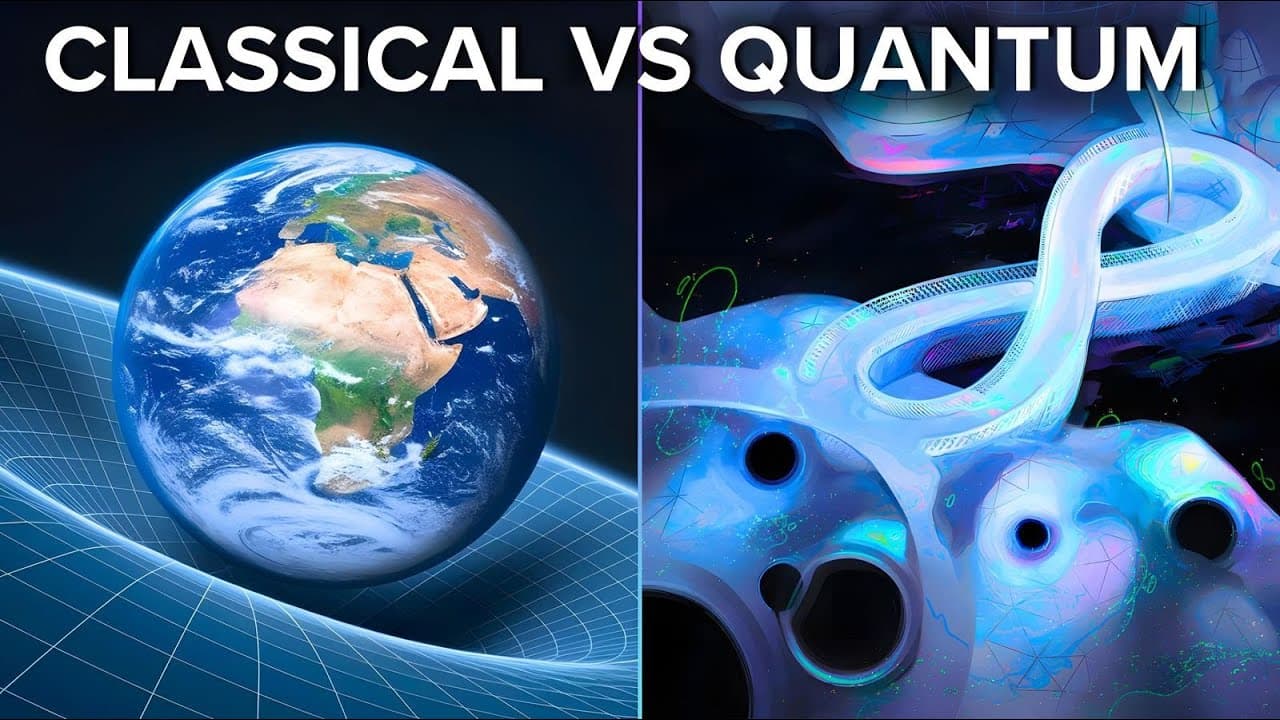
Current experiments are exploring whether gravity exhibits quantum properties or remains classical. The Diosi-Penrose model and Oppenheim's postquantum gravity suggest gravity may influence quantum systems and cause wavefunction collapse. The QGEM experiment aims to demonstrate quantum entanglement through gravitational interactions, potentially providing evidence for the quantum nature of gravity and its hypothetical carriers, the gravitons.
Transcript
Thank you to Brilliant for supporting PBS. If we discover how to connect quantum mechanics with general relativity we’ll pretty much win physics. There are multiple theories that claim to do this, but it’s notoriously difficult to test them. They seem to require absurd experiments like a particle collider the size of a galaxy. Or we could try to... Read More
Key Insights
- The quest to unify quantum mechanics and general relativity is ongoing, with new experiments exploring the quantum nature of gravity.
- Traditional approaches have focused on quantizing gravity, but some theories suggest gravity may remain classical while influencing quantum systems.
- The Diosi-Penrose model and Oppenheim's postquantum gravity propose that gravity causes quantum wavefunction collapse, potentially testable via gravitational diffusion.
- Experiments like QGEM aim to detect quantum entanglement induced by gravitational interactions, which would imply gravity's quantum nature.
- The QGEM experiment involves creating entanglement between masses using a Stern-Gerlach interferometer setup with nanodiamonds.
- Successful QGEM results could provide indirect evidence for gravitons, the hypothetical quantum carriers of gravity.
- Current experiments have ruled out strong gravity-induced collapse theories, but new experiments are planned to further test these ideas.
- Understanding whether gravity is quantum or classical could resolve a century-old mystery and fundamentally change our understanding of spacetime.
Install to Summarize YouTube Videos and Get Transcripts
Explore YouTube Video Summarizer or Get YouTube Transcript Extractor
Questions & Answers
Q: What are the main challenges in unifying quantum mechanics with general relativity?
The main challenges include the difficulty in quantizing gravity, as gravity involves the fabric of spacetime itself, which is challenging to reconcile with the discrete nature of quantum mechanics. Additionally, existing theories like string theory and loop quantum gravity struggle to make testable predictions, complicating efforts to unify these fundamental forces.
Q: What is the Diosi-Penrose model and how does it relate to gravity?
The Diosi-Penrose model suggests that gravity, being classical, causes the collapse of the quantum wavefunction when the superposition of matter distributions creates tension with a singular gravitational field. This model implies that gravity influences quantum systems by collapsing superpositions when they deviate too far from a classical spacetime curvature.
Q: How does the QGEM experiment aim to test the quantum nature of gravity?
The QGEM experiment aims to test the quantum nature of gravity by creating quantum entanglement through gravitational interactions. It uses a Stern-Gerlach interferometer setup with nanodiamonds to detect entanglement between masses, which, if successful, would suggest that gravity is quantum and provide indirect evidence for the existence of gravitons.
Q: What implications would a successful QGEM experiment have for physics?
A successful QGEM experiment would have significant implications, suggesting that gravity is indeed quantum. This would provide indirect evidence for gravitons and imply that spacetime itself can exhibit quantum properties like superposition. Such findings could fundamentally change our understanding of gravity and spacetime, potentially leading to new physics beyond current theories.
Q: What are gravitational diffusion and its potential role in quantum wavefunction collapse?
Gravitational diffusion refers to random fluctuations in the gravitational field that could disrupt quantum superpositions, causing wavefunction collapse. This concept is central to Oppenheim's postquantum gravity theory, proposing that such diffusion could be a testable signature of gravity's classical influence on quantum systems, offering a potential path to understanding gravity's role in quantum mechanics.
Q: How do current experiments constrain theories of gravity-induced collapse?
Current experiments have constrained theories of gravity-induced collapse by ruling out models with rapid spacetime diffusion, suggesting that any gravity-induced collapse mechanism is weak. By measuring mass with high precision and observing interference patterns in large molecules, researchers have placed limits on the strength of gravity's influence on quantum wavefunction collapse.
Q: What role does quantum entanglement play in testing gravity's quantum nature?
Quantum entanglement plays a crucial role in testing gravity's quantum nature by serving as a potential indicator of gravitational interactions at the quantum level. If gravitational interactions can induce entanglement between particles, it would imply that gravity itself has quantum properties, challenging classical notions of gravity and supporting the existence of gravitons as quantum carriers.
Q: Why is detecting single gravitons challenging, and how might QGEM provide indirect evidence?
Detecting single gravitons is challenging due to their extremely low energy and weak interaction with matter, making direct detection nearly impossible. The QGEM experiment might provide indirect evidence for gravitons by demonstrating entanglement between masses through gravitational interactions, suggesting that gravitons mediate these interactions similarly to how photons mediate electromagnetic forces.
Summary & Key Takeaways
-
The video discusses the ongoing efforts to unify quantum mechanics and general relativity, focusing on experiments that could reveal whether gravity is quantum or classical. Traditional approaches have struggled, leading to new theories and experiments that explore these fundamental questions.
-
The Diosi-Penrose model and Oppenheim's postquantum gravity suggest gravity might cause quantum wavefunction collapse, potentially testable through experiments measuring gravitational diffusion. These theories propose gravity's classical nature influences quantum systems.
-
The QGEM experiment seeks to demonstrate quantum entanglement through gravitational interactions, using nanodiamonds in a Stern-Gerlach interferometer setup. Success would imply gravity's quantum nature and provide indirect evidence for gravitons, furthering our understanding of spacetime.
Read in Other Languages (beta)
Share This Summary 📚
Summarize YouTube Videos and Get Video Transcripts with 1-Click
Try YouTube Summary with ChatGPT & Claude or YouTube Transcript Generator
Explore More Summaries from PBS Space Time 📚
Summarize YouTube Videos and Get Video Transcripts with 1-Click
Try YouTube Summary with ChatGPT & Claude or YouTube Transcript Generator