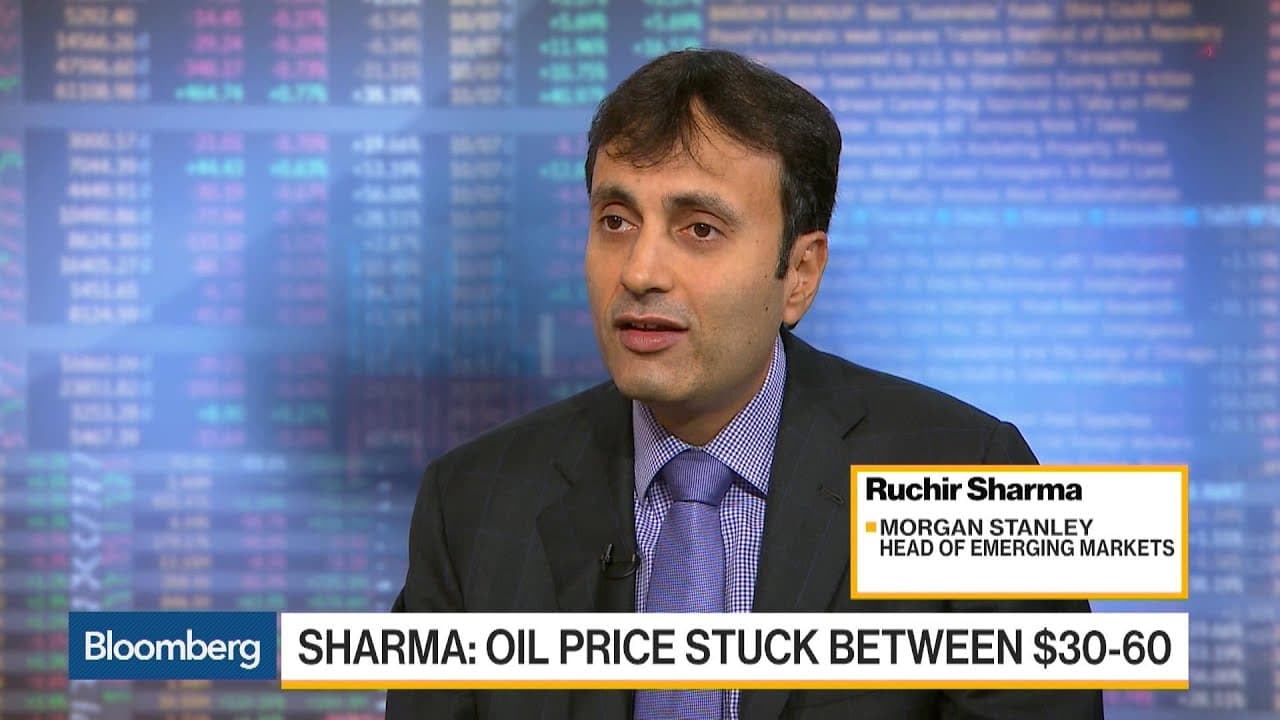
Morgan Stanley's Sharma Sees Oil Stuck in $30-$60 Range
TL;DR
Oil prices likely to remain between $30 and $60.
Transcript
if you look at the S&P yes it's almost 10% since the election but you say 2 and a half% growth is more feasible than 4% what's the market pricing in I think that the market is not pricing in that much more growth if you look at like expectations because uh you know the other thing which is playing in the market currently is the prospect of a corpor... Read More
Key Insights
- The S&P 500 has risen almost 10% since the election, driven by expectations of corporate tax cuts rather than economic growth.
- Market expectations do not foresee significant economic growth beyond 2.5% for the current and next year.
- The potential for a corporate tax cut is a major factor driving market optimism, despite limited growth expectations.
- Oil prices historically trade in a wide range after a crash, with current expectations set between $30 and $60.
- Investors should be cautious about energy stocks as oil prices approach the higher end of the expected range.
- The current price of oil aligns with its long-term historical average, contrary to perceptions of a significant drop.
- A border adjustability tax is a controversial proposal with uncertain market impacts, not yet priced in.
- Clarity on corporate tax reforms and their structure is crucial for encouraging capital investment and market stability.
Install to Summarize YouTube Videos and Get Transcripts
Explore YouTube Video Summarizer or Get YouTube Transcript Extractor
Questions & Answers
Q: What is driving the recent rise in the S&P 500?
The recent rise in the S&P 500, which has increased nearly 10% since the election, is primarily driven by expectations of a significant corporate tax cut. This anticipated policy change has led to upward revisions in earnings estimates, despite modest economic growth projections.
Q: What are the expectations for economic growth according to the transcript?
Economic growth expectations are modest, with forecasts not exceeding 2.5% for both the current and next year. This suggests that the market is not anticipating dramatic growth, and the optimism is largely tied to potential corporate tax reforms rather than economic expansion.
Q: Why should investors be cautious about energy stocks?
Investors should be cautious about energy stocks as oil prices approach the higher end of the expected $30 to $60 range. Historically, after a crash, oil prices tend to trade in a wide range, and investing at the higher end may not be prudent given the potential for prices to fall back.
Q: How do current oil prices compare to historical averages?
Current oil prices are consistent with their long-term historical average, despite perceptions of a significant decline from previous highs. Historically, oil prices have been deregulated since 1973, and today's prices are not much higher than inflation-adjusted averages over the past century.
Q: What is the potential impact of a border adjustability tax?
A border adjustability tax is a controversial proposal with uncertain impacts on market internals. Its implementation is considered a 50/50 possibility, and the market has not yet priced in its effects. Clarity on this tax's potential enactment and structure is still awaited.
Q: What is the likelihood of corporate tax cuts being implemented?
The likelihood of corporate tax cuts being implemented is relatively high, with estimates suggesting that such cuts are 70-80% priced into the market. This expectation is a key driver of current market optimism, despite limited expectations for substantial economic growth.
Q: How important is the structure of corporate tax reforms?
The structure of corporate tax reforms is crucial for encouraging capital investment. Properly designed tax credits can stimulate growth, while poorly structured reforms may simply result in cash distributions without significant investment benefits. The market is closely watching for clarity on these reforms.
Q: What are the main factors affecting the market currently?
The main factors affecting the market include the potential for corporate tax cuts, which drive optimism, and the uncertainty surrounding the border adjustability tax. Additionally, oil prices trading within a historical range and modest economic growth expectations are influencing market dynamics.
Summary & Key Takeaways
-
Ruchir Sharma from Morgan Stanley discusses market expectations, noting that the S&P 500's rise is largely driven by anticipated corporate tax cuts rather than substantial economic growth. He suggests that oil prices are likely to remain between $30 and $60, aligning with historical averages.
-
Sharma advises caution for investors considering energy stocks, as oil prices near the higher end of the expected range. He highlights the importance of structuring corporate tax reforms to encourage capital investment, amidst ongoing uncertainty about proposed border adjustability taxes.
-
The discussion includes the potential impact of tax reforms on market internals, with a focus on the likelihood of achieving proposed changes. Sharma emphasizes that current market optimism is based on anticipated tax cuts, with limited expectations for economic growth beyond 2.5%.
Read in Other Languages (beta)
Share This Summary 📚
Summarize YouTube Videos and Get Video Transcripts with 1-Click
Try YouTube Summary with ChatGPT & Claude or YouTube Transcript Generator
Explore More Summaries from Bloomberg Originals 📚





Summarize YouTube Videos and Get Video Transcripts with 1-Click
Try YouTube Summary with ChatGPT & Claude or YouTube Transcript Generator