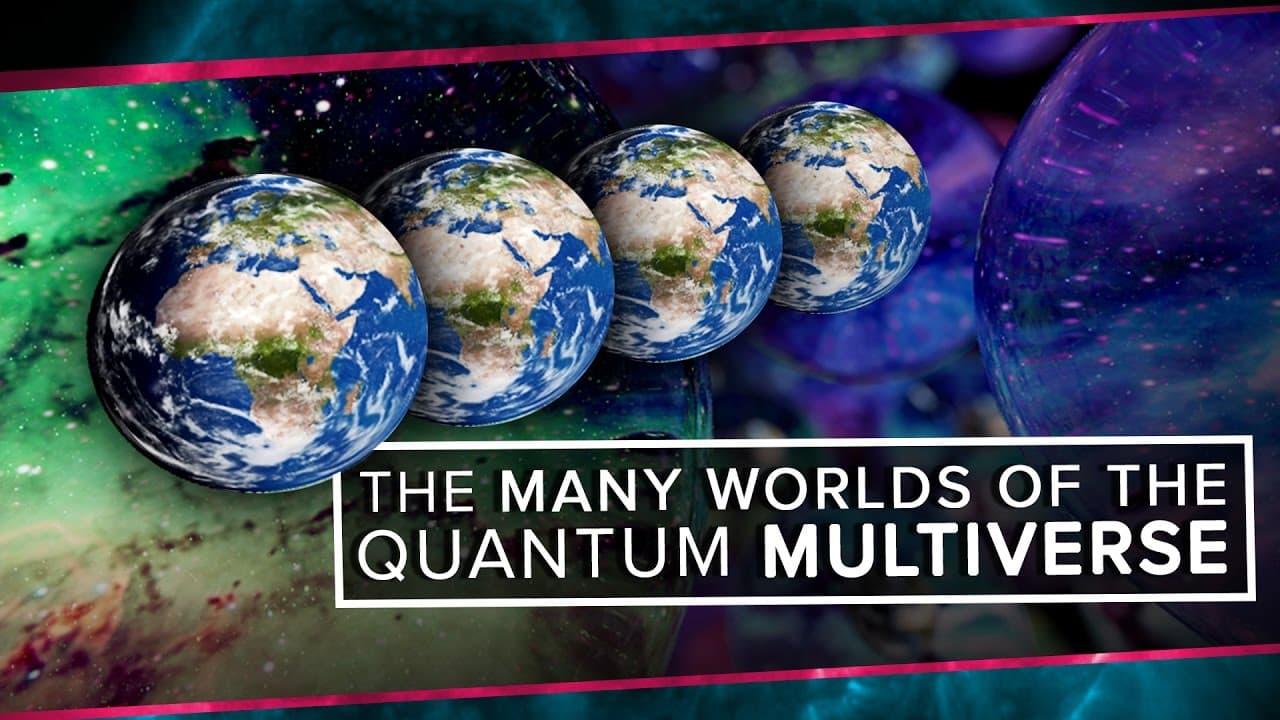
The Many Worlds of the Quantum Multiverse
TL;DR
The many worlds theory suggests infinite branching realities.
Transcript
The weird rules of the subatomic world are very, very different to those of the familiar large-scale universe. A huge outstanding question is when and why does the weirdness of quantum mechanics give way to classical physics. One answer to this question suggests that the entire universe is so much weirder than we imagined, or should I say the multi... Read More
Key Insights
- The quantum world operates under different rules than the classical world, raising questions about when and why this transition occurs.
- Superposition is a core concept in quantum mechanics, where particles exist in multiple states until measured.
- The Copenhagen interpretation suggests observation collapses quantum possibilities into a single reality, while many worlds theory proposes no collapse occurs.
- Schrodinger's cat thought experiment highlights the absurdity of quantum superposition extending to macroscopic scales.
- Decoherence explains why quantum superpositions don't extend to the macroscopic world, as interactions with the environment cause coherence loss.
- The many worlds interpretation suggests reality splits into branches at every quantum event, creating infinite alternate timelines.
- Many worlds is a deterministic interpretation, providing a predictable chain of cause and effect, unlike the randomness of Copenhagen.
- The philosophical implications of many worlds include questions about free will and the existence of infinite versions of oneself.
Install to Summarize YouTube Videos and Get Transcripts
Explore YouTube Video Summarizer or Get YouTube Transcript Extractor
Questions & Answers
Q: What is the main difference between the Copenhagen interpretation and the many worlds theory?
The main difference is that the Copenhagen interpretation suggests that observation collapses quantum possibilities into a single reality, while the many worlds theory proposes that no collapse occurs, and all possibilities continue independently, creating infinite alternate timelines. This means that every quantum event results in a branching of realities according to the many worlds theory.
Q: How does decoherence explain the transition from quantum to classical worlds?
Decoherence explains the transition by suggesting that quantum superpositions lose coherence when interacting with the environment. This loss of coherence prevents quantum effects from manifesting at macroscopic scales, which is why we don't observe superpositions in everyday life. Decoherence helps bridge the gap between the quantum and classical worlds by explaining why quantum effects are not typically observed on a larger scale.
Q: What philosophical questions does the many worlds theory raise?
The many worlds theory raises philosophical questions about free will and the existence of infinite versions of oneself. If every possible decision and outcome creates a new reality, it challenges our understanding of free will, as all potential choices are made in different branches. It also suggests that there are infinite versions of each individual, each experiencing different realities, which can be an overwhelming concept to consider.
Q: Why is the many worlds theory considered a deterministic interpretation?
The many worlds theory is considered deterministic because it suggests that every quantum event leads to a predictable chain of cause and effect, with all possibilities being realized in different branches of reality. Unlike the Copenhagen interpretation, which involves randomness in the collapse of possibilities, the many worlds theory maintains that all outcomes occur, and we simply experience one of the many branches, making it a deterministic view of quantum mechanics.
Q: What is the role of superposition in quantum mechanics?
Superposition is a fundamental concept in quantum mechanics where particles exist in multiple states simultaneously until measured. This means that particles do not have definite properties until observed, and instead, they are described by a probability cloud of all possible states. Superposition is key to understanding quantum phenomena like interference patterns and quantum entanglement, as it allows particles to exist in multiple possible trajectories or states.
Q: How does the double-slit experiment illustrate quantum superposition?
The double-slit experiment illustrates quantum superposition by showing that particles, such as photons or electrons, can create an interference pattern when not observed, suggesting they take multiple paths simultaneously. When observed, the interference pattern disappears, and particles behave as if they took a single path. This experiment demonstrates the concept of superposition, where particles exist in multiple states until measured, resulting in a single outcome.
Q: What is the significance of Hugh Everett's contribution to quantum mechanics?
Hugh Everett's contribution to quantum mechanics is significant because he proposed the many worlds interpretation, which suggests that all possible outcomes of quantum events are realized in separate, branching realities. This idea challenges the traditional Copenhagen interpretation and provides an alternative view that eliminates the need for wave function collapse. Although initially not widely accepted, Everett's theory has gained traction and is now considered a serious interpretation of quantum mechanics.
Q: What challenges does the many worlds theory face in gaining acceptance?
The many worlds theory faces challenges in gaining acceptance due to its lack of empirical evidence and the overwhelming implications of infinite branching realities. While it is supported by the mathematics of quantum mechanics, it has not made predictions that distinguish it from other interpretations. Additionally, the existential implications of the theory, such as the existence of infinite versions of oneself, can be difficult to accept, contributing to skepticism and debate within the scientific community.
Summary & Key Takeaways
-
The many worlds theory of quantum mechanics proposes that every quantum event creates branching realities, leading to infinite alternate timelines. Unlike the Copenhagen interpretation, which suggests observation collapses possibilities into a single reality, many worlds maintains all possibilities continue independently.
-
Decoherence is the process by which quantum superpositions lose coherence when interacting with the environment, preventing quantum effects from manifesting at macroscopic scales. This concept helps explain why we don't observe superpositions in everyday life.
-
The philosophical implications of the many worlds theory raise questions about free will and the existence of infinite versions of oneself. Despite its lack of empirical evidence, the theory is supported by the mathematics of quantum mechanics and is considered a serious interpretation.
Read in Other Languages (beta)
Share This Summary 📚
Summarize YouTube Videos and Get Video Transcripts with 1-Click
Try YouTube Summary with ChatGPT & Claude or YouTube Transcript Generator
Explore More Summaries from PBS Space Time 📚
Summarize YouTube Videos and Get Video Transcripts with 1-Click
Try YouTube Summary with ChatGPT & Claude or YouTube Transcript Generator