How Did Darwin Develop Natural Selection Theory?
TL;DR
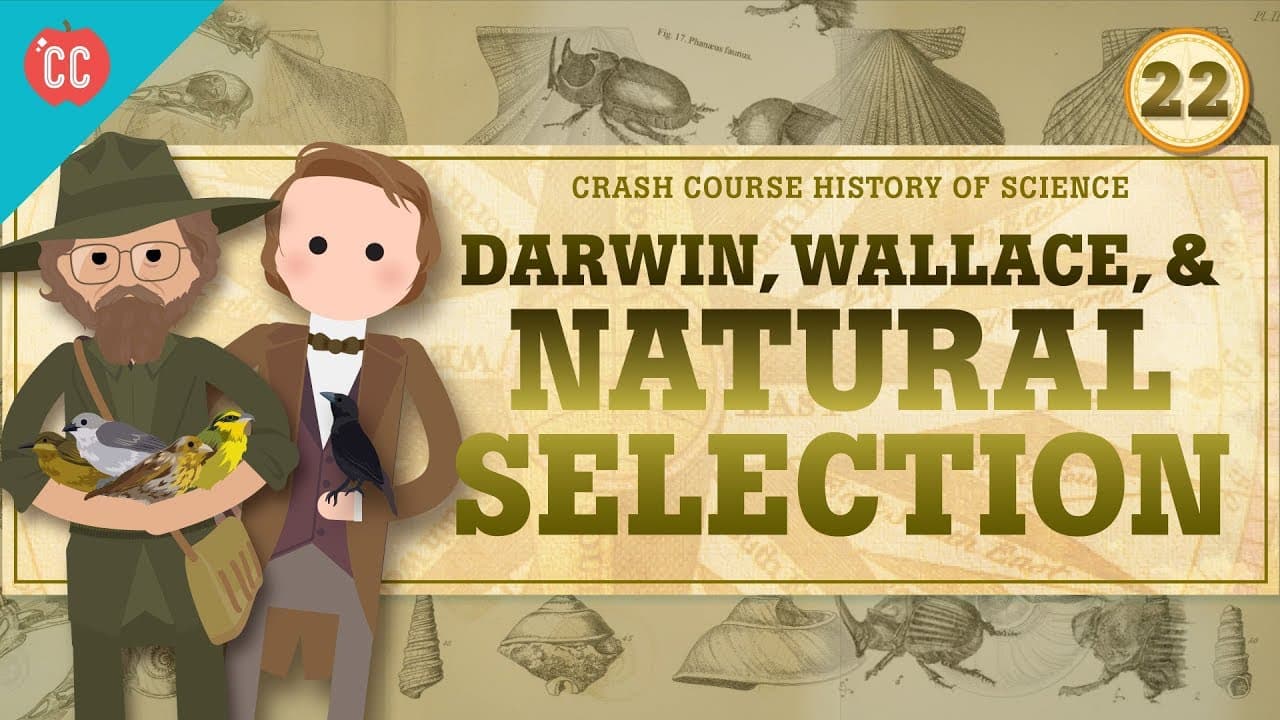
Charles Darwin and Alfred Russel Wallace independently developed the theory of natural selection, which explains how species evolve over time through environmental pressures favoring certain traits. Their work shifted the understanding of life from a fixed creation to a dynamic process of evolution, influencing future biological research.
Transcript
If you only remember one name in the entire history of modern biology, it should be… two names. Because the first biologists were a pair of freaky intellectual twins, just like Newton and Leibniz. But with more barnacles and monkeys. Let’s meet Charles Darwin and Alfred Russel Wallace. [INTRO MUSIC PLAYS] In the early 1800s, England was already mov... Read More
Key Insights
- Charles Darwin and Alfred Russel Wallace both contributed to the theory of natural selection, a key mechanism of evolution.
- Natural selection posits that organisms better adapted to their environment tend to survive and produce more offspring.
- Darwin's voyage on the HMS Beagle was crucial in developing his ideas on evolution, offering firsthand observation of diverse species.
- The Galapagos finches were instrumental in Darwin’s understanding of how species adapt to different environments.
- Darwin was influenced by Thomas Malthus's ideas on population growth and resource competition.
- Wallace independently conceived the theory of natural selection while in Southeast Asia, leading to a joint publication with Darwin.
- Darwin's 'On the Origin of Species' popularized the concept of evolution and was a scientific bestseller.
- Darwin and Wallace's work laid the foundation for modern biology, shifting focus from observation to theory testing.
Install to Summarize YouTube Videos and Get Transcripts
Explore YouTube Video Summarizer or Get YouTube Transcript Extractor
Questions & Answers
Q: How did Charles Darwin develop the theory of natural selection?
Charles Darwin developed the theory of natural selection through observations made during his voyage on the HMS Beagle. He studied various species, especially in the Galapagos Islands, noting how they adapted to different environments. Influenced by Thomas Malthus's ideas on population and resources, Darwin proposed that advantageous traits are preserved over generations, leading to species evolution.
Q: What role did Alfred Russel Wallace play in the theory of natural selection?
Alfred Russel Wallace independently conceived the theory of natural selection while exploring Southeast Asia. Observing that different environments produced distinct species, Wallace's insights paralleled Darwin's. His communication with Darwin led to a joint publication, acknowledging both their contributions and solidifying the theory's foundation in evolutionary biology.
Q: Why was the Galapagos Islands important to Darwin's research?
The Galapagos Islands were crucial to Darwin's research because they provided a natural laboratory where he observed variations among species, such as finches, that had adapted to different island environments. These observations helped Darwin formulate his ideas on natural selection, illustrating how species evolve by adapting to their surroundings over time.
Q: What influence did Thomas Malthus have on Darwin's theory?
Thomas Malthus influenced Darwin's theory by introducing the concept of population growth outpacing resource availability, leading to competition for survival. This idea helped Darwin understand that in nature, individuals with advantageous traits are more likely to survive and reproduce, a process he termed natural selection, which drives evolutionary change.
Q: How did Darwin's 'On the Origin of Species' impact scientific thought?
Darwin's 'On the Origin of Species' revolutionized scientific thought by providing a well-supported explanation for evolution through natural selection. It shifted the perspective from fixed species creation to dynamic evolutionary processes, integrating various branches of natural history and setting the stage for modern biological research focused on theory testing and evidence-based conclusions.
Q: What challenges did Darwin face in publishing his theory?
Darwin faced challenges in publishing his theory, including the need for incontrovertible evidence and potential backlash from religious and scientific communities. Despite these concerns, the joint publication with Wallace and the subsequent release of 'On the Origin of Species' successfully communicated his ideas, garnering significant attention and acceptance among scientists and the public.
Q: How did social Darwinism misuse Darwin and Wallace's theory?
Social Darwinism misused Darwin and Wallace's theory by applying the concept of 'survival of the fittest' to justify social hierarchies and inequalities. This interpretation distorted the scientific principles of natural selection, using them to promote the idea that certain human groups were inherently superior, a notion neither Darwin nor Wallace endorsed.
Q: What is the significance of Wallace's Line in biogeography?
Wallace's Line is significant in biogeography as it demarcates a boundary between the distinct faunal regions of Asia and Australia. Discovered by Alfred Russel Wallace, this line highlights how geographical barriers influence species distribution and evolution, contributing to the understanding of biogeography and the environmental factors shaping biodiversity across regions.
Summary & Key Takeaways
-
Charles Darwin's development of the theory of natural selection was influenced by his voyage on the HMS Beagle, where he observed diverse species, particularly in the Galapagos Islands. His understanding was further shaped by reading Thomas Malthus's work on population dynamics, leading to the realization that species evolve through natural selection, where advantageous traits are preserved over generations.
-
Alfred Russel Wallace independently arrived at the theory of natural selection during his travels in Southeast Asia. He noted that different environments seemed to produce distinct species, a realization that aligned with Darwin's findings. Wallace's communication with Darwin prompted a joint publication, solidifying their contributions to evolutionary biology.
-
The publication of 'On the Origin of Species' by Darwin introduced the concept of evolution by natural selection to a wide audience, marking a shift from static views of life to a dynamic understanding of species change over time. Despite initial resistance, particularly from religious groups, the theory gained acceptance and laid the groundwork for future biological research.
Read in Other Languages (beta)
Share This Summary 📚
Summarize YouTube Videos and Get Video Transcripts with 1-Click
Try YouTube Summary with ChatGPT & Claude or YouTube Transcript Generator
Explore More Summaries from CrashCourse 📚



Summarize YouTube Videos and Get Video Transcripts with 1-Click
Try YouTube Summary with ChatGPT & Claude or YouTube Transcript Generator