The Doomsday Argument
TL;DR
The doomsday argument suggests humanity's end may be near.
Transcript
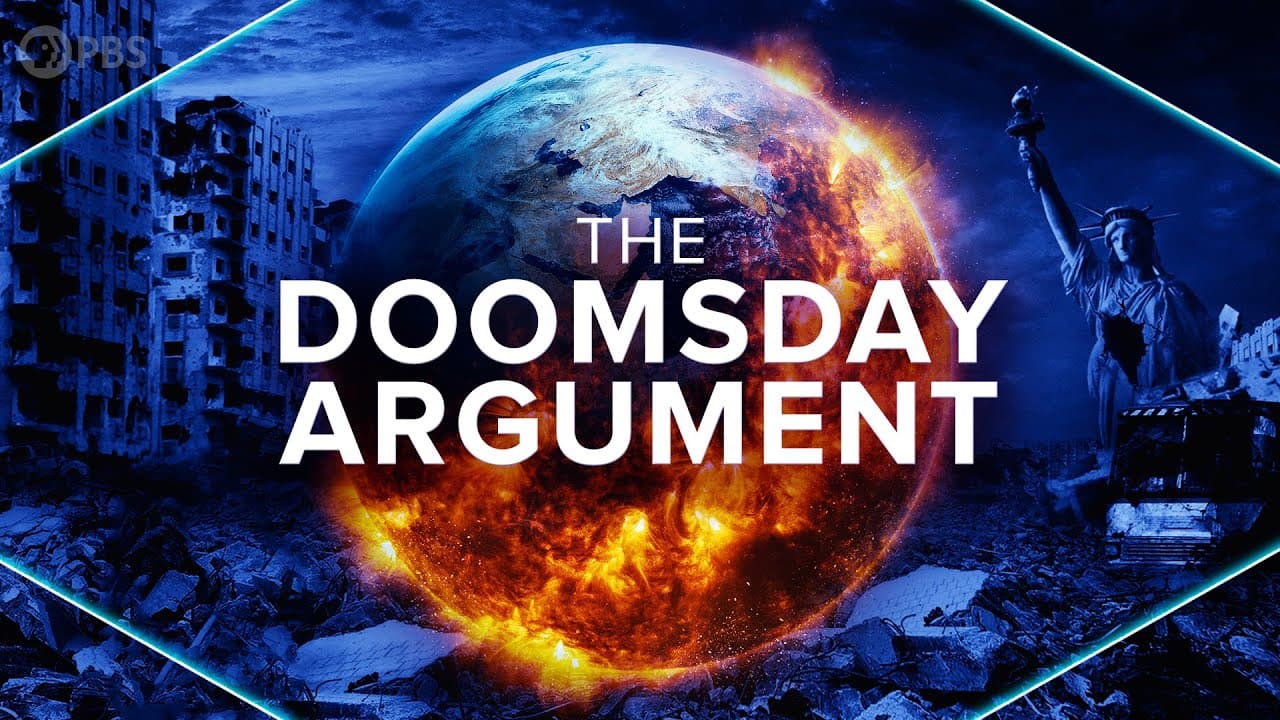
Since the dawn of humanity around 100 billion people have lived. How many will live in the future of our species? We might hope for a trillion times that if we colonize the galaxy. But a simple statistical argument tells us that the doom of our species is much, much closer. In some recent episodes we’ve explored the anthropic principle and seen how... Read More
Key Insights
- The anthropic principle suggests that our universe is finely tuned for life due to the existence of many other universes, increasing the likelihood of life-supporting conditions.
- The Copernican principle implies that we should expect to be in a typical part of the universe, contrasting with the anthropic principle's focus on rare environments.
- Steven Weinberg used anthropic reasoning to estimate the cosmological constant, predicting its value before dark energy was discovered.
- The doomsday argument applies statistical reasoning to suggest humanity is likely mid-way through its existence, implying a higher probability of near-term extinction.
- Critics of the doomsday argument question the validity of its assumptions, particularly regarding the definition of the reference class of observers.
- The self-sampling assumption posits that observers should consider themselves randomly selected from all existent observers, influencing predictions about the universe.
- The doomsday argument's reliance on hypothetical scenarios, like the doom-late and doom-soon boxes, raises questions about its practical applicability.
- Anthropic reasoning can lead to both profound insights, such as estimating the cosmological constant, and speculative scenarios like the Boltzmann brain.
Install to Summarize YouTube Videos and Get Transcripts
Explore YouTube Video Summarizer or Get YouTube Transcript Extractor
Questions & Answers
Q: What is the doomsday argument?
The doomsday argument is a statistical hypothesis suggesting that humanity is likely closer to its end than expected. It uses the self-sampling assumption to propose that we are more likely to be among the first 100 billion humans than among a far larger number, implying a higher probability of near-term extinction.
Q: How does the anthropic principle relate to the cosmological constant?
The anthropic principle suggests that our universe's conditions are finely tuned for life. Steven Weinberg applied this principle to estimate the cosmological constant, predicting its value before dark energy was discovered. His reasoning was based on the idea that we exist in a universe with conditions that allow for life, making certain cosmological constants more likely.
Q: What is the self-sampling assumption?
The self-sampling assumption is a philosophical idea stating that observers should reason as if they are randomly selected from the set of all existent observers. This assumption influences predictions about the universe and humanity's future by suggesting that we should expect to find ourselves in typical conditions for observers.
Q: Why is the doomsday argument controversial?
The doomsday argument is controversial because it relies on hypothetical scenarios and assumptions about the reference class of observers. Critics question its practical applicability and the validity of its assumptions, particularly regarding the definition of the reference class, which affects predictions about humanity's future.
Q: What are some criticisms of the doomsday argument?
Critics of the doomsday argument challenge its assumptions, especially the definition of the reference class, which determines predictions about humanity's future. They argue that the argument's reliance on hypothetical scenarios, like the doom-late and doom-soon boxes, raises questions about its validity and practical applicability.
Q: How does the Copernican principle contrast with the anthropic principle?
The Copernican principle suggests that we should expect to be in a typical part of the universe, implying that our position is not special. In contrast, the anthropic principle focuses on the rarity of life-supporting conditions, positing that our universe's conditions are finely tuned for life due to the existence of many other universes.
Q: What is the significance of Steven Weinberg's prediction about the cosmological constant?
Steven Weinberg's prediction about the cosmological constant demonstrated the potential of anthropic reasoning for making scientific predictions. He estimated the constant's value before dark energy was discovered, showing how the anthropic principle could be used to make informed guesses about the universe's conditions.
Q: What are some speculative scenarios resulting from anthropic reasoning?
Anthropic reasoning can lead to speculative scenarios like the Boltzmann brain, where a brain with current mental experiences could spontaneously form in a high-entropy void. It also raises the simulation hypothesis, suggesting that we could be simulations in a far-future experiment. These scenarios highlight the principle's potential for leading to both profound insights and absurd ideas.
Summary & Key Takeaways
-
The doomsday argument uses statistical reasoning to suggest that humanity may be closer to its end than expected. This idea is based on the anthropic principle, which posits that our universe's conditions are finely tuned for life.
-
Steven Weinberg's application of anthropic reasoning to the cosmological constant showed the potential of this principle for making predictions, even before the discovery of dark energy.
-
Critics of the doomsday argument challenge its assumptions, particularly the definition of the reference class, which affects predictions about humanity's future and the universe's nature.
Read in Other Languages (beta)
Share This Summary 📚
Summarize YouTube Videos and Get Video Transcripts with 1-Click
Try YouTube Summary with ChatGPT & Claude or YouTube Transcript Generator
Explore More Summaries from PBS Space Time 📚
Summarize YouTube Videos and Get Video Transcripts with 1-Click
Try YouTube Summary with ChatGPT & Claude or YouTube Transcript Generator