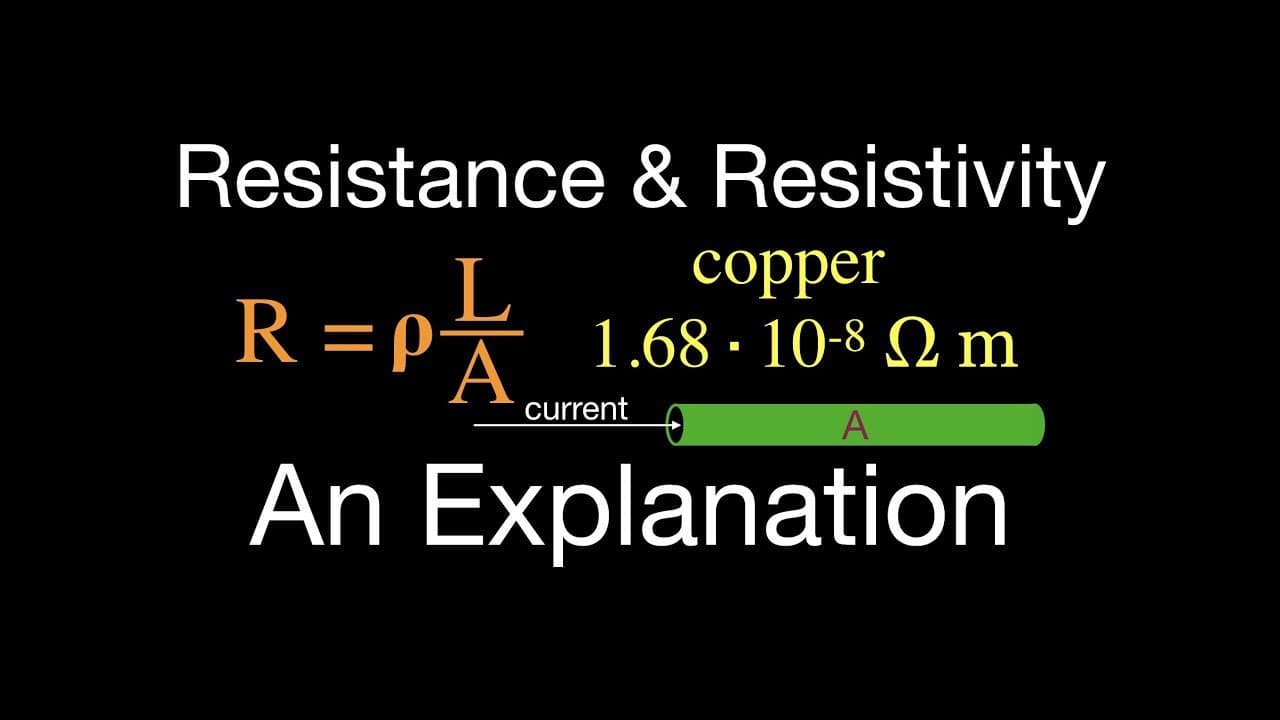
Resistance & Resistivity, An Explanation
TL;DR
Explaining resistance and resistivity in conductors, including a simple calculation example.
Transcript
okay in today's video I'm going to go over an explanation for resistance and resistivity I have made previous videos for some example problems for resistance in resistivity and I also made some videos for electric current and for Ohm's law you can link to those videos in the upper right hand corner of this video and please don't forget before you g... Read More
Key Insights
- 😵 Resistance in conductors is impacted by length and cross-sectional area.
- 💐 Resistivity defines a material's resistance to electric flow.
- 😘 Conductors like copper with low resistivity are commonly used due to their efficiency.
- 🎚️ Different materials have varying resistivity levels, impacting their usage in electrical applications.
- ❓ Resistance calculations involve considering length, area, and material resistivity.
- 🎨 Understanding resistance and resistivity is crucial in designing efficient electrical circuits.
- 😵 Longer wires and smaller cross-sectional areas increase resistance in conductors.
Install to Summarize YouTube Videos and Get Transcripts
Explore YouTube Video Summarizer or Get YouTube Transcript Extractor
Questions & Answers
Q: How does wire length affect resistance?
Wire length directly affects resistance; longer wires have higher resistance due to increased electron collision.
Q: What role does cross-sectional area play in resistance?
Cross-sectional area inversely affects resistance; larger areas reduce resistance as electrons have more space to flow.
Q: What is resistivity in the context of conductivity?
Resistivity is a material property defining how well a substance resists electric flow; higher resistivity means higher resistance.
Q: What factors determine the resistance of a conductor?
Resistance is influenced by length, cross-sectional area, and the material's resistivity; longer wires and smaller areas increase resistance in a material with higher resistivity.
Summary & Key Takeaways
-
Four wires made of the same material but varying in diameter and length demonstrate different resistances to current flow.
-
Resistance is directly proportional to length and inversely proportional to cross-sectional area in a conductor.
-
Resistivity, a material-dependent constant, affects the resistance of a conductor.
Read in Other Languages (beta)
Share This Summary 📚
Summarize YouTube Videos and Get Video Transcripts with 1-Click
Try YouTube Summary with ChatGPT & Claude or YouTube Transcript Generator
Explore More Summaries from Step by Step Science 📚


Summarize YouTube Videos and Get Video Transcripts with 1-Click
Try YouTube Summary with ChatGPT & Claude or YouTube Transcript Generator