What Makes the Italian Language Unique and Beautiful?
TL;DR
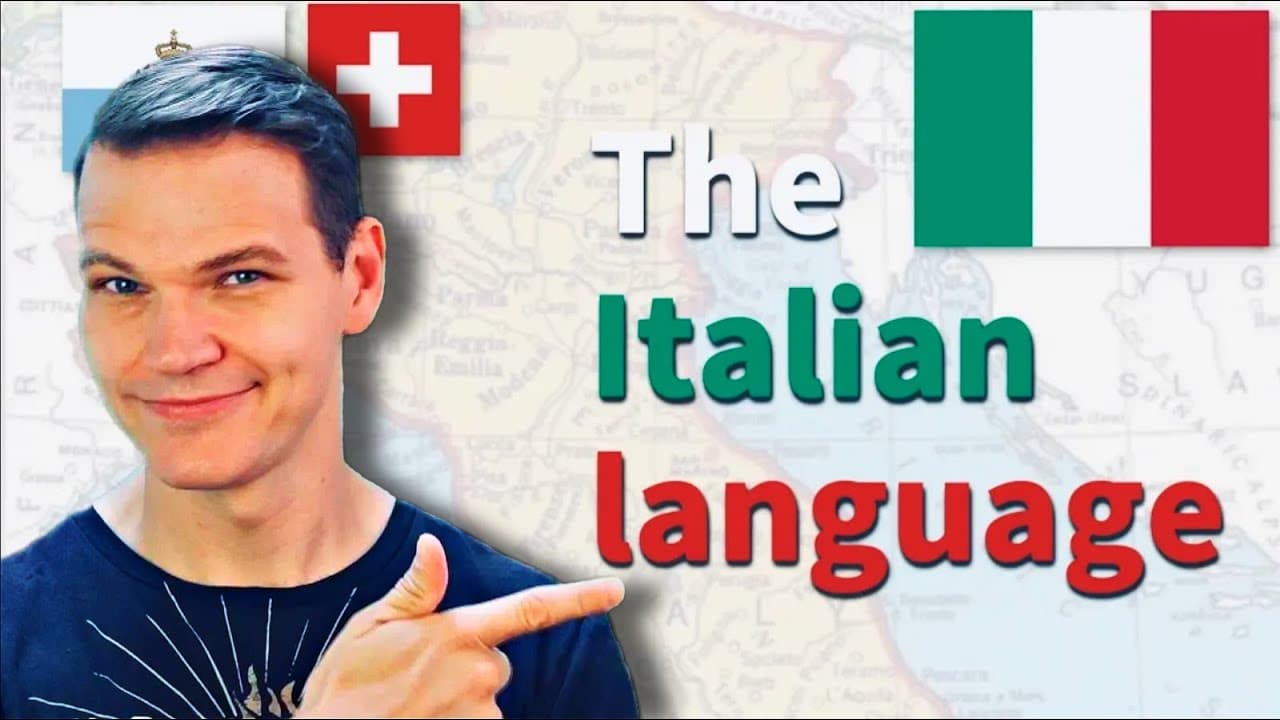
The Italian language, with around 68 million speakers mainly in Italy, is renowned for its rich history and cultural influence. Standard Italian evolved from the Tuscan dialect, significantly shaped by literary figures like Dante. Italian features unique pronunciation rules, gender agreements in grammar, and is recognized as the fourth most studied language worldwide due to its appeal and historical significance.
Transcript
today's topic is the Italian language Italian may not get as much attention as French Spanish and Portuguese but it's still one of the most widely spoken languages in the European Union with around 68 million speakers there around 60 million of those speakers are in Italy of course where Italian is the official language Italian is a member of the I... Read More
Key Insights
- Italian is a Romance language with around 68 million speakers, primarily in Italy, where it is the official language.
- Standard Italian developed from the Tuscan dialect, particularly the Florentine dialect, influenced by Dante's literary works.
- The Italian language evolved from Vulgar Latin, with a vernacular literary tradition emerging in the late Middle Ages.
- Italian unification in the 19th century led to the adoption of Standard Italian, despite the linguistic diversity across the regions.
- Italian pronunciation features distinct sounds, such as the soft 'ch' and 'j' sounds, and a rolled 'r'.
- Italian words typically end in vowels, with stress often on the penultimate syllable, and verbs are divided into three conjugation classes.
- Italian grammar includes gender agreement for adjectives and nouns, with articles and adjectives differing based on gender and number.
- Italian is the fourth most widely studied language globally, reflecting its cultural influence and appeal.
Install to Summarize YouTube Videos and Get Transcripts
Explore YouTube Video Summarizer or Get YouTube Transcript Extractor
Questions & Answers
Q: What is the origin of Standard Italian?
Standard Italian originated from the Tuscan dialect, particularly the Florentine dialect. This dialect was chosen due to its use in influential literary works by authors such as Dante Alighieri, whose writings were widely read and understood across Italy, thus establishing it as the standard literary language.
Q: How did Italian become the official language of Italy?
Italian became the official language of Italy following the unification of the historical states of Italy in the 19th century. At that time, Alessandro Manzoni proposed using the modern Florentine dialect as the standard, which was accepted by the Italian government, despite the fact that most Italians did not initially speak it.
Q: What are some unique features of Italian pronunciation?
Italian pronunciation includes distinct sounds such as the soft 'ch' and 'j' sounds before certain vowels, a rolled 'r', and the pronunciation of 'z' as 'ts'. Additionally, Italian words typically end in vowels, and the stress is often on the penultimate syllable, contributing to the language's melodic quality.
Q: How is Italian grammar structured in terms of gender and number?
Italian grammar involves gender agreement for nouns and adjectives, with nouns ending in 'o' usually being masculine and those ending in 'a' being feminine. Adjectives and articles must agree with the gender and number of the nouns they describe, with different forms for masculine and feminine, singular and plural.
Q: What role did Dante play in the development of the Italian language?
Dante Alighieri played a crucial role in the development of the Italian language through his literary works, particularly 'The Divine Comedy'. His use of the Florentine dialect in his writings helped establish it as the standard literary language, influencing the development of Standard Italian.
Q: Why is Italian considered a widely studied language?
Italian is considered a widely studied language due to its rich cultural heritage and influence, both historically and in contemporary times. It is the fourth most studied language globally, reflecting its appeal and the widespread interest in Italian culture, including its art, music, and cuisine.
Q: What are some challenges learners face when studying Italian?
Learners of Italian often face challenges with its pronunciation, particularly with sounds like the rolled 'r' and the soft 'ch'. Additionally, mastering the grammar, including gender agreement and the various verb conjugations, can be complex due to the language's intricate rules and exceptions.
Q: How does Italian handle verb conjugations?
Italian verbs are divided into three conjugation classes: -are, -ere, and -ire, each with its own set of endings. While -are verbs are mostly regular, -ere and -ire verbs include many irregular forms. Italian also uses compound tenses, formed with auxiliary verbs, adding complexity to verb conjugation.
Summary & Key Takeaways
-
Italian is a widely spoken Romance language with deep historical roots, primarily in Italy, where it serves as the official language. Its development from the Tuscan dialect, particularly the Florentine dialect, was significantly influenced by literary figures like Dante, Petrarch, and Manzoni.
-
The language evolved from Vulgar Latin, with a shift towards vernacular literature in the Middle Ages. Despite Italy's diverse dialects, Standard Italian became the official language post-unification in the 19th century, even though most Italians initially did not speak it.
-
Italian features distinctive pronunciation rules, including specific consonant sounds and vowel endings. Its grammar involves gender agreement for nouns and adjectives, with different articles and adjective placements based on gender and number, making it a unique and fascinating language to study.
Read in Other Languages (beta)
Share This Summary 📚
Summarize YouTube Videos and Get Video Transcripts with 1-Click
Try YouTube Summary with ChatGPT & Claude or YouTube Transcript Generator
Explore More Summaries from Langfocus 📚
Summarize YouTube Videos and Get Video Transcripts with 1-Click
Try YouTube Summary with ChatGPT & Claude or YouTube Transcript Generator