How Can You Edit Faces with Artificial Intelligence?
TL;DR
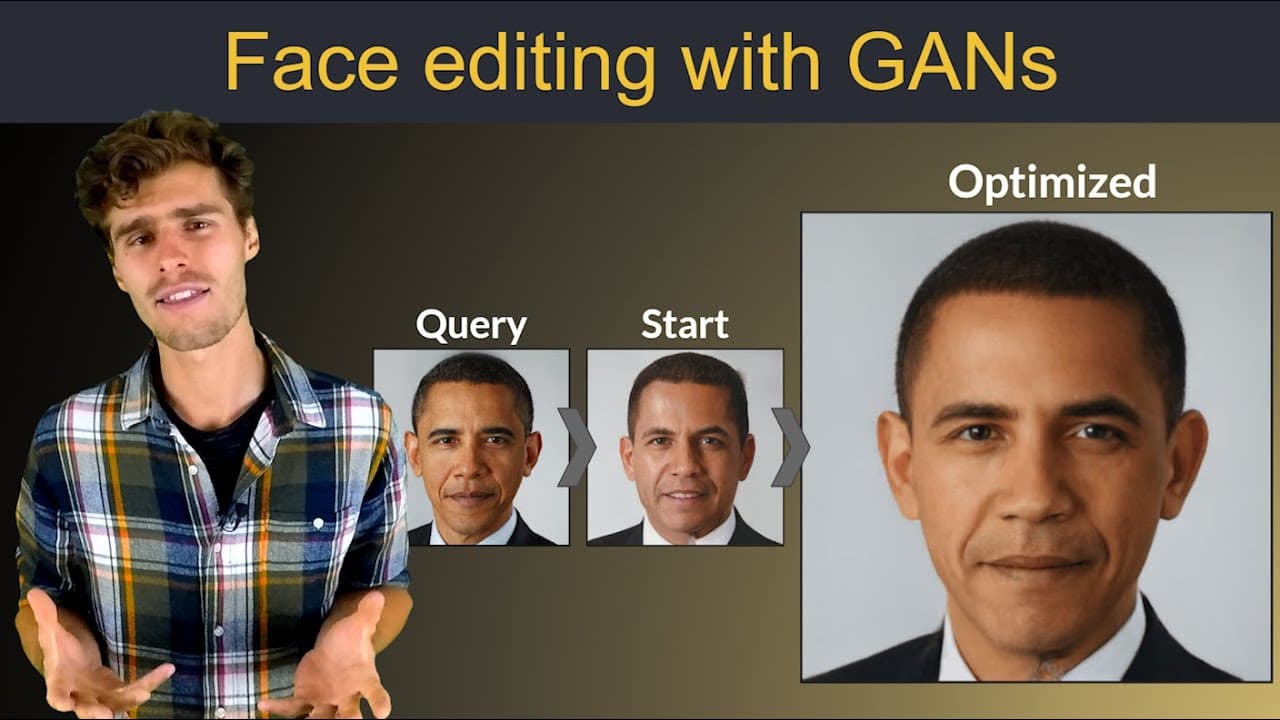
You can edit faces using generative adversarial networks (GANs), which allow for manipulation in the latent space of trained models. By adjusting the latent vectors, users can create diverse images, altering attributes such as gender or expressions, enabling extensive customization. Overall, GANs provide a powerful and versatile tool for image generation and modification.
Transcript
over the past few years in machine learning we've seen dramatic progress in the field of generative models and while there are a lot of different flavors of these generative models in this video I want to talk specifically about one model called the generative adversarial Network or in short gap now gans were first invented by Ian Goodfellow in 201... Read More
Key Insights
- 👨🔬 GANs have significantly evolved since their inception in 2014, with extensive research enhancing their capabilities and applications.
- ❓ The dual structure of the generator and discriminator in GANs creates a dynamic interplay that fosters improved image accuracy and quality.
- 🤗 Open-source models and datasets allow enthusiasts to train GANs across diverse areas, from generating faces to creating artwork.
- 😒 Effective training of GANs often involves creative techniques like progressive growing of layers and the use of mapping networks for versatile manipulations.
- 👾 Latent space manipulation offers users the ability to adjust and explore specific attributes in generated images, contributing to personalized digital experiences.
- 😑 The process of finding optimal latent vectors can be complex, yet leveraging pre-trained neural networks simplifies and accelerates optimization.
- 🏑 GANs' applications extend beyond novelty; they drive innovation in fields such as film, gaming, and personalized marketing visuals.
Install to Summarize YouTube Videos and Get Transcripts
Explore YouTube Video Summarizer or Get YouTube Transcript Extractor
Questions & Answers
Q: What are generative adversarial networks (GANs), and who invented them?
Generative adversarial networks (GANs) are a class of machine learning frameworks that consist of two neural networks, the generator and the discriminator. Ian Goodfellow proposed this model in 2014. The generator creates synthetic images while the discriminator evaluates their authenticity, leading to high-quality image generation.
Q: How can GANs be trained on different datasets?
GANs can be trained on any dataset as they rely on unsupervised learning. Essentially, you input a collection of images, and the GAN learns the features and distribution of this data without needing explicit labels. This flexibility allows for various applications, such as generating anime faces or even transforming satellite imagery into art.
Q: What is the latent space in GANs, and why is it important?
The latent space in GANs refers to the compact representation of features captured during training. It enables users to explore variations in generated images by manipulating these latent vectors. Understanding and navigating this space allows for creative applications, such as altering attributes of faces or generating unique artistic styles.
Q: How does the styleGAN architecture improve on traditional GANs?
StyleGAN enhances traditional GAN architectures by incorporating a mapping network that transforms input noise into a vector representing style attributes. This architecture allows for dynamic manipulation of image features. Additionally, it integrates progressive growing of the model layers to stabilize training, thus producing high-fidelity images more efficiently.
Q: What difficulties arise from optimizing latent vectors and how are they mitigated?
Directly optimizing latent vectors can lead to convergence issues in local minima. Instead, a two-step process using feature vectors from a pre-trained network, like VGG, is employed. This approach uses a semantic representation of images rather than pixel differences, leading to better optimization results and more realistic images being generated.
Q: What practical applications stem from manipulating images in a GAN's latent space?
Manipulating GANs' latent space opens doors for numerous applications. Users can alter facial attributes such as age, gender, or expressions, enabling creative experimentation. This technology fuels innovations in digital art, advertising, and even personalized content creation, making it of high interest across various industries.
Q: How can a user start experimenting with GANs?
To experiment with GANs, users can access pre-configured IPython notebooks that provide hands-on coding experiences. These resources include instructions on training models, manipulating latent vectors, and experimenting with different datasets, enabling users to explore the exciting possibilities of GANs.
Summary & Key Takeaways
-
Generative adversarial networks (GANs), introduced by Ian Goodfellow in 2014, have evolved markedly, showcasing diverse applications, notably in creating synthetic images.
-
GANs employ a dual-network system comprising a generator, which creates images, and a discriminator, which evaluates them to ensure realism, resulting in high-quality outcomes.
-
By manipulating the latent space of trained GANs, users can create diverse images, exploring features like gender or facial expressions extensively, making the technology versatile and accessible.
Read in Other Languages (beta)
Share This Summary 📚
Summarize YouTube Videos and Get Video Transcripts with 1-Click
Try YouTube Summary with ChatGPT & Claude or YouTube Transcript Generator
Explore More Summaries from Arxiv Insights 📚
Summarize YouTube Videos and Get Video Transcripts with 1-Click
Try YouTube Summary with ChatGPT & Claude or YouTube Transcript Generator