AlphaGo - How AI mastered the hardest boardgame in history
TL;DR
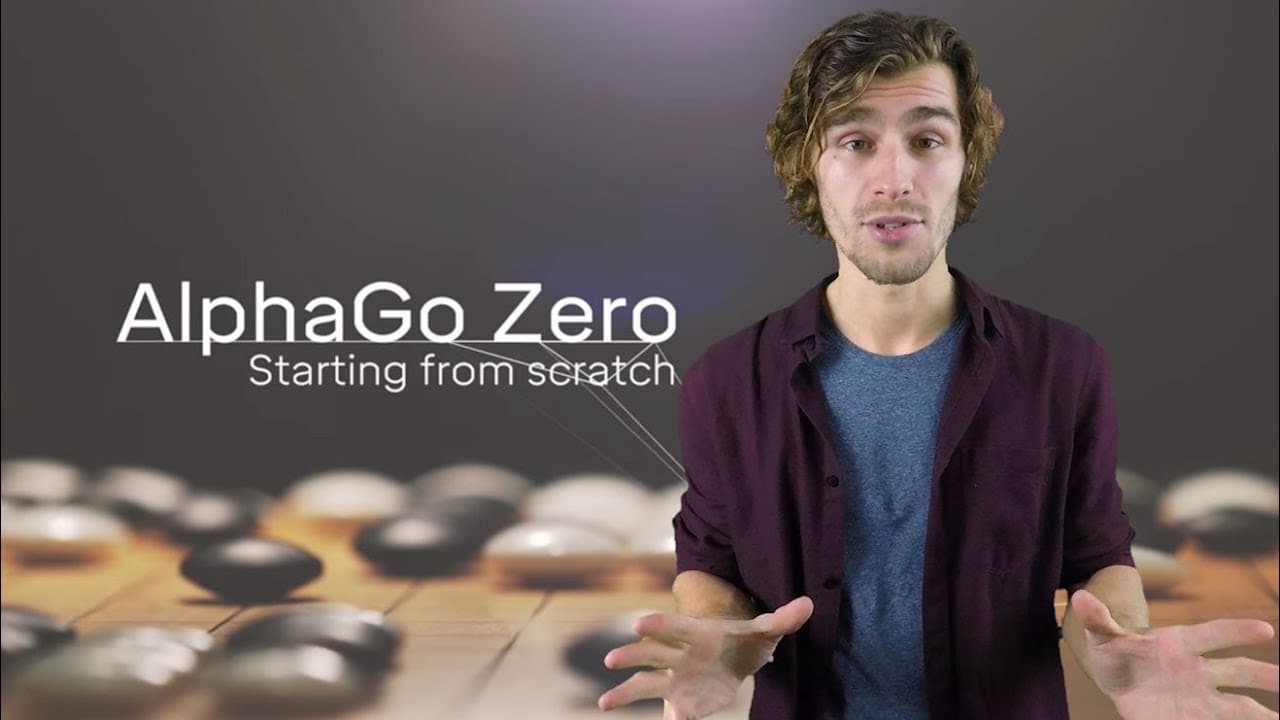
AlphaGo Zero improves upon its predecessor by using self-play and advanced neural architecture.
Transcript
so about two weeks ago the alphago team by google deepmind they published their latest paper in the alphago series this time it's called alphago zero and I want to dive into some of the technical details that make this version of alphago so much better than the previous version that beat lee sedol you ready to dive in deep my name is Andrew and wel... Read More
Key Insights
- 🖐️ AlphaGo Zero's training method entirely forgoes human data, demonstrating advanced capabilities in reinforcement learning through pure self-play.
- 💐 The shift to a residual network architecture enhances gradient flow, improving training stability and efficiency in complex decision-making scenarios.
- ✋ By combining policy and value evaluations into a single network, AlphaGo Zero simplifies its architecture, reducing computational costs while maintaining high performance.
- 🏂 The introduction of historical board state representations helps the model develop strategic awareness, mimicking human-like cognitive processes.
- ✊ AlphaGo Zero showcases the power of deep learning by outperforming human strategies, highlighting the potential for AI in complex problem-solving tasks.
- 👻 The integration of Monte Carlo simulations allows AlphaGo Zero to explore vast game trees, generating accurate move probabilities and decreasing random decision-making.
- 👾 The model's enhanced move discovery indicates a shift away from established tactics towards innovative strategies, showcasing adaptability in game dynamics.
Install to Summarize YouTube Videos and Get Transcripts
Explore YouTube Video Summarizer or Get YouTube Transcript Extractor
Questions & Answers
Q: How does AlphaGo Zero train without human data?
AlphaGo Zero uses self-play instead of relying on datasets of human gameplay. It generates its training data by playing games against itself, which allows it to learn and adapt strategies independently, leveraging reinforcement learning principles and avoiding overfitting to human styles.
Q: What is a significant architectural change in AlphaGo Zero?
A major change in AlphaGo Zero is its shift from conventional convolutional networks to a residual architecture. This allows for direct pathways for gradients during training, facilitating a smoother learning process and enabling the network to effectively train even when initial performance is poor.
Q: Why are historical board states included in AlphaGo Zero's representation?
AlphaGo Zero utilizes past board states in its 19x19 grid representation to create an attention mechanism. This historical context allows the network to consider previous opponent moves, which is crucial for making informed decisions in subsequent turns and handling specific game rules effectively.
Q: How does AlphaGo Zero stabilize the training process?
The use of Monte Carlo tree search plays a pivotal role in stabilizing the training for AlphaGo Zero. By simulating potential moves and their outcomes across numerous iterations, it provides a structured approach for evaluating board states, ensuring that even during self-play, the learning remains consistent and reliable.
Summary & Key Takeaways
-
AlphaGo Zero differs from previous versions by exclusively using self-play for training, eliminating the need for human game data. This innovative approach facilitates learning from scratch.
-
The architecture of AlphaGo Zero employs a residual network instead of traditional convolutional structures, allowing effective gradient flow and better performance in evaluating game positions.
-
Key improvements include combining the policy and value networks into one, simplifying decision-making processes while leveraging Monte Carlo tree search to stabilize self-play training and enhance move selection.
Read in Other Languages (beta)
Share This Summary 📚
Summarize YouTube Videos and Get Video Transcripts with 1-Click
Try YouTube Summary with ChatGPT & Claude or YouTube Transcript Generator
Explore More Summaries from Arxiv Insights 📚

Summarize YouTube Videos and Get Video Transcripts with 1-Click
Try YouTube Summary with ChatGPT & Claude or YouTube Transcript Generator