An introduction to Policy Gradient methods - Deep Reinforcement Learning
TL;DR
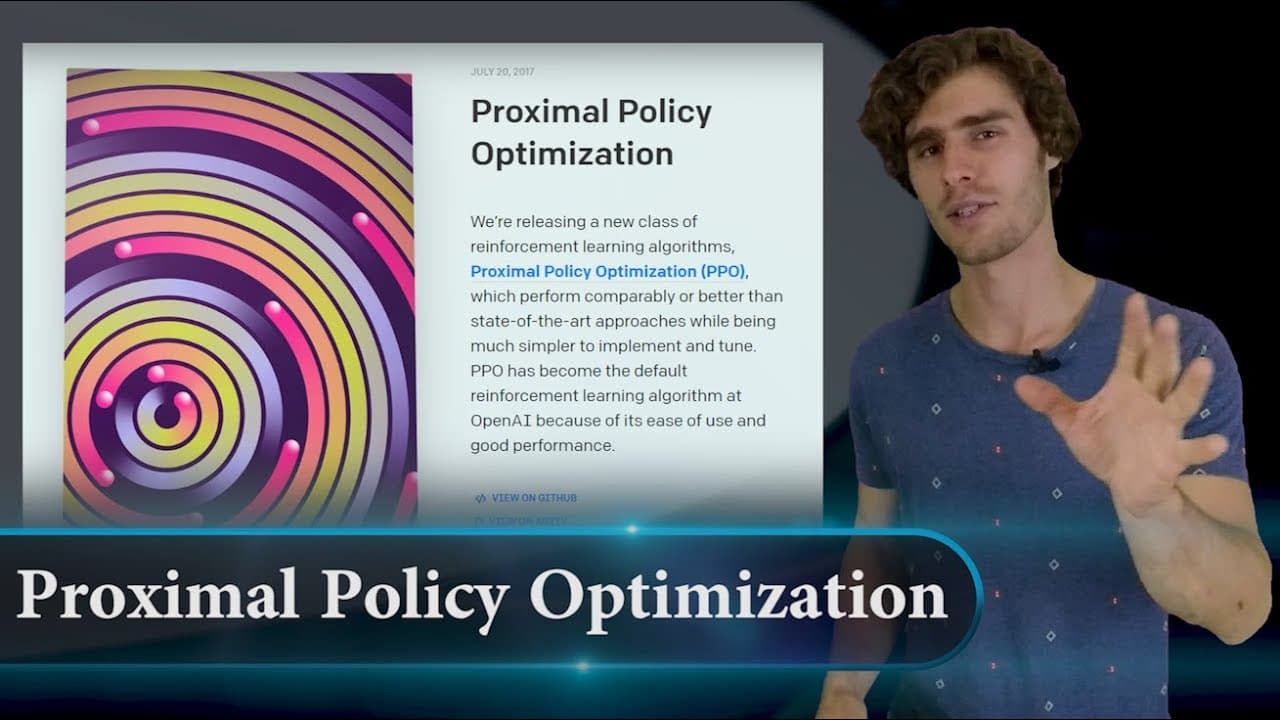
This episode explores the Proximal Policy Optimization algorithm, addressing challenges in deep reinforcement learning.
Transcript
hi everybody welcome back to archive insights so lately we've seen a lot of new emerging algorithms in deep reinforcement learning and in this episode I want to dive into one specific algorithm called proximal policy optimization that was designed at opening eye and has proven successful on a wide variety of tasks going all the way from robotic con... Read More
Key Insights
- 🧍 PPO stands out in the reinforcement learning landscape due to its simplicity and effectiveness, requiring minimal adjustments from traditional policy gradient methods while providing robust performance.
- 👻 The algorithm operates by learning directly from real-time interactions with the environment, allowing it to generate its own training data, which is a departure from methods using stored experiences.
- ☠️ By minimizing an adjusted objective that balances the rate of policy updates, PPO prevents drastic learning changes and promotes more reliable training outcomes.
- 👶 Encoding the entropy term within PPO's objective encourages exploration, fostering a balanced approach between exploiting known actions and exploring new possibilities.
- 👻 The successful design of PPO was influenced by previous work in TRPO, allowing for the adaptable learning methods that PPO introduces, combining the strengths of earlier algorithms in a more user-friendly package.
- 🥰 The algorithm has demonstrated state-of-the-art results across various fields, including robotic control and complex gaming scenarios, solidifying its status as a cornerstone of modern reinforcement learning.
- 💄 Effective hyperparameter tuning within PPO helps optimize its performance, making it versatile for different applications in deep reinforcement learning.
Install to Summarize YouTube Videos and Get Transcripts
Explore YouTube Video Summarizer or Get YouTube Transcript Extractor
Questions & Answers
Q: What problem does Proximal Policy Optimization (PPO) aim to solve in reinforcement learning?
PPO addresses several critical challenges in reinforcement learning, particularly the instability caused by the dynamic nature of training data that changes as the agent learns. Unlike static datasets used in supervised learning, reinforcement learning relies on data generated by the agent itself, which can lead to fluctuating data distributions and result in instability during the training process. PPO provides a structured approach to manage these fluctuating distributions by controlling policy updates to be more conservative and thereby increasing learning efficiency.
Q: How does PPO differ from traditional reinforcement learning approaches like DQN?
PPO is classified as a policy gradient method, meaning it optimizes policies directly rather than relying on a value estimate as in Q-learning methods like DQN. Unlike DQN, which utilizes replay buffers to learn from past experiences, PPO updates policy parameters using actions taken in the environment in real-time, thereby leveraging temporal correlations in its data. This fundamental difference allows PPO to adaptively learn from its own recent actions, making it suitable for continuous action spaces and more complex environments.
Q: What is the role of the advantage function in the PPO algorithm?
The advantage function serves a crucial role in PPO by estimating the relative value of taking specific actions from a given state compared to the expected outcome. It combines information about the total discounted rewards received from actions with a baseline estimate, allowing the agent to discern whether the action taken was beneficial or detrimental. This evaluation informs policy updates, assisting in adapting the agent’s behavior towards actions that yield higher rewards while stabilizing the learning process against noisy value estimates.
Q: Can you explain how the PPO objective function maintains stability during training?
The objective function of PPO includes a clipped version of the probability ratio between the new and old policy outputs. This clipping mechanism ensures that the updated policy does not stray too far from the previous policy, thus preserving stability. If the policy update is too drastic, the function limits the amount of change allowed, effectively reducing the risk of deteriorating the learned behavior. This conservative approach to policy updates helps to mitigate the variance caused by noise in advantage estimates, promoting stable convergence.
Summary & Key Takeaways
-
The Proximal Policy Optimization (PPO) algorithm was designed at OpenAI to tackle issues in reinforcement learning, such as data instability due to changing policies. It allows agents to learn directly from interactions with the environment.
-
The core mechanism of PPO employs a unique objective function that maintains stable updates during training by preventing drastic changes in policy, thus mitigating the variance associated with the advantage function and reinforcing effective actions.
-
PPO balances performance and ease of implementation, gaining popularity as a benchmark in deep reinforcement learning tasks by simplifying the complex coding demands of previous algorithms while achieving superior performance.
Read in Other Languages (beta)
Share This Summary 📚
Summarize YouTube Videos and Get Video Transcripts with 1-Click
Try YouTube Summary with ChatGPT & Claude or YouTube Transcript Generator
Explore More Summaries from Arxiv Insights 📚


Summarize YouTube Videos and Get Video Transcripts with 1-Click
Try YouTube Summary with ChatGPT & Claude or YouTube Transcript Generator