An introduction to Reinforcement Learning
TL;DR
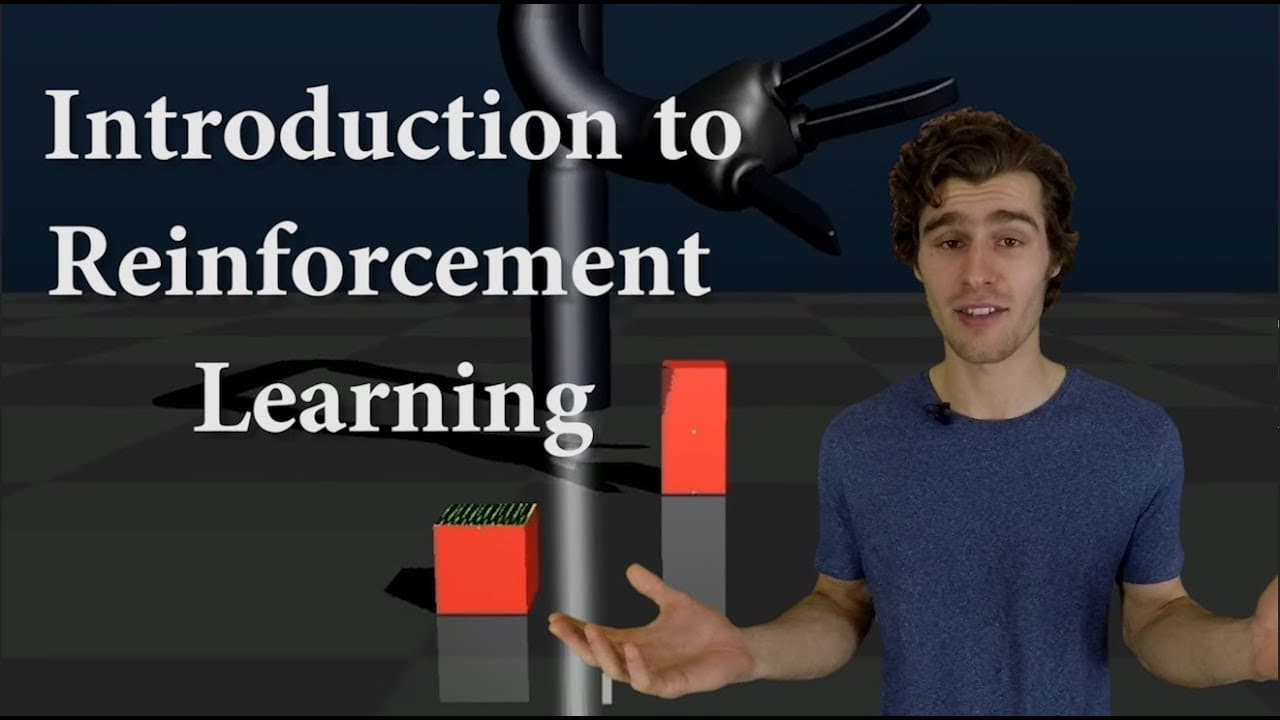
This content provides an in-depth introduction to deep reinforcement learning and its challenges.
Transcript
from the amazing results and vintage Atari games deep Minds victory with alphago stunning breakthroughs in robotic arm manipulation and even beating professional players at 1v1 dota the field of reinforcement learning has literally exploded in recent years ever since the impressive breakthrough on the imagenet classification challenge in 2012 the s... Read More
Key Insights
- 🏑 Reinforcement learning has rapidly evolved since the introduction of deep learning, significantly impacting fields such as robotics and gaming.
- 🥺 The primary challenge of sparse rewards complicates the learning process, making it difficult for agents to assign credit to past actions leading to success or failure.
- 🪡 Traditional supervised learning surpasses reinforcement learning efficiencies in contexts with full feedback, demonstrating the need for better exploration strategies in RL algorithms.
- 🦻 Reward shaping can aid agents but must be approached carefully to avoid unintended behaviors that could arise from overfitting to specific reward structures.
- ♻️ Testing and training in complex environments necessitate extensive exploration for effective reinforcement learning, which can be sample inefficient.
- ❓ Despite its advancements, reinforcement learning still heavily relies on human-engineered solutions to achieve practical outcomes in robotics.
- 🤨 The intersection of AI and robotics raises significant ethical concerns regarding safety and the potential misuse of technologies, highlighting the need for regulations.
Install to Summarize YouTube Videos and Get Transcripts
Explore YouTube Video Summarizer or Get YouTube Transcript Extractor
Questions & Answers
Q: What is reinforcement learning, and how does it differ from supervised learning?
Reinforcement learning (RL) is a type of machine learning where agents learn to make decisions by taking actions in an environment to maximize a reward. Unlike supervised learning, where models are trained on labeled datasets with known outputs, RL operates without explicit labels. Instead, models learn from the consequences of their actions, receiving feedback in the form of rewards or penalties based on overall performance.
Q: What is the credit assignment problem in reinforcement learning?
The credit assignment problem refers to the difficulty in determining which actions contributed to an agent's ultimate reward or penalty, especially in cases where rewards are sparse. When agents receive feedback only at the end of an episode, they must assess which specific actions led to positive or negative outcomes, complicating the learning process and potentially leading to incorrect adjustments in their behavior.
Q: Why is reward shaping challenging in reinforcement learning?
Reward shaping is the process of designing intermediate rewards to guide an agent's learning. This approach can be problematic because it requires crafting a reward structure for each new environment, leading to scalability issues. Moreover, agents can become overly focused on the specific reward signals, resulting in unanticipated behaviors that deviate from the intended goal, a phenomenon known as the misalignment problem.
Q: What is the significance of sparse reward settings in reinforcement learning?
Sparse reward settings present unique challenges for reinforcement learning as agents often receive feedback infrequently. This means that the agents must explore extensively to discover rewarding behaviors, which can lead to inefficient learning. Sparse rewards make it harder for agents to associate specific actions with positive outcomes, necessitating longer training durations to achieve competence.
Q: How do policy gradients work in reinforcement learning?
Policy gradients are a technique used to optimize the policy network in reinforcement learning by directly adjusting the action probabilities based on the received rewards. After executing a series of actions, the network calculates gradients to increase the likelihood of actions that resulted in positive rewards while decreasing the chances of actions that led to negative outcomes, refining the agent's decision-making over time.
Q: What role does exploration play in reinforcement learning?
Exploration in reinforcement learning is critical for agents to discover effective strategies and behaviors. It involves trying out various actions, including random choices, to gather information about the environment. Successful exploration enables agents to learn from both positive and negative experiences, contributing to the refinement of their policy and improving overall performance over time.
Q: How do advancements in reinforcement learning impact robotics?
Advancements in reinforcement learning have the potential to significantly enhance the capabilities of robotics, enabling them to learn complex tasks autonomously. However, robotics faces challenges such as sparse rewards and high-dimensional action spaces. Reinforcement learning can help bridge the gap between robot capabilities and intelligent behavior, allowing for the development of robots that can adapt to dynamic environments and perform intricate tasks independently.
Summary & Key Takeaways
-
The field of reinforcement learning has seen significant advancements since 2012, with applications spanning various tasks, including robotics and gaming.
-
The main challenge in reinforcement learning is the sparse reward problem, where agents struggle to learn from limited feedback in complex environments.
-
This video highlights the importance of designing reward functions and discusses the technological challenges in creating intelligent robotic behavior.
Read in Other Languages (beta)
Share This Summary 📚
Summarize YouTube Videos and Get Video Transcripts with 1-Click
Try YouTube Summary with ChatGPT & Claude or YouTube Transcript Generator
Explore More Summaries from Arxiv Insights 📚


Summarize YouTube Videos and Get Video Transcripts with 1-Click
Try YouTube Summary with ChatGPT & Claude or YouTube Transcript Generator