The Quasar from The Beginning of Time | STELLAR
TL;DR
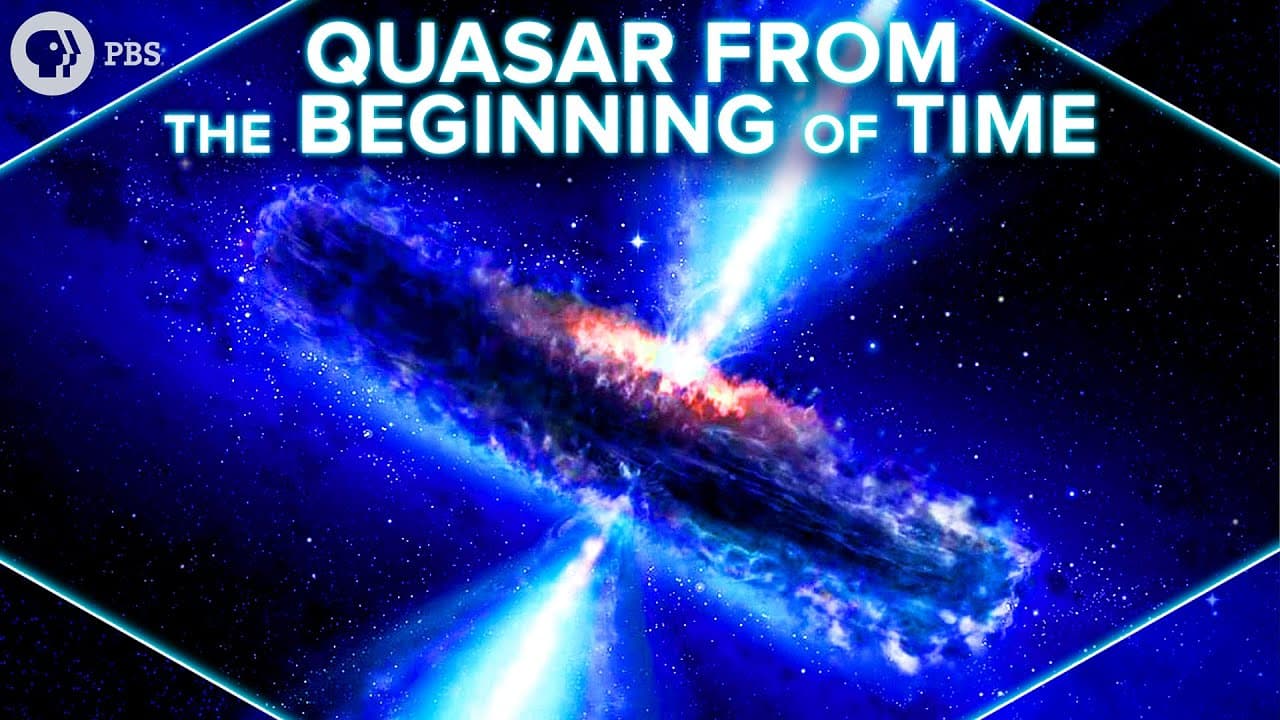
A quasar from the universe's infancy was observed using advanced telescopes.
Transcript
Thank you to Draper and its Hack the Moon initiative for supporting PBS Digital Studios. These black stones are volcanic rock, and this is one of the youngest patches of land on planet Earth, but that same geological event that built this land has provided another window: it allows us to observe a time when the universe was still cooling from the f... Read More
Key Insights
- Mauna Kea in Hawaii hosts 13 major telescopes, making it a premier site for astronomical observations due to its altitude and clear skies.
- The Gemini North telescope played a key role in observing the most distant quasar ever seen, located in the constellation of Boötes.
- This quasar's light, redshifted due to the universe's expansion, has traveled for 13.1 billion years, offering insights into the early universe.
- The quasar's spectrum reveals a time when the universe was filled with hydrogen gas before the process of reionization cleared the skies.
- The quasar's central black hole has a mass of 800 million Suns, posing questions about its rapid growth in the early universe.
- Adaptive optics at Gemini correct atmospheric turbulence, allowing clearer images by using a deformable mirror and artificial guide stars.
- The discovery highlights the capabilities of modern telescopes and the importance of observing different wavelengths to understand cosmic phenomena.
- PBS's Summer of Space initiative features various programs exploring space science, including gravitational waves and the Event Horizon Telescope.
Install to Summarize YouTube Videos and Get Transcripts
Explore YouTube Video Summarizer or Get YouTube Transcript Extractor
Questions & Answers
Q: What makes Mauna Kea a significant site for astronomical observations?
Mauna Kea is a significant site for astronomical observations due to its high altitude of 4,200 meters, which provides clear skies and reduced atmospheric interference. It hosts 13 major telescopes from 11 different countries, making it a premier location for observing celestial phenomena in the northern hemisphere.
Q: What is unique about the quasar observed by the Gemini North telescope?
The quasar observed by the Gemini North telescope is unique due to its extreme distance, with its light having traveled for 13.1 billion years. This makes it the most distant quasar ever observed, providing a glimpse into the early universe when it was filled with hydrogen gas before the process of reionization.
Q: How do adaptive optics improve the observations at Gemini?
Adaptive optics improve observations at Gemini by correcting atmospheric turbulence that blurs incoming light. This is achieved through a deformable mirror that adjusts in real-time to match and correct the warping of light waves, aided by artificial guide stars created by lasers, resulting in clearer and sharper images of distant celestial objects.
Q: What does the quasar's spectrum reveal about the early universe?
The quasar's spectrum reveals that during its time, the universe was filled with hydrogen gas, which absorbed much of the ultraviolet light. This period, before the process of reionization, was when the first stars and galaxies began forming, eventually clearing the hydrogen and leaving a transparent universe, providing insights into the universe's early conditions.
Q: Why is the mass of the quasar's black hole significant?
The mass of the quasar's black hole is significant because it is 800 million times the mass of the Sun, raising questions about how such a massive black hole could form and grow so rapidly in the early universe. This challenges current understanding of black hole formation and growth, prompting further research into cosmological models.
Q: What role does the Gemini North Infrared Spectrograph play in observing quasars?
The Gemini North Infrared Spectrograph (GNIRS) plays a crucial role in observing quasars by breaking down incoming light into its component wavelengths, allowing astronomers to analyze the light's spectrum. This helps determine the quasar's redshift, distance, and the conditions of the early universe, providing valuable data for understanding cosmic evolution.
Q: How does the PBS Summer of Space initiative contribute to public understanding of space?
The PBS Summer of Space initiative contributes to public understanding of space by offering a series of science and history programs that explore various aspects of space science. These programs, available on PBS and online, cover topics such as gravitational waves and the Event Horizon Telescope, making complex scientific concepts accessible to a broader audience.
Q: What future episodes are planned in the Stellar mini-series?
Future episodes in the Stellar mini-series include explorations by Dianna Cowern from Physics Girl at the LIGO observatory to learn about gravitational waves, and Joe Hanson from It's Okay to Be Smart visiting the Event Horizon Telescope. These episodes aim to delve deeper into groundbreaking space research and the technology behind these discoveries.
Summary & Key Takeaways
-
The Gemini North telescope in Hawaii observed the most distant quasar ever seen, located in the constellation Boötes. This quasar, with its light redshifted due to the universe's expansion, has traveled for 13.1 billion years, offering insights into the universe's infancy, when it was filled with hydrogen gas.
-
The quasar's central black hole, with a mass of 800 million Suns, raises questions about its rapid growth in the early universe. Adaptive optics at Gemini correct atmospheric turbulence, allowing clearer images by using a deformable mirror and artificial guide stars, demonstrating the capabilities of modern telescopes.
-
PBS's Summer of Space initiative features various programs exploring space science, including gravitational waves and the Event Horizon Telescope, highlighting the importance of observing different wavelengths to understand cosmic phenomena and the ongoing efforts to unravel the mysteries of the universe.
Read in Other Languages (beta)
Share This Summary 📚
Summarize YouTube Videos and Get Video Transcripts with 1-Click
Try YouTube Summary with ChatGPT & Claude or YouTube Transcript Generator
Explore More Summaries from PBS Space Time 📚

Summarize YouTube Videos and Get Video Transcripts with 1-Click
Try YouTube Summary with ChatGPT & Claude or YouTube Transcript Generator