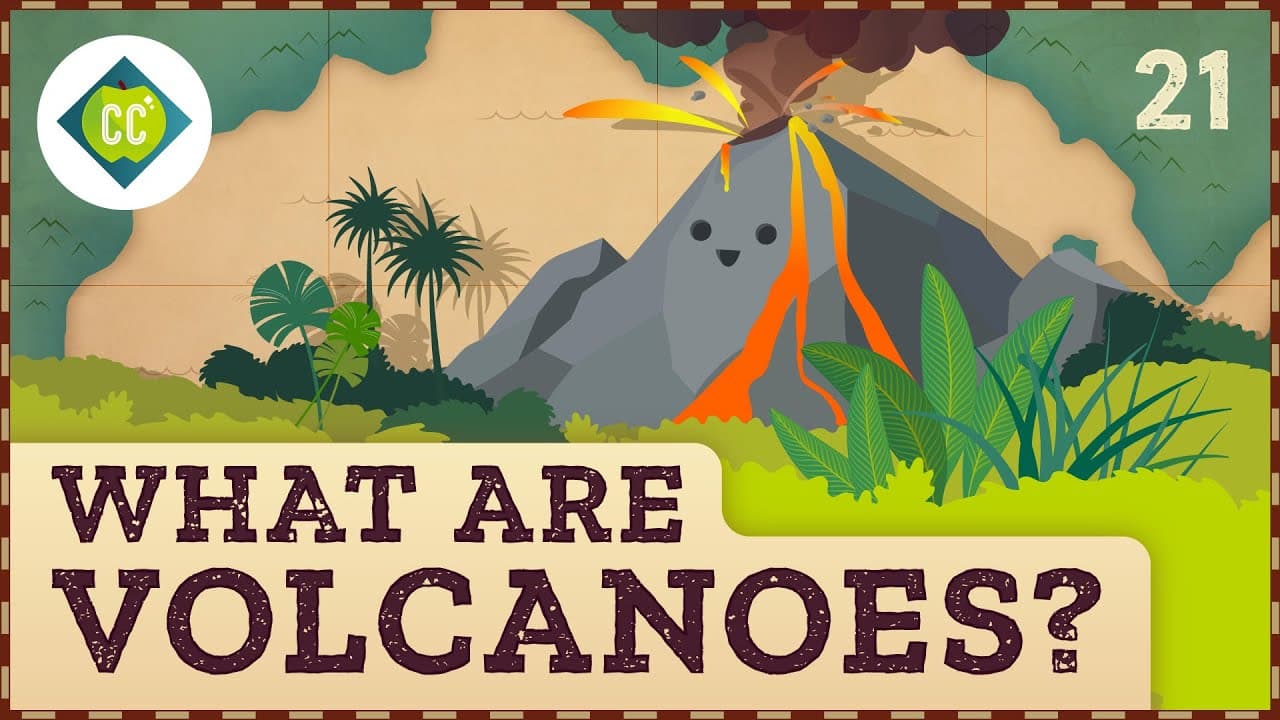
What Are Volcanoes? Crash Course Geography #21
TL;DR
Volcanoes are dangerous yet fascinating landforms that provide insights into the Earth's internal workings and can be predicted to some extent through various monitoring techniques.
Transcript
There is one experience in my life that I consider a truly unforgettable moment. I was standing on the edge of Mount Yasur in Vanuatu, one of the most active volcanoes in the world. As I peered down into the crater full of billowing gases and bubbling lava, I felt like I was looking into the center of our Earth. As the sun set, I watched the red gl... Read More
Key Insights
- 🍽️ Volcanoes are part of the endogenic system of the geological cycle, shaped by the interaction of tectonic plates.
- 🫢 Scientists use various techniques to predict volcanic eruptions, including examining rocks, monitoring ground temperature, and studying changes in gases, earthquakes, and magnetic fields.
- 🖕 Volcanoes follow a pattern, mostly located above subduction zones and at mid-ocean ridges. Mantle plumes can also drive volcanic activity within plates.
- 🤢 Underwater volcanoes respond to sea level changes and short-term variations in Earth's orbit, potentially linking volcanic activity to Milankovitch cycles.
- 💁 Volcanoes provide insights into the Earth's structure, the history of its atmosphere, and the formation of igneous rocks.
- 🌋 Different types of lava determine the type of eruption and the shape of the volcano. Mafic lavas lead to shield volcanoes, while felsic lavas result in stratovolcanoes.
- 🌋 Volcanoes are interconnected with other geological processes and operate as part of an interconnected system on Earth.
Install to Summarize YouTube Videos and Get Transcripts
Explore YouTube Video Summarizer or Get YouTube Transcript Extractor
Questions & Answers
Q: How do scientists predict volcanic eruptions?
Scientists use various techniques such as examining rocks, monitoring ground temperature, studying changes in gases, earthquakes, and magnetic fields to predict volcanic eruptions. These methods have helped save lives and could be further developed using satellite data to monitor ground temperature.
Q: What causes volcanoes to erupt?
Volcanoes erupt when magma rises to the surface due to the pressure buildup. The type of eruption depends on the viscosity of the magma. Mafic lavas, which are low in gas content, result in quiet eruptions, while felsic lavas, which are high in gas content, lead to explosive eruptions.
Q: How do mantle plumes contribute to volcanic activity?
Mantle plumes are special features where abnormally hot magma rises from the lower mantle and melts crustal rock. The plumes create hot spot volcanoes, such as the Hawaiian Islands, and can be responsible for a chain of volcanic islands or a hot-spot trace. The exact mechanism of mantle plumes is still under investigation.
Q: How do underwater volcanoes respond to sea level changes?
Underwater volcanoes, which make up 70% of volcanic activity, respond to sea level changes associated with glacials and interglacials. As the sea level drops during a glacial period, the pressure on the underwater volcanoes eases, resulting in more eruptions. Short-term sea level changes from ocean tides and changes in the shape of Earth's orbit also influence underwater volcanic activity.
Summary & Key Takeaways
-
Volcanoes are part of the endogenic system of the geological cycle, powered by heat from the Earth's core and shaped by the interaction of tectonic plates.
-
Scientists study volcanoes to predict eruptions by examining rocks, monitoring ground temperature, and studying changes in gases, earthquakes, and magnetic fields.
-
Volcanoes follow a pattern, mostly located above subduction zones and at mid-ocean ridges, but some occur within plates due to mantle plumes.
Read in Other Languages (beta)
Share This Summary 📚
Summarize YouTube Videos and Get Video Transcripts with 1-Click
Try YouTube Summary with ChatGPT & Claude or YouTube Transcript Generator
Explore More Summaries from CrashCourse 📚



Summarize YouTube Videos and Get Video Transcripts with 1-Click
Try YouTube Summary with ChatGPT & Claude or YouTube Transcript Generator