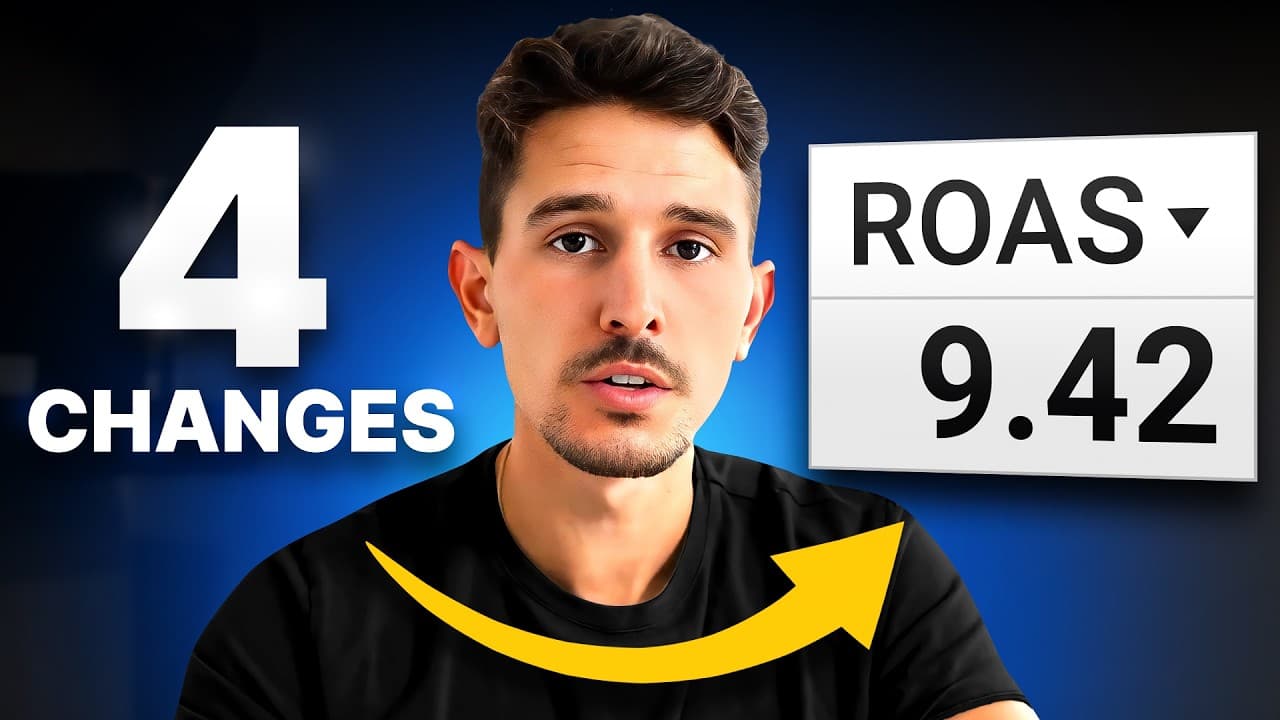
Increase your ROAS by 25% in 30 days with these 4 easy changes
TL;DR
Increase your ROAS by 25% with a simple 30-day strategy.
Transcript
if you want to increase your Facebook return on ad spend by 25% in the next 30 days while only touching your ad account four times in this 30-day period then I'm going to break down a challenge for you that is going to completely transform your return on ad spend i've driven over half a billion dollars in revenue for direct to consumer brands of al... Read More
Key Insights
- The strategy involves setting up four key campaigns: prospecting, retargeting, existing customer retention, and scaling, each with specific targets and structures.
- A core rule is to set your budget at the start and not adjust it for the entire 30-day period to maintain consistency.
- Introducing new creative content weekly is crucial for the strategy, focusing on iterations of successful ads.
- The optimization cycle involves selecting top-performing ads for scaling and cutting underperforming ones weekly.
- The scaling campaign is initially paused and only activated after identifying top-performing ads from other campaigns.
- The strategy emphasizes minimal daily adjustments, allowing business owners to focus on broader business goals.
- The process includes using data-driven decisions rather than guesswork to improve ad performance and ROAS.
- The approach is designed to be simple and repeatable, allowing continuous improvement beyond the initial 30 days.
Install to Summarize YouTube Videos and Get Transcripts
Explore YouTube Video Summarizer or Get YouTube Transcript Extractor
Questions & Answers
Q: What is the main goal of the strategy discussed in the video?
The main goal of the strategy is to increase the return on ad spend (ROAS) by 25% within 30 days. This is achieved by setting up four specific types of campaigns: prospecting, retargeting, existing customer retention, and scaling. The strategy is designed to be simple and repeatable, allowing for continuous improvement in ad performance.
Q: How does the strategy suggest handling the ad budget?
The strategy emphasizes setting a budget at the beginning of the 30-day period and not adjusting it throughout the duration. This consistency in budgeting is crucial for maintaining stable ad performance. It is recommended to start with the current budget to avoid any drastic changes that could negatively impact the return on ad spend.
Q: What role does creative content play in the strategy?
Creative content is a vital component of the strategy, with new creative iterations required every week. The focus is on creating variations of successful ads to keep the content fresh and engaging. This continuous introduction of new creative helps in maintaining audience interest and improving ad performance.
Q: What is the optimization cycle mentioned in the video?
The optimization cycle is a weekly process where top-performing ads are identified and scaled, while underperforming ads are cut. This cycle ensures that only the best ads receive the majority of the budget, optimizing the overall return on ad spend. It is a critical part of the strategy to ensure continuous improvement in ad performance.
Q: How does the strategy propose using the scaling campaign?
The scaling campaign is initially set up but paused at the start. It is only activated after identifying top-performing ads from other campaigns. This approach ensures that only the most effective ads are used in the scaling campaign, maximizing the return on ad spend by focusing on proven content.
Q: Why is minimizing daily adjustments important in this strategy?
Minimizing daily adjustments is important because it allows business owners to focus on broader business objectives rather than getting caught up in constant ad management. By limiting changes to once a week, the strategy reduces the risk of over-managing and allows for more strategic, data-driven decisions to enhance ad performance.
Q: What is the significance of using data-driven decisions in this strategy?
Data-driven decisions are crucial in this strategy because they ensure that adjustments are based on actual performance metrics rather than guesswork. This approach leads to more effective ad management, as it focuses on scaling successful ads and cutting underperforming ones based on concrete data, ultimately improving the return on ad spend.
Q: How does the strategy ensure continuous improvement beyond the initial 30 days?
The strategy is designed to be simple and repeatable, allowing for continuous improvement beyond the initial 30 days. By following the core rules and optimization cycle, business owners can maintain and enhance ad performance over time. The focus on data-driven decisions and regular creative updates ensures that the strategy remains effective in the long term.
Summary & Key Takeaways
-
The video outlines a strategy to increase Facebook ROAS by 25% in 30 days using a structured approach involving four campaigns. The focus is on maintaining a consistent budget, introducing new creative weekly, and optimizing ad performance through a clear process.
-
The strategy emphasizes setting up prospecting, retargeting, retention, and scaling campaigns with specific rules and structures. It includes a weekly optimization cycle to identify and scale top-performing ads while cutting underperforming ones.
-
The approach is designed to be simple, allowing business owners to focus on other areas while improving ad performance. It relies on data-driven decisions and minimal daily adjustments, making it suitable for continuous improvement beyond the initial 30-day period.
Read in Other Languages (beta)
Share This Summary 📚
Summarize YouTube Videos and Get Video Transcripts with 1-Click
Try YouTube Summary with ChatGPT & Claude or YouTube Transcript Generator
Explore More Summaries from Sam Piliero 📚



Summarize YouTube Videos and Get Video Transcripts with 1-Click
Try YouTube Summary with ChatGPT & Claude or YouTube Transcript Generator