How Close To The Sun Can Humanity Get?
TL;DR
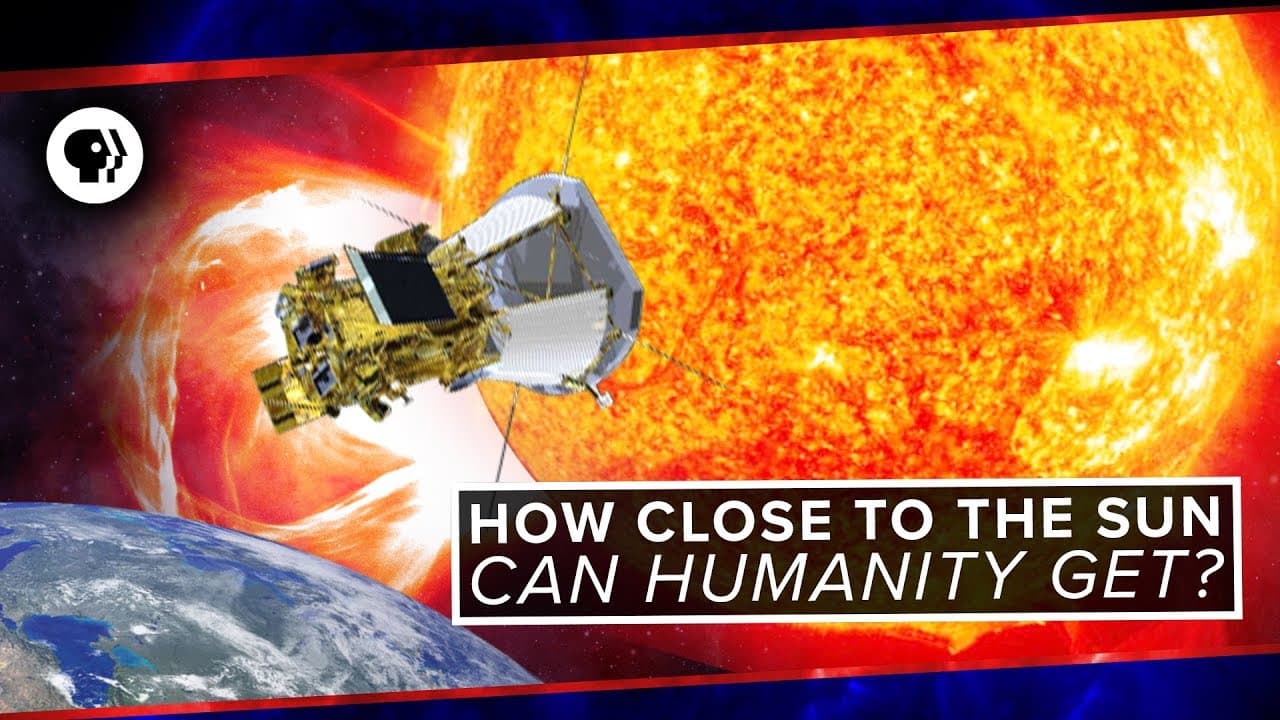
NASA's Parker Solar Probe aims to study the sun up close.
Transcript
[MUSIC PLAYING] The sun-- an entity worshiped as a god throughout time and across cultures. The source of all life and sustenance for our little blue space rock. And also, a force of unthinkable destructive power. But soon, humanity will reach out its collective hand and come closer to touching the sun than we ever have before, with the launch of t... Read More
Key Insights
- The Parker Solar Probe is set to fly closer to the sun than any previous human-made object, aiming to study its corona and solar wind.
- The sun's corona, visible only during solar eclipses, is hotter than the surface and poses a mystery that the probe aims to solve.
- Coronal mass ejections from the sun can disrupt Earth's technology, as seen in historical events like the Carrington Event of 1859.
- The Parker Solar Probe will carry four main instruments to study electromagnetic fields, solar wind particles, and capture images of the corona.
- A specially designed carbon composite heat shield will protect the probe from extreme temperatures, maintaining its instruments at safe levels.
- The probe will use Venus flybys to slow down and adjust its orbit, allowing it to approach the sun closely.
- By the end of its mission, the probe will have completed 26 close approaches to the sun, gathering crucial data.
- The mission draws parallels to the legend of Icarus but uses advanced technology to safely study the sun.
Install to Summarize YouTube Videos and Get Transcripts
Explore YouTube Video Summarizer or Get YouTube Transcript Extractor
Questions & Answers
Q: Why is the Parker Solar Probe mission significant?
The Parker Solar Probe mission is significant because it will fly closer to the sun than any previous human-made object. This proximity allows it to study the sun's corona and solar wind directly, which are crucial for understanding solar phenomena that can affect Earth's technology and environment.
Q: What challenges does the Parker Solar Probe face?
One of the main challenges the Parker Solar Probe faces is surviving the extreme temperatures near the sun. To address this, it is equipped with a specially designed carbon composite heat shield that can withstand temperatures up to 1,650 Kelvin, ensuring that the instruments remain at room temperature.
Q: How does the Parker Solar Probe approach the sun?
The Parker Solar Probe uses gravitational assists from Venus to slow down and adjust its orbit, enabling it to approach the sun closely. This method involves seven Venus flybys, which gradually reduce the probe's velocity and allow it to enter a highly elliptical orbit that brings it near the sun.
Q: What instruments are on the Parker Solar Probe?
The Parker Solar Probe carries four main instruments: the Field Experiment to study electromagnetic fields, the SWEAP to measure solar wind particles, the ISIS to capture energetic particles, and the WISPR to produce images of the solar corona. Together, these instruments provide a comprehensive understanding of the sun's environment.
Q: What historical events highlight the importance of studying the sun?
The Carrington Event of 1859 is a historical example that highlights the importance of studying the sun. This massive coronal mass ejection disrupted Earth's magnetosphere, causing widespread telegraph failures and auroras visible across the planet. A similar event today could have severe impacts on modern technology.
Q: What mysteries does the Parker Solar Probe aim to solve?
The Parker Solar Probe aims to solve mysteries such as why the sun's corona is significantly hotter than its surface and how solar wind particles are accelerated. Understanding these phenomena is crucial for predicting solar activity and protecting Earth's technological infrastructure.
Q: How does the Parker Solar Probe contribute to solar research?
The Parker Solar Probe contributes to solar research by providing unprecedented data on the sun's corona and solar wind. Its close proximity allows for detailed measurements and imaging, enhancing our understanding of solar dynamics and their effects on the solar system, including Earth.
Q: What parallels are drawn between the Parker Solar Probe and the legend of Icarus?
The Parker Solar Probe mission draws parallels to the legend of Icarus, who flew too close to the sun and perished. However, unlike Icarus, the probe is equipped with advanced technology, such as a carbon composite heat shield, to safely approach and study the sun, fulfilling a long-held human ambition.
Summary & Key Takeaways
-
The Parker Solar Probe is a NASA mission designed to study the sun's corona and solar wind by flying closer than any previous spacecraft. This mission aims to unlock mysteries about solar phenomena that can impact Earth's technology.
-
The probe is equipped with instruments to measure electromagnetic fields, solar wind particles, and capture images of the sun's corona. It uses a heat shield to withstand the sun's intense temperatures, maintaining its instruments at room temperature.
-
Parker Solar Probe's mission involves multiple Venus flybys to adjust its orbit and approach the sun closely. By the mission's end, it will have completed 26 close approaches, providing invaluable data on solar activity.
Read in Other Languages (beta)
Share This Summary 📚
Summarize YouTube Videos and Get Video Transcripts with 1-Click
Try YouTube Summary with ChatGPT & Claude or YouTube Transcript Generator
Explore More Summaries from PBS Space Time 📚




Summarize YouTube Videos and Get Video Transcripts with 1-Click
Try YouTube Summary with ChatGPT & Claude or YouTube Transcript Generator