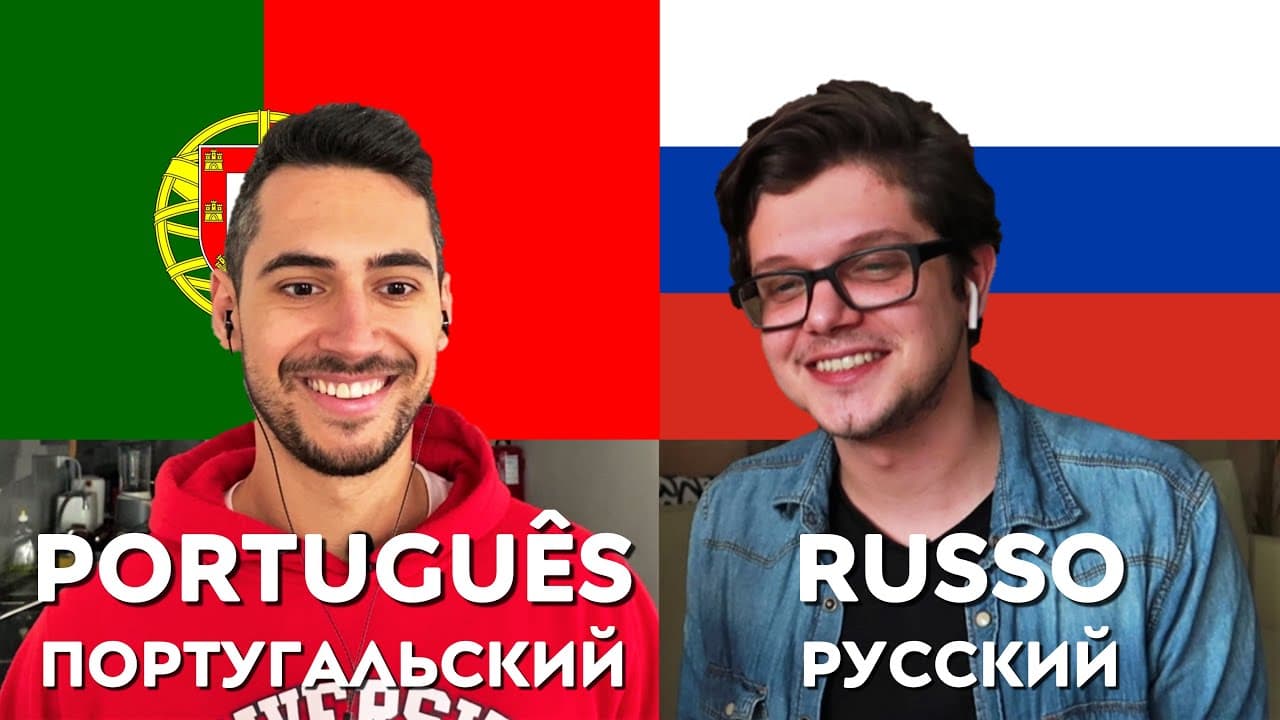
Porque é que o português e o russo se parecem?
TL;DR
Portuguese and Russian sound similar due to shared phonetic features.
Transcript
Hello everyone and welcome back to Portuguese With Leo Today I'm going to talk about a topic that I'm sure has crossed the minds of many of you the first time you heard someone speak Portuguese, especially Portuguese from Portugal: Why does it sound like we speak Russian? This is a question that puzzles many people, both foreigners who don't know... Read More
Key Insights
- Portuguese and Russian, despite being from different language families, share phonetic similarities that make them sound alike to foreigners.
- Both languages are stress-timed, meaning the intervals between stressed syllables are consistent, leading to vowel reduction.
- The phonetic sounds /ʃ/ and /ʒ/ are common in both languages, contributing to their similar auditory impression.
- Consonant clusters are prevalent in both languages due to syllable reduction, making words shorter and more compact.
- Russian and Portuguese share some Latin-derived vocabulary, though meanings can differ significantly.
- The sounds /l/ and /ʎ/ exist in both languages but not in Spanish, highlighting unique phonetic characteristics.
- Nasal sounds present a learning challenge for Russian speakers learning Portuguese, despite some nasal sounds existing in Russian.
- Vowel sounds like /ɨ/ differ between the languages, with Russian often emphasizing these sounds more strongly.
Install to Summarize YouTube Videos and Get Transcripts
Explore YouTube Video Summarizer or Get YouTube Transcript Extractor
Questions & Answers
Q: Why do Portuguese and Russian sound similar despite being different languages?
Portuguese and Russian sound similar primarily due to shared phonetic characteristics. Both are stress-timed languages, which means they have consistent intervals between stressed syllables, leading to vowel reduction. This results in a compact and consonant-heavy sound in both languages, contributing to their auditory resemblance.
Q: What role do consonant clusters play in the similarity between Portuguese and Russian?
Consonant clusters play a significant role in the similarity between Portuguese and Russian. Due to vowel reduction in stress-timed languages, both languages often have words with tightly packed consonants, making them sound similar. This phonetic feature contributes to the perception of similarity despite their different linguistic roots.
Q: How do the sounds /ʃ/ and /ʒ/ contribute to the perceived similarity?
The sounds /ʃ/ and /ʒ/ are prevalent in both Portuguese and Russian, contributing to their perceived similarity. These sounds are not as common in other Romance languages, making Portuguese stand out and sound more like a Slavic language to untrained ears. This shared phonetic feature enhances the auditory resemblance between the two languages.
Q: What challenges do Russian speakers face when learning Portuguese?
Russian speakers face several challenges when learning Portuguese, primarily due to vowel and nasal sound differences. Portuguese has more developed nasal sounds, which are less prominent in Russian. Additionally, vowel sounds like /ɨ/ are pronounced differently, often leading to difficulties in pronunciation and comprehension for Russian learners of Portuguese.
Q: How does the stress-timed nature of both languages affect their phonetics?
The stress-timed nature of both Portuguese and Russian affects their phonetics by creating consistent intervals between stressed syllables. This timing leads to vowel reduction, where unstressed vowels are shortened or dropped, resulting in a more consonant-heavy and compact speech pattern. This phonetic feature is a key reason why the languages sound similar.
Q: Are there any common vocabulary roots between Portuguese and Russian?
Yes, there are common vocabulary roots between Portuguese and Russian, primarily due to shared Latin influences. While both languages have borrowed Latin-derived words, the meanings can differ significantly. These shared roots can sometimes create a false sense of familiarity for learners, as similar-sounding words may have different meanings.
Q: What are some specific examples of similar-sounding words in both languages?
Specific examples of similar-sounding words include the Portuguese word 'chapéu' and the Russian 'шапка' (shapka), both related to headwear. Additionally, the word 'mala' in Portuguese and 'мало' (malo) in Russian sound alike but have different meanings. These examples highlight how phonetic similarities can exist despite different meanings.
Q: How do vowel sounds differ between Portuguese and Russian?
Vowel sounds differ between Portuguese and Russian in their pronunciation and emphasis. For instance, the sound /ɨ/ in Portuguese is typically unstressed and subtle, while in Russian, it can be tonic and more pronounced. This difference in vowel treatment can pose challenges for Russian speakers learning Portuguese, as they may overemphasize certain sounds.
Summary & Key Takeaways
-
Portuguese and Russian share unexpected phonetic similarities despite being from different language families. Both languages are stress-timed, leading to similar patterns of vowel reduction and consonant clusters. These features contribute to their similar sound.
-
Key phonetic sounds like /ʃ/ and /ʒ/ are common in both languages, creating an auditory resemblance. Additionally, the presence of certain consonant sounds and syllable structures further enhances the perception of similarity between Portuguese and Russian.
-
Russian and Portuguese have some vocabulary with shared Latin roots, though meanings can vary. The languages also differ in vowel pronunciation, with Russian emphasizing certain sounds more, presenting challenges for learners transitioning between the two languages.
Read in Other Languages (beta)
Share This Summary 📚
Summarize YouTube Videos and Get Video Transcripts with 1-Click
Try YouTube Summary with ChatGPT & Claude or YouTube Transcript Generator
Explore More Summaries from Portuguese With Leo 📚



Summarize YouTube Videos and Get Video Transcripts with 1-Click
Try YouTube Summary with ChatGPT & Claude or YouTube Transcript Generator