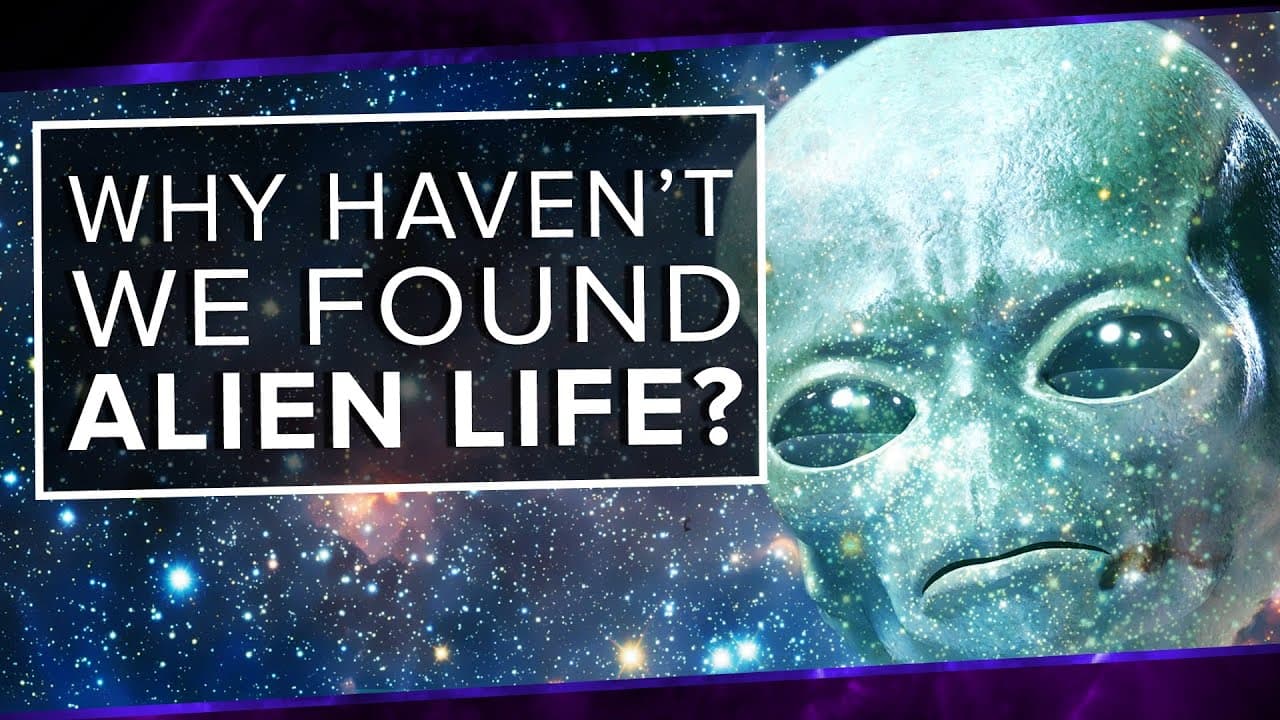
Why Haven't We Found Alien Life?
TL;DR
The universe seems ripe for life, yet we see none.
Transcript
Are we alone? Recent amazing discoveries have given us more hope than ever that our universe is full of life. So why don't we see it? [MUSIC PLAYING] Why don't we see alien civilizations? We've asked this question before here on "Space Time," and if you haven't seen that episode you should check it out. But today we'd like to go deeper because it r... Read More
Key Insights
- The Kepler Space Observatory suggests billions of Earth-like planets exist, yet we see no alien civilizations, posing the Fermi Paradox.
- The 'Great Filter' theory posits either life is rare or civilizations self-destruct before reaching advanced stages.
- Earth's rapid transition from a magma ball to a life-filled slimeball suggests life's genesis may not be the Great Filter.
- Abiogenesis or panspermia are two hypotheses for life's origin, with implications for life's abundance in the galaxy.
- Life on Earth began remarkably quickly, suggesting simple life forms might be common throughout the galaxy.
- The slow evolution of multicellular organisms suggests complexity, rather than life itself, may be the bottleneck.
- Humanity might be among the first intelligent civilizations, given Earth's early emergence in cosmic history.
- Technological life forms might still be rare, as intelligence evolution is complex and potentially random.
Install to Summarize YouTube Videos and Get Transcripts
Explore YouTube Video Summarizer or Get YouTube Transcript Extractor
Questions & Answers
Q: What is the Fermi Paradox?
The Fermi Paradox is the apparent contradiction between the high probability of extraterrestrial life and the lack of evidence or contact with such civilizations. Despite the vast number of potentially habitable planets, we see no signs of intelligent life, prompting questions about the rarity of life or the self-destruction of civilizations.
Q: How quickly did life appear on Earth?
Life appeared on Earth remarkably quickly, transitioning from a magma-covered planet to one filled with simple life forms in less than 300 million years. This rapid emergence suggests that the genesis of life might not be the limiting factor in the universe's potential for life.
Q: What are abiogenesis and panspermia?
Abiogenesis is the natural process of life arising from non-living matter, while panspermia suggests life originated elsewhere in the universe and was transported to Earth via meteorites or comets. Both theories imply that life could be common in the galaxy, given the right conditions.
Q: Why might humanity be among the first intelligent civilizations?
Humanity might be among the first intelligent civilizations because Earth emerged early in the universe's history. Only a small fraction of Earth-like planets needed a head start to produce advanced civilizations, and it's possible we are early outliers in the cosmic timeline.
Q: What is the 'Great Filter' theory?
The 'Great Filter' theory suggests there is a stage in the evolution of life that is extremely difficult to surpass, which could explain the lack of observed alien civilizations. This filter could occur at any point, from the genesis of life to the development of advanced technology, potentially leading to self-destruction.
Q: How does the evolution of multicellular organisms affect the search for life?
The evolution of multicellular organisms took billions of years, suggesting that while simple life might be common, complex life is rarer. This slow development indicates that the transition to complexity could be a significant bottleneck in the evolution of intelligent civilizations.
Q: What role does the anthropic principle play in understanding life in the universe?
The anthropic principle suggests that observers will always observe a universe capable of supporting observers. This principle highlights the selection bias in our observations, as we can only exist in a universe where life is possible, complicating assessments of life's rarity or uniqueness.
Q: What evidence suggests life might be abundant in the galaxy?
Evidence such as Earth's rapid transition to a life-filled state and the possibility of panspermia suggest life might be abundant. The discovery of biogenic carbon in ancient zircons and the potential for life on other planets further support the idea that simple life forms could be common in the galaxy.
Summary & Key Takeaways
-
The universe is filled with potentially habitable planets, yet we haven't encountered alien civilizations, posing the Fermi Paradox. Theories suggest either the rarity of life or the self-destruction of civilizations as possible explanations.
-
Earth's rapid transition from a lifeless state to a life-filled planet suggests life's genesis might not be the bottleneck. Abiogenesis or panspermia might explain the abundance of simple life forms in the galaxy.
-
Humanity may be among the first intelligent civilizations due to Earth's early emergence. The slow evolution of multicellular organisms suggests complexity, rather than life itself, might be the limiting factor.
Read in Other Languages (beta)
Share This Summary 📚
Summarize YouTube Videos and Get Video Transcripts with 1-Click
Try YouTube Summary with ChatGPT & Claude or YouTube Transcript Generator
Explore More Summaries from PBS Space Time 📚

Summarize YouTube Videos and Get Video Transcripts with 1-Click
Try YouTube Summary with ChatGPT & Claude or YouTube Transcript Generator