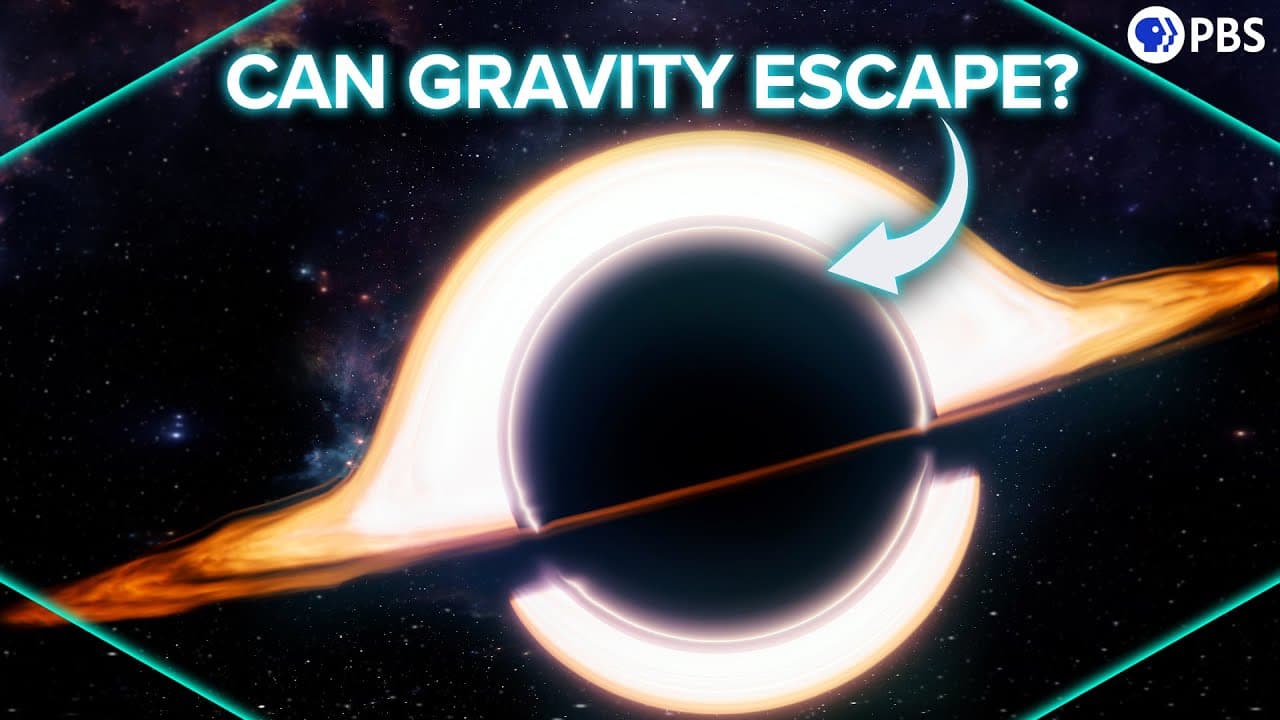
How Does Gravity Escape A Black Hole?
TL;DR
Gravity affects the universe despite black holes' event horizons.
Transcript
Fact: in a black hole, all of the mass is concentrated at the singularity at the very center Fact: every black hole singularity is surrounded by an event horizon. Nothing can escape from within the event horizon unless it can travel faster than light. Fact: gravity travels at the speed of light. So how does a black hole manage to communicate its gr... Read More
Key Insights
- Black holes are formed when mass collapses into a singularity surrounded by an event horizon, beyond which nothing can escape.
- Gravity, as per Einstein's general relativity, is not a force but the curvature of spacetime caused by mass.
- Gravitational waves, disturbances in spacetime, travel at the speed of light, confirmed by observations of neutron star collisions.
- A black hole's gravity affects the universe because the gravitational field exists independently of the mass causing it.
- In quantum gravity theories, gravity might be mediated by particles called gravitons, which are not restricted by the event horizon.
- Virtual particles, which mediate forces in quantum fields, do not travel in a defined path and are not limited by the speed of light.
- The mass of a black hole can still be 'seen' as it appears frozen at the event horizon due to relativistic effects.
- The concept of mass in general relativity is complex, as the gravitational field itself contributes to mass, affecting how it's perceived.
Install to Summarize YouTube Videos and Get Transcripts
Explore YouTube Video Summarizer or Get YouTube Transcript Extractor
Questions & Answers
Q: How does Einstein's theory of general relativity describe gravity?
Einstein's general relativity describes gravity not as a traditional force, but as the curvature of spacetime caused by mass. This theory predicts that massive objects like black holes can warp the fabric of space and time, influencing the motion of other objects and the propagation of light, explaining gravitational phenomena without the need for a force acting at a distance.
Q: What role do gravitational waves play in confirming the speed of gravity?
Gravitational waves are ripples in spacetime caused by certain types of motion, such as colliding neutron stars. These waves travel at the speed of light, a prediction of general relativity. Their detection, arriving simultaneously with electromagnetic signals from the same events, confirms that gravitational influences propagate at light speed, supporting Einstein's theory.
Q: Why doesn't a black hole's event horizon prevent its gravity from affecting the universe?
In general relativity, the gravitational field exists independently of the mass that causes it, meaning a black hole's gravity doesn't need to escape the event horizon to affect the universe. The curvature of spacetime around a black hole influences its surroundings, allowing its gravitational effects to be felt even though the mass is hidden.
Q: How do virtual particles relate to the concept of gravity in quantum field theory?
In quantum field theory, forces are mediated by virtual particles, like virtual photons for electromagnetism. Similarly, gravity could be mediated by virtual gravitons. These particles don't travel in a defined path and are not restricted by the speed of light, meaning they can influence gravitational fields without needing to escape a black hole's event horizon.
Q: Can the mass of a black hole be observed, and how does it affect its gravitational influence?
The mass of a black hole can be observed in terms of its past mass, as it appears frozen at the event horizon due to relativistic effects. This past mass continues to exert gravitational influence, allowing the effects of a black hole's mass to be felt despite being hidden from direct observation.
Q: What is the relationship between mass and the gravitational field in general relativity?
In general relativity, the gravitational field itself has energy and contributes to the mass of an object. This makes the concept of mass complex, as the gravitational field influences how mass is perceived. The mass of a black hole, for example, is not localized but distributed across the gravitational field, affecting the universe at large.
Q: How does the concept of virtual particles challenge the idea of information transmission across an event horizon?
Virtual particles, which mediate forces in quantum field theory, are not restricted by the speed of light and don't follow defined paths. This means they can mediate gravitational forces without needing to cross an event horizon, challenging the notion that information can't be transmitted from within a black hole.
Q: How does the video address the possibility of black holes possessing electric charge?
The video explains that a black hole can possess electric charge because the electromagnetic field around it grows when it swallows charge. Observers have causal contact with the past charge that fell into the black hole, allowing the electromagnetic influence to be exerted on the surrounding universe, similar to how gravitational effects are felt.
Summary & Key Takeaways
-
The video explores the nature of gravity in black holes, explaining how gravity influences the universe despite the event horizon. It discusses Einstein's general relativity, which describes gravity as the curvature of spacetime rather than a force.
-
It delves into the speed of gravity, confirmed by gravitational waves traveling at light speed, and explains how black holes' gravity affects the universe despite their event horizons. The video also explores quantum gravity theories and the role of virtual particles.
-
Virtual gravitons, in quantum gravity theories, can mediate gravitational forces without being restricted by the event horizon. The video clarifies misconceptions about virtual particles and discusses how a black hole's mass is perceived from the universe's perspective.
Read in Other Languages (beta)
Share This Summary 📚
Summarize YouTube Videos and Get Video Transcripts with 1-Click
Try YouTube Summary with ChatGPT & Claude or YouTube Transcript Generator
Explore More Summaries from PBS Space Time 📚
Summarize YouTube Videos and Get Video Transcripts with 1-Click
Try YouTube Summary with ChatGPT & Claude or YouTube Transcript Generator