How Noise-Canceling Headphones Create Silence in Microseconds | WSJ Tech Behind
TL;DR
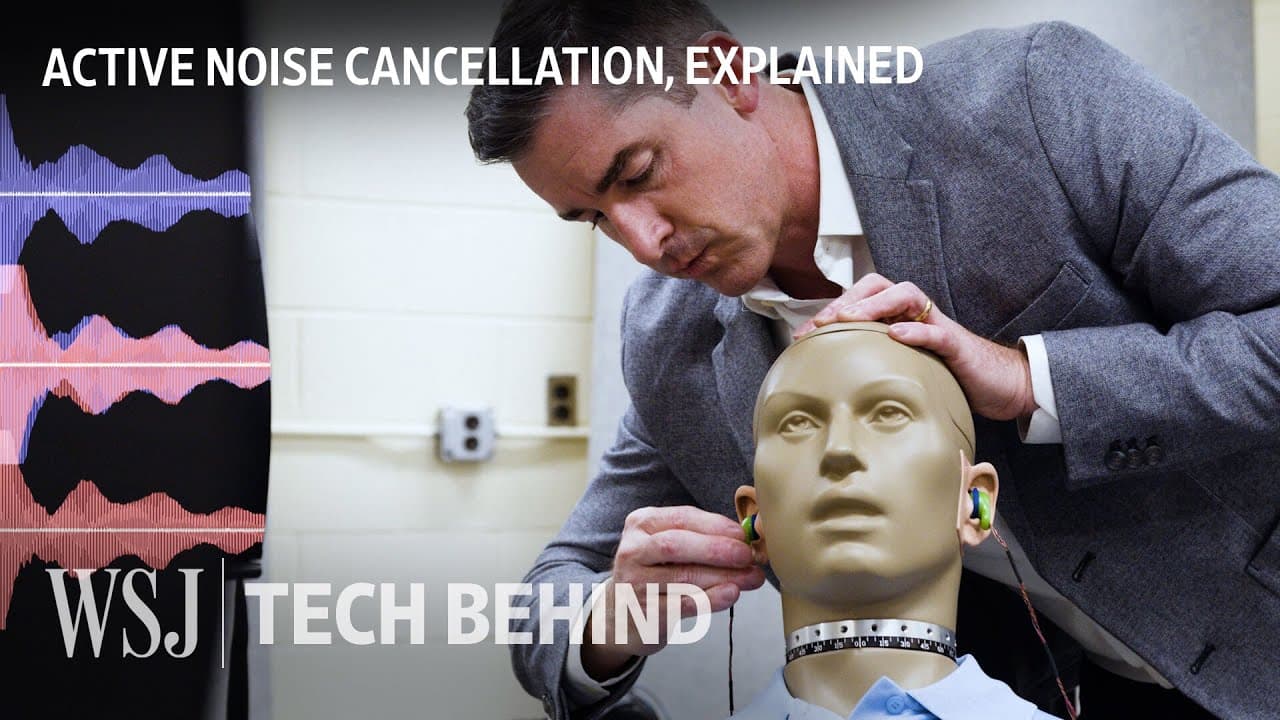
Noise-canceling headphones use technology to produce an inverse sound wave that cancels out the incoming noise, resulting in silence.
Transcript
(sound waves vibrating) - [Narrator] Here's a sound wave. And here's its inverse. (sound wave beeping) Combine them and you have silence. (upbeat music) That's the basic idea behind noise-canceling headphones. But it takes a lot of technology to make that seemingly simple science possible. - We have 15 millionths of a second to measure the noise, r... Read More
Key Insights
- 👋 Noise-canceling headphones operate through the principle of destructive interference, where an equal and opposite sound wave cancels out incoming noise.
- ✈️ Bose pioneered noise-cancellation technology for headphones, initially focusing on reducing noise on airplanes.
- 🔇 Active noise-canceling headphones require components like microphones, a signal processor, and a speaker to accurately cancel out background noise.
- 😂 Noise-canceling algorithms can be personalized for users based on their individual ear shapes and preferences.
- 🖐️ Noise is not always undesirable, as it plays a critical role in our brain's perception and body's functioning.
- 😀 Current noise-canceling algorithms excel at canceling predictable or stationary sounds but face challenges with non-stationary noises.
- 🥰 Some noise-canceling headphones offer transparency modes, allowing users to hear their surroundings and maintain awareness.
Install to Summarize YouTube Videos and Get Transcripts
Explore YouTube Video Summarizer or Get YouTube Transcript Extractor
Questions & Answers
Q: How do noise-canceling headphones cancel out sound waves?
Noise-canceling headphones produce an inverse sound wave that cancels out the incoming sound wave through the process of destructive interference. When the two waves are combined, they result in silence.
Q: How did Bose contribute to the development of noise-canceling technology?
Bose was the first company to develop noise-cancellation technology for headphones. Dr. Bose was inspired by the noisy environment on airplanes and wanted to find a way to control noise. The company developed prototypes for pilots in 1986.
Q: How does active noise cancellation in headphones work?
Active noise cancellation in headphones involves components such as outer and inner microphones, a digital signal processor, and a speaker. The outer microphone tracks incoming noise, while the inner microphone monitors sound waves inside the ear. The processor computes algorithms based on the microphone data, and the speaker cancels out the background noise while playing the desired sound.
Q: Can noise-canceling algorithms be personalized for different users?
Yes, noise-canceling algorithms can be personalized for different users. For example, Bose plays a welcome chime and monitors feedback from the internal microphone to customize the noise-canceling filters accordingly. This requires extensive testing to ensure effectiveness in various environments.
Key Insights:
- Noise-canceling headphones operate through the principle of destructive interference, where an equal and opposite sound wave cancels out incoming noise.
- Bose pioneered noise-cancellation technology for headphones, initially focusing on reducing noise on airplanes.
- Active noise-canceling headphones require components like microphones, a signal processor, and a speaker to accurately cancel out background noise.
- Noise-canceling algorithms can be personalized for users based on their individual ear shapes and preferences.
- Noise is not always undesirable, as it plays a critical role in our brain's perception and body's functioning.
- Current noise-canceling algorithms excel at canceling predictable or stationary sounds but face challenges with non-stationary noises.
- Some noise-canceling headphones offer transparency modes, allowing users to hear their surroundings and maintain awareness.
- Future developments in noise-cancellation technology involve using machine learning to intelligently eliminate unwanted sounds or voices across various contexts.
Summary & Key Takeaways
-
Noise-canceling headphones work by generating an equal and opposite wave to cancel out the incoming sound wave.
-
Bose was the first company to develop noise-cancellation technology for headphones, starting with prototypes for pilots in 1986.
-
Active noise cancellation requires components such as microphones, a digital signal processor, and a speaker to cancel out background noise while playing desired sounds.
Read in Other Languages (beta)
Share This Summary 📚
Summarize YouTube Videos and Get Video Transcripts with 1-Click
Try YouTube Summary with ChatGPT & Claude or YouTube Transcript Generator
Explore More Summaries from The Wall Street Journal 📚





Summarize YouTube Videos and Get Video Transcripts with 1-Click
Try YouTube Summary with ChatGPT & Claude or YouTube Transcript Generator