How Are Myths Analyzed and Interpreted?
TL;DR
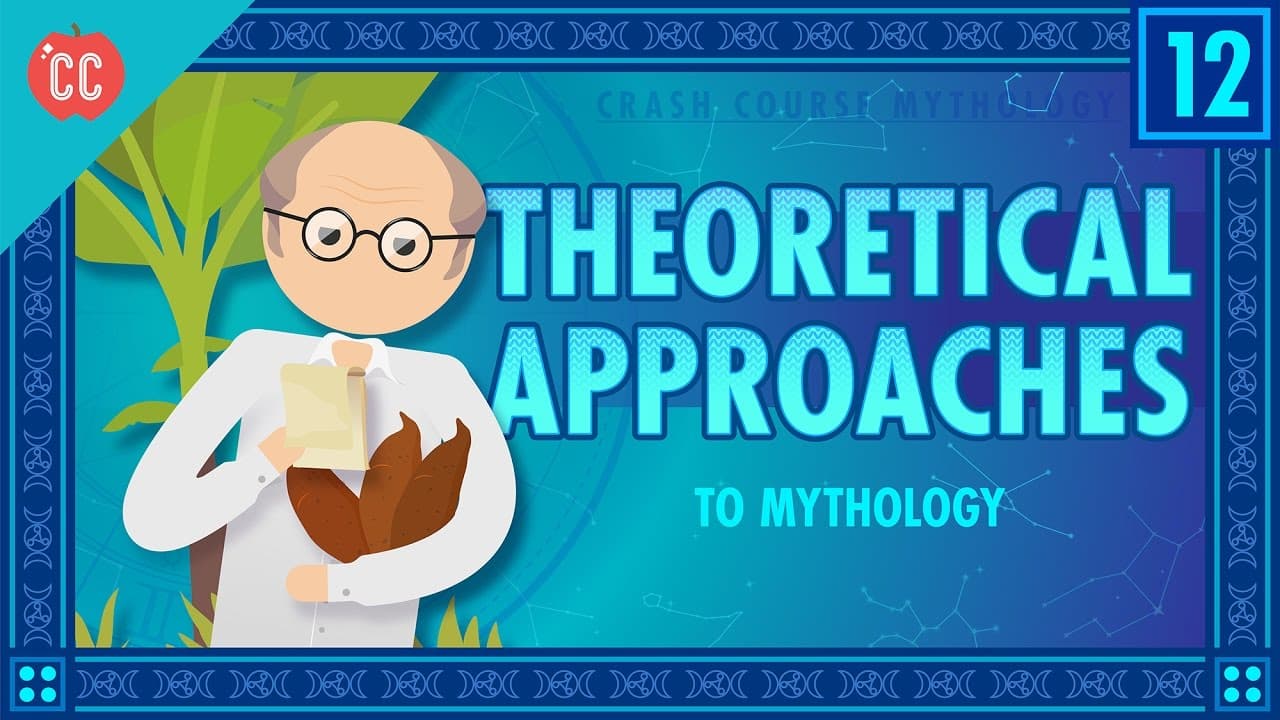
Myths have been studied through various lenses over centuries, from ancient Greek philosophers to modern anthropologists and psychologists. Theories range from myths as primitive science to psychological projections of the unconscious. Each approach provides unique insights into the cultural and psychological functions of myths.
Transcript
Hey there, I'm Mike Rugnetta This is Crash Course mythology, and in the first episode of this series, we defined what we mean by myth. I also said that we weren't gonna get too theoretical because the theory of mythology gets complicated quickly-- but you all have asked for an episode on theories of mythology; ...and if you know me, and the other t... Read More
Key Insights
- Mythology is the systematic study of myths, distinct from myths themselves.
- Ancient Greek philosophers like Plato viewed myths as irrational and false, yet serving a rational purpose.
- Euhemerism interprets myths as primitive explanations or distorted historical accounts.
- The 18th and 19th centuries saw a rise in comparative mythology due to linguistic discoveries.
- 20th-century anthropology emphasized fieldwork to understand myths in living societies.
- Freud and Jung viewed myths as projections of the unconscious, differing on individual versus collective unconscious.
- Joseph Campbell's monomyth theory suggests a single underlying pattern in all myths.
- Contemporary approaches focus on diverse methods, including social, psychological, and political analyses.
Install to Summarize YouTube Videos and Get Transcripts
Explore YouTube Video Summarizer or Get YouTube Transcript Extractor
Questions & Answers
Q: How are myths studied in modern anthropology?
Modern anthropology studies myths by conducting fieldwork to observe how they function in living societies. This approach, pioneered by figures like Bronisław Malinowski, emphasizes understanding myths as direct expressions of cultural beliefs and practices, rather than symbolic representations. This method acknowledges the complexity of myths and their roles in safeguarding morality, enhancing beliefs, and guiding rituals.
Q: What is Euhemerism in mythological studies?
Euhemerism is a theory in mythological studies that interprets myths as primitive explanations of the natural world or as distorted historical accounts of past events. Named after Euhemeros, who suggested that gods were once humans whose deeds became legendary, this theory views myths as evolving from real historical figures and events, eventually transforming into divine narratives.
Q: How did Freud and Jung differ in their views on myths?
Freud and Jung both saw myths as projections of the unconscious, but differed in their interpretations. Freud believed myths were strategies for managing internal conflicts and making the unconscious palatable to the conscious mind. Jung, on the other hand, viewed myths as expressions of the collective unconscious, shared across humanity, with archetypal characters reflecting universal aspects of the human psyche.
Q: What is the monomyth theory proposed by Joseph Campbell?
The monomyth theory, proposed by Joseph Campbell, suggests that all mythical stories share a fundamental structure, known as the hero's journey. This theory posits that myths across cultures follow a similar pattern of departure, initiation, and return, reflecting universal human experiences and the individual's quest for identity and purpose. Campbell's ideas have influenced storytelling in literature and film.
Q: What role did structuralism play in mythological studies?
Structuralism, introduced by Claude Levi-Strauss, played a significant role in mythological studies by analyzing myths through their underlying structures. It posits that myths, like other cultural phenomena, are built on binary oppositions such as male/female and hero/villain. This approach aimed to uncover the universal structures underlying cultural expressions, though it faced criticism for oversimplifying the complexity of myths.
Q: How did early Christian thinkers view Greek and Roman myths?
Early Christian thinkers, influenced by Platonic ideas, viewed Greek and Roman myths as falsehoods. They believed these myths were influenced by demons to prepare people for the story of Jesus and to contrast with pagan gods. This perspective established a dichotomy between 'mythos' and 'logos,' associating myths with falsehood and Christian teachings with transcendent truth.
Q: What impact did the discovery of Proto-Indo-European languages have on myth studies?
The discovery of Proto-Indo-European languages in the 18th and 19th centuries had a significant impact on myth studies, leading to the development of comparative mythology. This linguistic breakthrough suggested a common origin for European, Indian, and Southwest-Asian myths, prompting scholars to explore similarities in myths and propose theories about shared cultural and historical roots.
Q: How do contemporary mythologists approach the study of myths?
Contemporary mythologists approach the study of myths with diverse methodologies, incorporating social, psychological, literary, and political analyses. Figures like William Doty and Wendy Doniger advocate for eclectic approaches, encouraging the examination of myths' contexts and functions. This modern perspective recognizes the complexity of myths and their role in reflecting and shaping cultural and individual experiences.
Summary & Key Takeaways
-
Myths have been analyzed through various theories, from Plato's view of myths as falsehoods to Euhemerism's interpretation of myths as primitive explanations. Over time, anthropology and psychology have contributed to understanding myths' roles in societies, with figures like Freud, Jung, and Campbell offering insights into their psychological and cultural significance.
-
The study of myths evolved with the discovery of Proto-Indo-European languages, leading to comparative mythology. Structuralism, proposed by Claude Levi-Strauss, suggested myths are built on cultural binaries. Contemporary scholars like William Doty and Wendy Doniger advocate for eclectic approaches, examining myths through multiple lenses.
-
Modern mythological studies incorporate diverse perspectives, including anthropology, psychology, and structuralism, to understand myths' functions and meanings. While early theories often viewed myths as primitive or false, contemporary approaches recognize their complexity and cultural significance, exploring how they reflect and shape human experiences.
Read in Other Languages (beta)
Share This Summary 📚
Summarize YouTube Videos and Get Video Transcripts with 1-Click
Try YouTube Summary with ChatGPT & Claude or YouTube Transcript Generator
Explore More Summaries from CrashCourse 📚




Summarize YouTube Videos and Get Video Transcripts with 1-Click
Try YouTube Summary with ChatGPT & Claude or YouTube Transcript Generator