7 Cascaded HV Transformers
TL;DR
Cascaded transformers generate high voltage efficiently using a series connection.
Transcript
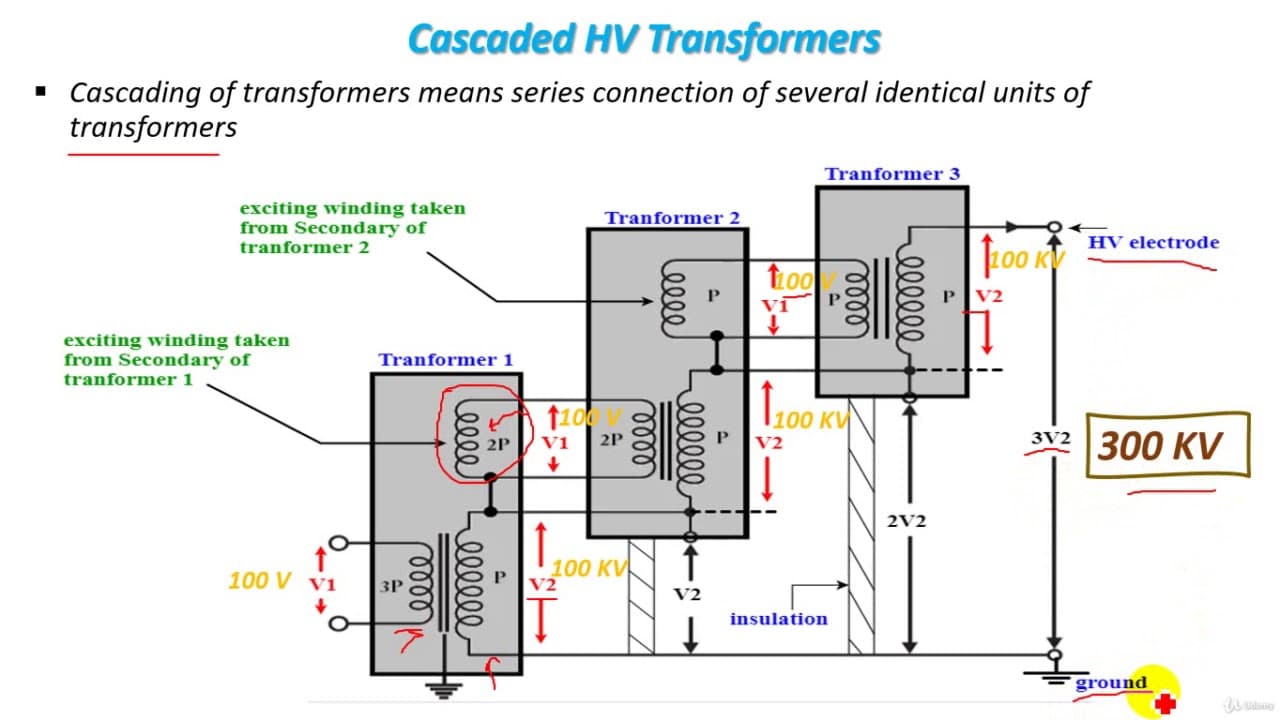
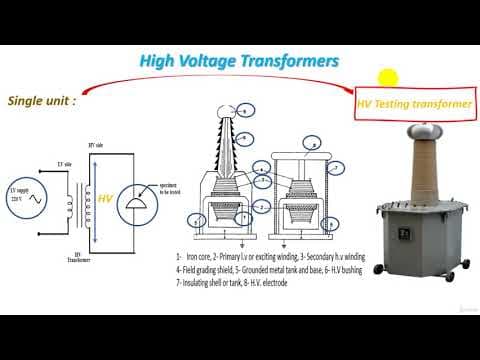
hello guys this lecture will be about understanding the operation of cascaded high voltage transformer for producing high voltage ec greater than 300 kilovolt as explained before single unit high voltage transformer can be used to reduce voltage greater than 300 kilovolt due to insulation problems and erection problems so we use cascaded high volta... Read More
Key Insights
- Cascaded high voltage transformers are used to generate voltages greater than 300 kilovolts by connecting multiple transformers in series, overcoming insulation and erection issues present in single-unit transformers.
- The primary and secondary windings of each transformer in the cascade have specific roles, with the exciting winding transferring voltage to the next transformer in the series, ensuring consistent voltage multiplication.
- The output voltage of a cascaded transformer system is the sum of the secondary voltages of each transformer, allowing for a final output that is significantly higher than the input voltage.
- Insulation is critical in cascaded transformer systems, as each transformer is subjected to different voltage levels, necessitating appropriate insulation to prevent electrical breakdown.
- The second and third transformers in the cascade require insulation to withstand higher voltages, with the third transformer needing the most robust insulation due to its higher voltage exposure.
- Cascaded transformers offer advantages such as the generation of very high AC voltages, flexibility, and reduced size and weight of individual units, making them efficient for specific high-voltage applications.
- A key disadvantage of cascaded transformers is the heavy loading on the primary windings of lower-stage transformers, leading to higher voltage drops and limiting the number of units that can be effectively used.
- The optimal number of cascaded transformer units is three, balancing the benefits of high voltage generation with manageable voltage drop and loading issues.
Install to Summarize YouTube Videos and Get Transcripts
Explore YouTube Video Summarizer or Get YouTube Transcript Extractor
Questions & Answers
Q: How do cascaded high voltage transformers work?
Cascaded high voltage transformers work by connecting multiple identical transformers in series. Each transformer has primary, secondary, and exciting windings. The exciting winding transfers voltage to the next transformer, allowing the system to multiply the input voltage and achieve a significantly higher output voltage. This configuration overcomes the insulation and erection challenges faced by single-unit transformers.
Q: What is the purpose of the exciting winding in cascaded transformers?
The exciting winding in cascaded transformers serves to transfer voltage from one transformer to the next in the series. It has the same number of turns as the primary winding, ensuring that the voltage applied to it is consistent with the primary voltage. This transfer is crucial for maintaining the voltage multiplication effect across the cascade, resulting in a high final output voltage.
Q: Why is insulation important in cascaded transformer systems?
Insulation is crucial in cascaded transformer systems because each transformer is subjected to different voltage levels. Proper insulation prevents electrical breakdown and ensures safe operation. The second and third transformers in the cascade require stronger insulation, with the third needing the most robust insulation due to its exposure to the highest voltage, thus preventing potential electrical hazards.
Q: What are the advantages of using cascaded high voltage transformers?
Cascaded high voltage transformers offer several advantages, including the ability to generate very high AC voltages greater than 300 kilovolts. They provide flexibility and allow for the reduction in size and weight of individual transformer units. This makes them suitable for specific high-voltage applications where space and weight constraints are considerations.
Q: What is a disadvantage of cascaded transformers?
A notable disadvantage of cascaded transformers is the heavy loading on the primary windings of lower-stage transformers. This loading results in higher voltage drops across the system, limiting the number of transformer units that can be practically used. Consequently, the optimal number of units is typically three to balance the benefits with manageable voltage drop and loading issues.
Q: How is the output voltage of a cascaded transformer system determined?
The output voltage of a cascaded transformer system is determined by summing the secondary voltages of each transformer in the series. In a system with three transformers, each with a secondary voltage of 100 kilovolts, the final output voltage would be 300 kilovolts. This cumulative effect allows for the generation of high voltages efficiently.
Q: What is the optimal number of units in a cascaded transformer system?
The optimal number of units in a cascaded transformer system is typically three. This number balances the advantages of high voltage generation with the limitations imposed by voltage drop and loading issues on the primary windings of lower-stage transformers. Using more than three units can lead to excessive voltage drops, reducing the system's efficiency.
Q: What role does the primary winding play in cascaded transformers?
In cascaded transformers, the primary winding is responsible for receiving the input voltage, which is then transferred to the secondary winding to produce a higher voltage. The primary winding of each transformer is also connected to the exciting winding of the previous transformer, facilitating the voltage transfer and multiplication process across the cascade.
Summary & Key Takeaways
-
Cascaded high voltage transformers are designed to generate voltages greater than 300 kilovolts by connecting multiple identical transformers in series. This configuration addresses insulation and erection challenges that single-unit transformers face at such high voltages, ensuring efficient operation and high voltage output.
-
In a cascaded transformer setup, the primary and secondary windings of each transformer play crucial roles in voltage multiplication. The exciting winding transfers voltage between transformers, allowing the output voltage to be the sum of all secondary voltages, achieving high voltage levels efficiently.
-
Insulation is vital in cascaded transformer systems, as each transformer experiences different voltage levels. The second and third transformers require stronger insulation to handle higher voltages, with the third transformer needing the most robust insulation due to its exposure to the highest voltage.
Read in Other Languages (beta)
Share This Summary 📚
Summarize YouTube Videos and Get Video Transcripts with 1-Click
Try YouTube Summary with ChatGPT & Claude or YouTube Transcript Generator
Explore More Summaries from HVdesc 📚
Summarize YouTube Videos and Get Video Transcripts with 1-Click
Try YouTube Summary with ChatGPT & Claude or YouTube Transcript Generator