Space DOES NOT Expand Everywhere
TL;DR
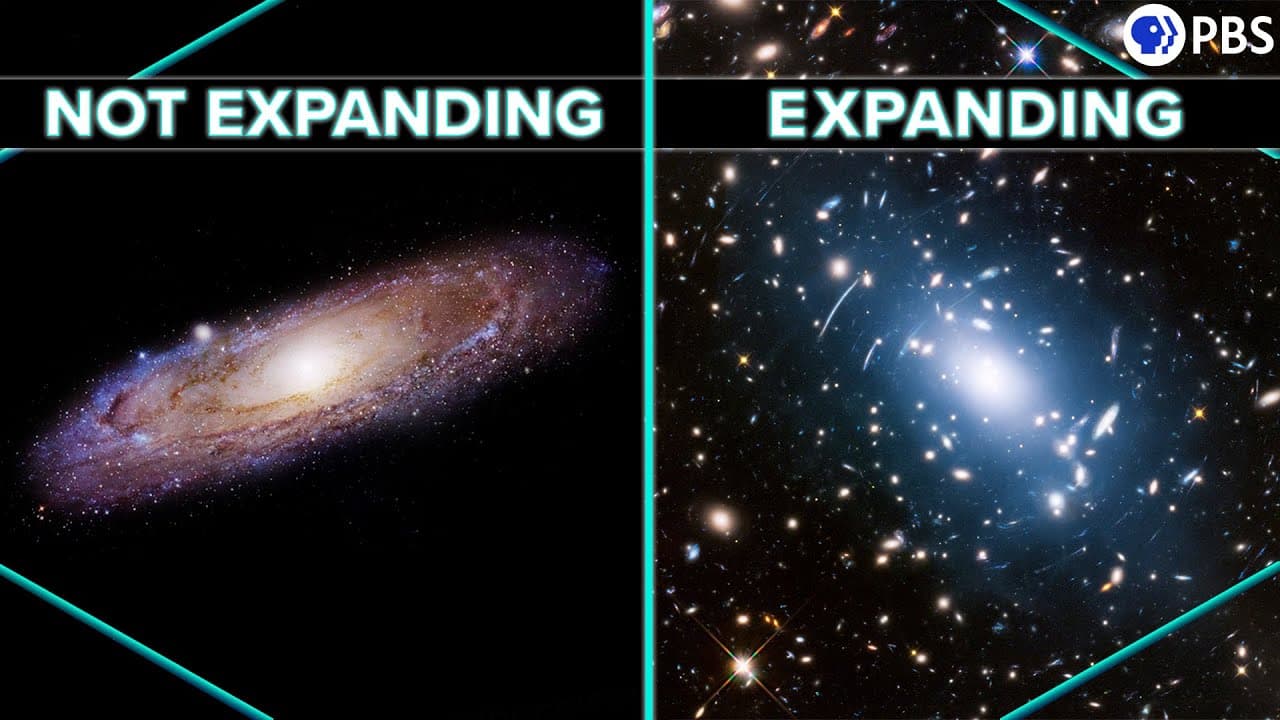
Space expands on large scales, but not within galaxies.
Transcript
Space is big, and it’s getting bigger. But where does all that new space actually come from? And is it popping into existence all around you right now? Is that why the remote control is always further away than I thought? Nearly a hundred years ago, a collection of observations and theoretical ideas came together to reveal the universe is expanding... Read More
Key Insights
- The universe is expanding, but this expansion doesn't affect gravitationally bound systems like galaxies and solar systems.
- The FLRW metric describes the universe's geometry, assuming homogeneity and isotropy on large scales.
- Space expansion is often visualized using a balloon analogy, where galaxies move apart as the balloon inflates.
- Locally, the gravitational pull within galaxies prevents space from expanding, as described by the Schwarzschild metric.
- The concept of space expanding involves an increase in the scale factor, but not a stretching of space like rubber.
- The universe's expansion is infinite, enabled by the infinite divisibility of space in general relativity.
- Dark energy's density remains constant as space expands, increasing its total content in the universe.
- Quantum mechanics and general relativity conflict at small scales, posing challenges in understanding space's fabric.
Install to Summarize YouTube Videos and Get Transcripts
Explore YouTube Video Summarizer or Get YouTube Transcript Extractor
Questions & Answers
Q: Why doesn't space expand within galaxies?
Space doesn't expand within galaxies because they are gravitationally bound systems. The gravitational pull within these systems is strong enough to counteract the effects of cosmic expansion. This is described by the Schwarzschild metric, which shows that space around massive objects is static and inwardly pinched, preventing expansion.
Q: What is the FLRW metric?
The FLRW metric is a solution to Einstein's general relativity equations that describes the large-scale structure of the universe. It assumes that the universe is homogeneous and isotropic, meaning it looks the same in all directions and matter is evenly distributed. This metric helps explain the universe's expansion by using a scale factor that changes over time.
Q: How is cosmic expansion visualized?
Cosmic expansion is often visualized using a balloon analogy, where galaxies are glued to a balloon's surface. As the balloon inflates, the galaxies move apart, illustrating the expansion of space. However, this analogy has limitations, as it suggests space stretches like rubber, which isn't accurate. Instead, space expands by increasing the scale factor.
Q: What role does dark energy play in cosmic expansion?
Dark energy is a form of energy that permeates space, contributing to the universe's accelerated expansion. Its density remains constant as space expands, meaning the total amount of dark energy increases with the universe's growth. This expansion is significant on large scales but doesn't affect gravitationally bound systems like galaxies.
Q: How does space's infinite divisibility relate to expansion?
Space's infinite divisibility, as described in general relativity, allows for the universe's continuous expansion. It means space can be divided into infinitely smaller parts, enabling the scale factor to increase without changing space's fundamental nature. This concept supports the idea that the universe can expand indefinitely.
Q: What is the balloon analogy's limitation?
The balloon analogy is limited because it suggests that space stretches like rubber, which isn't the case. In reality, space doesn't thin out or build tension as it expands. Instead, new space is created, maintaining the same level of stretch, akin to adding more rubber as the balloon inflates.
Q: How do quantum mechanics and general relativity conflict?
Quantum mechanics and general relativity conflict at small scales, where space is thought to be quantized. General relativity assumes space is infinitely divisible, but quantum mechanics introduces a smallest measurable length, the Planck length. This discrepancy poses challenges in understanding the fabric of space and requires a unified theory of quantum gravity.
Q: What is the transplanckian problem?
The transplanckian problem involves understanding how Hawking radiation emerges from sub-Planck-wavelength radiation at a black hole's event horizon. It highlights the challenges in reconciling quantum mechanics with general relativity at small scales, as space is thought to be quantized. This problem is related to the holographic principle and remains an area of active research.
Summary & Key Takeaways
-
The universe is expanding, a phenomenon first observed nearly a century ago. This expansion is described by the FLRW metric, which assumes a homogeneous and isotropic universe. However, within gravitationally bound systems like galaxies, space doesn't expand due to the strong gravitational pull.
-
The balloon analogy helps visualize cosmic expansion, where galaxies move apart as the balloon inflates. However, this analogy is limited, as space doesn't stretch like rubber. Instead, space expands by increasing the scale factor, keeping the fundamental nature of space unchanged.
-
Dark energy contributes to the universe's expansion, with its density remaining constant as space expands. This results in an increase in dark energy content as the universe grows. The infinite scalability of space suggests the universe can expand indefinitely without affecting gravitationally bound systems.
Read in Other Languages (beta)
Share This Summary 📚
Summarize YouTube Videos and Get Video Transcripts with 1-Click
Try YouTube Summary with ChatGPT & Claude or YouTube Transcript Generator
Explore More Summaries from PBS Space Time 📚

Summarize YouTube Videos and Get Video Transcripts with 1-Click
Try YouTube Summary with ChatGPT & Claude or YouTube Transcript Generator