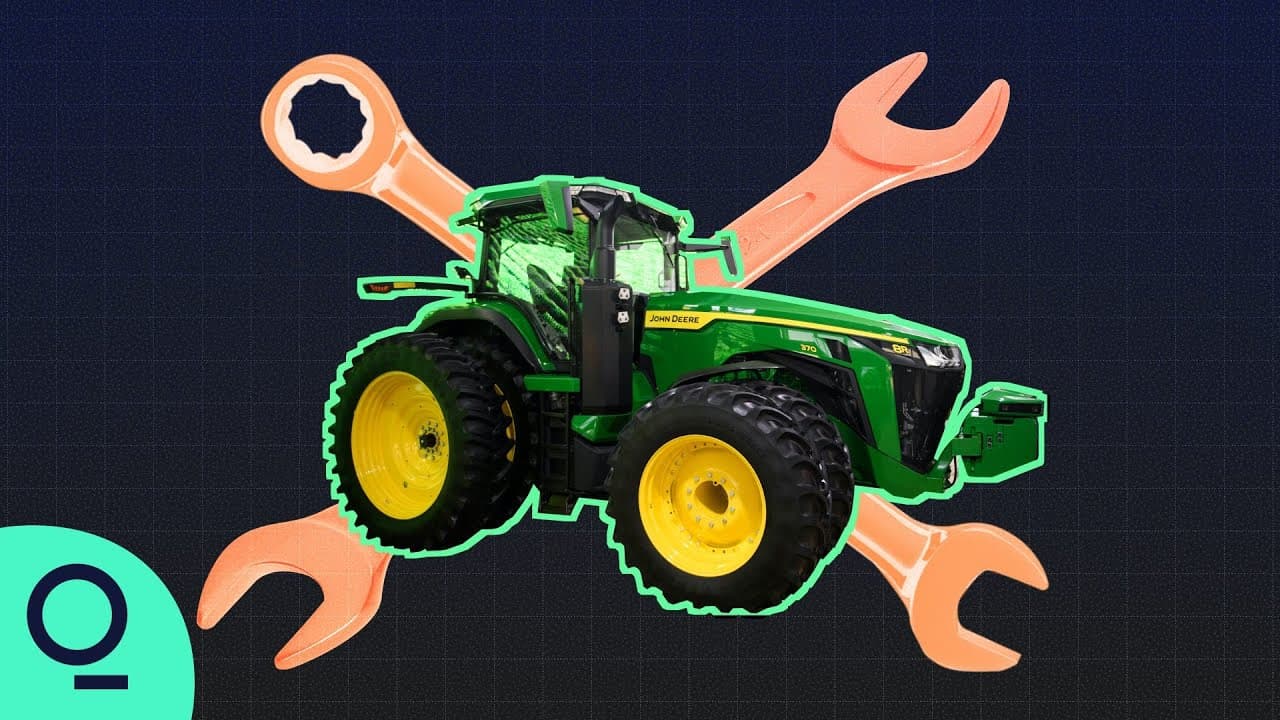
Why Are Farmers Revolting Against John Deere?
TL;DR
Farmers are challenging John Deere over repair restrictions on advanced equipment, arguing it limits their ability to fix machinery themselves. Despite record profits and resolving a union strike, Deere faces legal battles over right-to-repair issues. The outcome could significantly impact Deere's revenue from parts and services, which are more profitable than equipment sales.
Transcript
Farming in America could not exist without John Deere. I don't care where you are, in the rural parts of America, there's farmland, and you're inevitably going to see green tractors. Specifically in the Midwest where people who've had Deere machines for generations say that their family bleed green, it's really to that extent. But John Deere's trac... Read More
Key Insights
- John Deere's profits reached record levels in 2021, driven by increased demand during the pandemic.
- Farmers are frustrated with John Deere's restrictions on repairing their own equipment, leading to legal disputes.
- John Deere's equipment has become highly computerized, complicating repairs and requiring specialized diagnostics.
- The right-to-repair movement seeks to allow farmers to access necessary tools and information to fix their machinery.
- John Deere's repair policies are under scrutiny for potential antitrust violations, impacting their parts and services revenue.
- Farmers argue that the inability to repair equipment independently affects their operational efficiency and costs.
- The right-to-repair issue mirrors past automotive industry regulations that enabled third-party repairs.
- Some farmers resort to gray market solutions to bypass repair restrictions, highlighting the urgency for policy change.
Install to Summarize YouTube Videos and Get Transcripts
Explore YouTube Video Summarizer or Get YouTube Transcript Extractor
Questions & Answers
Q: Why are farmers upset with John Deere?
Farmers are upset with John Deere due to restrictions on repairing their own equipment. These restrictions require farmers to rely on licensed mechanics for repairs, which can be costly and time-consuming. The inability to independently fix machinery affects their operational efficiency and increases downtime, prompting calls for right-to-repair legislation.
Q: What is the right-to-repair movement?
The right-to-repair movement advocates for consumers' ability to repair and modify their own products, including agricultural machinery. It seeks to provide access to necessary tools, parts, and information, allowing independent repairs. This movement challenges manufacturers like John Deere, who restrict access to proprietary software and diagnostics, impacting farmers' autonomy.
Q: How has John Deere's equipment changed over time?
John Deere's equipment has evolved from simple mechanical systems to highly computerized machinery. Modern tractors and combines use advanced technology, including GNSS satellite guidance and digital information systems. This shift has increased productivity but also complicated repairs, as specialized diagnostic tools and software access are required to fix issues.
Q: What financial impact could right-to-repair laws have on John Deere?
Right-to-repair laws could significantly impact John Deere's financials by opening up the parts and services market to competition. Currently, parts and services are more profitable than equipment sales, and Deere's control over repairs ensures a steady revenue stream. Allowing independent repairs could reduce this income, affecting the company's overall profitability.
Q: How did John Deere resolve the union strike?
John Deere resolved the union strike by negotiating a new contract with the United Auto Workers, doubling raises and improving pensions for union members. This agreement came after Deere workers protested against the company's record profits and the CEO's significant pay raise, demanding a fairer share of the financial gains.
Q: What are the arguments against allowing farmers to repair their own equipment?
Opponents of allowing farmers to repair their own equipment argue that it could compromise safety and violate proprietary software agreements. John Deere claims that agricultural machinery is similar to aviation, where unauthorized modifications could pose risks. They emphasize the importance of controlled repairs to ensure safety and maintain equipment integrity.
Q: How are some farmers bypassing John Deere's repair restrictions?
Some farmers are bypassing John Deere's repair restrictions by purchasing diagnostic software and tools from gray markets, such as those in Hong Kong. These unofficial channels provide access to proprietary systems, allowing farmers to perform their own repairs despite the company's restrictions. This workaround highlights the urgency for right-to-repair solutions.
Q: What precedent exists for right-to-repair laws in other industries?
A precedent for right-to-repair laws exists in the automotive industry. In 2012, Massachusetts passed a right-to-repair law for cars and trucks, enabling third-party mechanics to access necessary tools and information for repairs. This legislation influenced broader industry practices, demonstrating the potential impact of similar laws on agricultural machinery.
Summary & Key Takeaways
-
John Deere faces challenges from farmers over repair restrictions on their advanced machinery. These restrictions prevent farmers from fixing their own equipment, leading to legal battles and calls for right-to-repair laws. The outcome of these disputes could affect Deere's lucrative parts and services revenue stream.
-
Despite resolving a union strike with improved worker contracts, John Deere's repair policies remain contentious. Farmers argue that these policies limit their ability to efficiently manage their equipment, affecting productivity and costs. The right-to-repair movement is gaining momentum, seeking legislative changes.
-
John Deere's advanced machinery relies heavily on computerized systems, complicating repairs and requiring dealer intervention. Farmers are pushing back against these restrictions, advocating for the right to repair their equipment independently. The resolution of this issue could reshape the agricultural machinery repair market.
Read in Other Languages (beta)
Share This Summary 📚
Summarize YouTube Videos and Get Video Transcripts with 1-Click
Try YouTube Summary with ChatGPT & Claude or YouTube Transcript Generator
Explore More Summaries from Bloomberg Originals 📚





Summarize YouTube Videos and Get Video Transcripts with 1-Click
Try YouTube Summary with ChatGPT & Claude or YouTube Transcript Generator