Horizon Radiation
TL;DR
Quantum fields and observer-dependent vacuums shape our understanding of horizons.
Transcript
[MUSIC PLAYING] The most successful theory in physics combines the weirdness of quantum mechanics with, well, the weirdness of special relativity, to give quantum field theory. This theory tells us that particles can be created and destroyed during interactions. Even so, every observer agrees on whether a particle exists or not, right? Yeah, about ... Read More
Key Insights
- Quantum field theory (QFT) combines quantum mechanics and relativity, explaining particle creation and destruction during interactions.
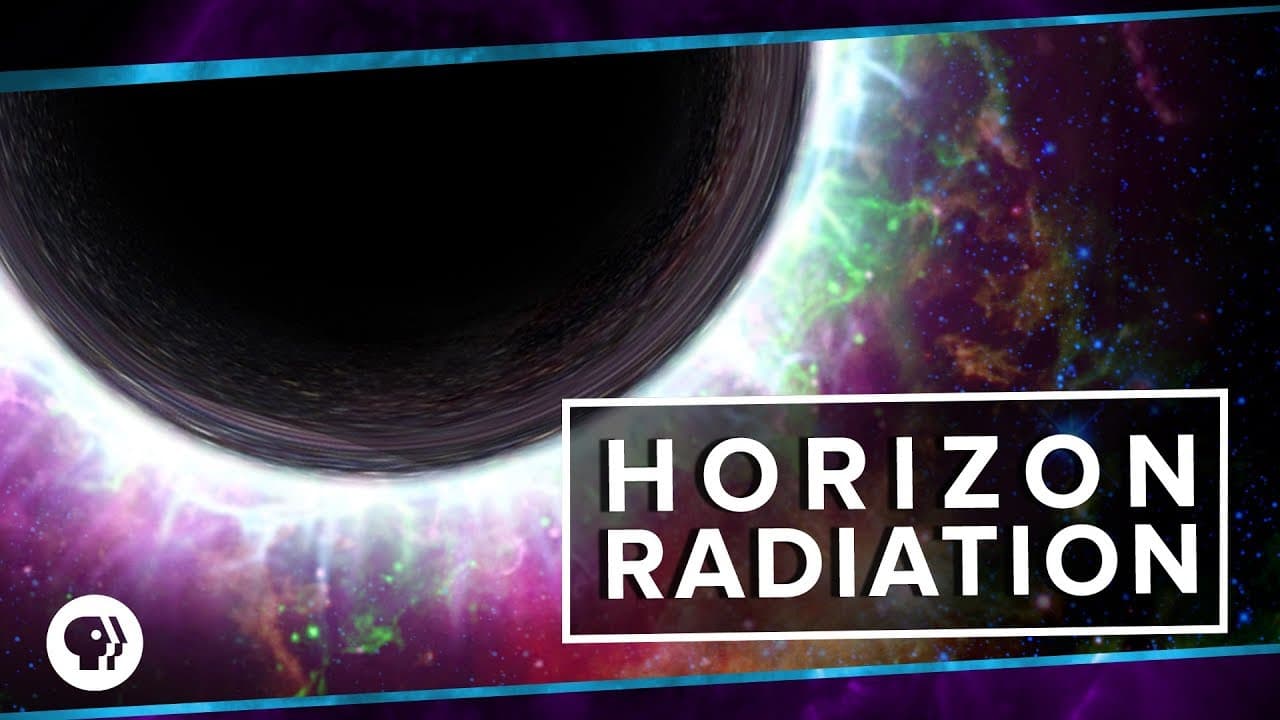
- Horizon concepts, like event horizons of black holes, limit an observer's causal connection, affecting the perception of particles.
- The vacuum and particle nature become observer-dependent near horizons, influencing phenomena like Hawking radiation and the Unruh effect.
- QFT describes particles as oscillations in quantum fields, and these oscillations can be represented in position or momentum space.
- Momentum space simplifies mathematical descriptions by uncoupling equations, allowing easier manipulation of particle interactions.
- Introducing horizons alters the field operators, changing the perception of the vacuum and creating thermal particles.
- The vacuum appears to have a non-zero temperature near horizons, producing thermal particles for some observers.
- Changing space-time boundaries, like in the Casimir effect, can also reduce particle numbers, demonstrating the vacuum's dynamic nature.
Install to Summarize YouTube Videos and Get Transcripts
Explore YouTube Video Summarizer or Get YouTube Transcript Extractor
Questions & Answers
Q: What is the significance of combining quantum mechanics with relativity?
Combining quantum mechanics with relativity is significant because it forms the basis of quantum field theory (QFT), which explains how particles can be created and destroyed during interactions. This integration allows us to understand fundamental processes in the universe, where both quantum effects and relativistic speeds play crucial roles, providing a more comprehensive framework for describing physical phenomena.
Q: How do horizons affect the perception of particles?
Horizons, such as black hole event horizons, affect the perception of particles by introducing boundaries in space-time that limit an observer's causal connection to certain regions. This leads to observer-dependent vacuums, where the nature of particles becomes relative to the observer's position and motion. As a result, phenomena like Hawking radiation and the Unruh effect emerge, where particles appear to be created or behave differently near horizons.
Q: What role does momentum space play in quantum field theory?
Momentum space plays a crucial role in quantum field theory by providing an alternative way to describe quantum fields. In momentum space, the equations become uncoupled, allowing for simpler mathematical manipulation of particle interactions. This representation helps in understanding how particles can be created or annihilated through changes in momentum modes, making it easier to solve complex equations that describe the dynamics of quantum fields.
Q: How do field operators change near horizons?
Near horizons, field operators must be reconfigured to maintain consistent laws of physics. The introduction of a horizon alters the available momentum modes, requiring a new combination of creation and annihilation operators. This change affects the perception of the vacuum, leading to the creation of thermal particles that appear to have a non-zero temperature for observers near the horizon, even though these particles don't exist for those without a horizon.
Q: What is the Unruh effect?
The Unruh effect is a phenomenon in quantum field theory where an accelerating observer perceives the vacuum as being filled with thermal particles. This effect arises because the observer's acceleration introduces an apparent horizon, altering the perception of the vacuum. The Unruh effect demonstrates the observer-dependent nature of particles and vacuums, highlighting how acceleration and horizons can influence the thermal properties of space-time.
Q: How does the Casimir effect relate to particle perception?
The Casimir effect relates to particle perception by demonstrating how changes in space-time boundaries can influence the vacuum. In this effect, the introduction of conducting plates reduces the energy of the vacuum between them, effectively decreasing the number of virtual particles. This shows that the vacuum is dynamic and can be altered by external conditions, affecting how particles are perceived and interact with their environment.
Q: Why is understanding horizons important for physics?
Understanding horizons is important for physics because they play a crucial role in shaping the observer-dependent nature of the universe. Horizons, such as those around black holes, affect the perception of particles and the vacuum, leading to phenomena like Hawking radiation and the Unruh effect. These insights are essential for developing a consistent understanding of quantum field theory and relativity, providing a deeper comprehension of the universe's fundamental processes.
Q: What is the relationship between quantum fields and particles?
The relationship between quantum fields and particles is that particles are seen as excitations or oscillations in quantum fields. Each type of particle corresponds to a specific quantum field that exists throughout space. The properties of these fields define the characteristics and interactions of particles. In quantum field theory, particles can be created or annihilated by manipulating the field's oscillations, allowing for a dynamic and comprehensive description of particle behavior in the universe.
Summary & Key Takeaways
-
Quantum field theory merges quantum mechanics and relativity, explaining how particles can be created or destroyed during interactions. Horizons, like those around black holes, affect observers' perceptions of particles and the vacuum, making these concepts crucial for understanding phenomena like Hawking radiation.
-
In quantum field theory, particles are seen as oscillations in fields that can be described in position or momentum space. Horizons introduce complexities that require reconfiguring field operators, altering the perception of the vacuum and creating thermal particles for certain observers.
-
The presence of horizons changes the dynamics of quantum fields, leading to observer-dependent vacuums and phenomena like the Unruh effect. These changes are crucial for maintaining consistent laws of physics across different reference frames and understanding thermal particle creation near horizons.
Read in Other Languages (beta)
Share This Summary 📚
Summarize YouTube Videos and Get Video Transcripts with 1-Click
Try YouTube Summary with ChatGPT & Claude or YouTube Transcript Generator
Explore More Summaries from PBS Space Time 📚

Summarize YouTube Videos and Get Video Transcripts with 1-Click
Try YouTube Summary with ChatGPT & Claude or YouTube Transcript Generator