Products
Features
YouTube Video Summarizer
Summarize YouTube videos
Web & PDF Highlighter
Highlight web pages & PDFs
Chat with PDF
Ask any PDF questions with AI
Ask AI Clone
Chat with your highlights & memories
Audio Transcriber
Transcribe audio files to text
Glasp Reader
Read and highlight articles
Kindle Highlight Export
Export your Kindle highlights
Idea Hatch
Hatch ideas from your highlights
Integrations
Obsidian Plugin
Notion Integration
Pocket Integration
Instapaper Integration
Medium Integration
Readwise Integration
Snipd Integration
Hypothesis Integration
Apps & Extensions
Chrome Extension
Safari Extension
Edge Add-ons
Firefox Add-ons
iOS App
Android App
Discover
Discover
Ideas
Discover new ideas and insights
Articles
Curated articles and insights
Books
Book recommendations by great minds
Posts
Essays and notes from readers
Quotes
Inspiring quotes collection
Videos
Curated videos and summaries
Explore Glasp
Glasp Newsletter
Weekly insights and updates
Glasp Talk
Interview series with great minds
Glasp Blog
Latest news and articles
Glasp Use Cases
Learn how others use Glasp
Build & Support
Glasp API
Access Glasp's API for developers
MCP Connector
Connect Glasp to Claude & ChatGPT
Community
Glasp Reddit Community
Students
Student discount and benefits
FAQs
Frequently Asked Questions
AboutPricing
DashboardLog inSign up

Transfer Function Derivation from State Model Statement Problem No 5 - Control Systems
10.3K views
•
April 6, 2022
by
Ekeeda
YouTube video player
Transfer Function Derivation from State Model Statement Problem No 5 - Control Systems

TL;DR

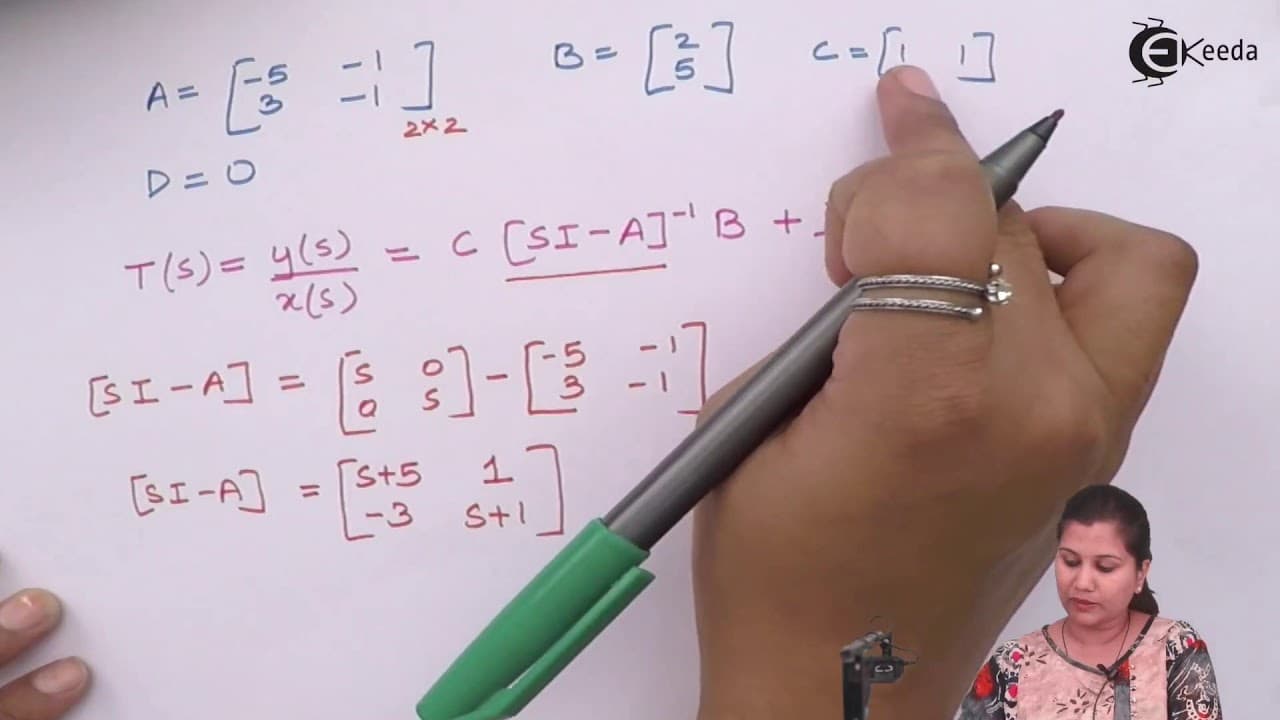
Learn how to calculate the transfer function of a system using the state model, by finding the values of matrices A, B, C, and D.

Transcript

hello friends in this video we are going to solve a problem on how to derive the transfer function when the state model of the system is given to us so let's solve the problem so our problem is we are given a single input single output system whose state variable description is given as this x dot equals to minus 5 minus 1 3 minus 1 x 1 x 2 plus 2 ... Read More

Key Insights

  • 🔙 The state model includes matrices A, B, C, and D, which represent the system's dynamics, inputs, and outputs.
  • 🔙 The transfer function can be obtained by finding the inverse of (sI - A), multiplying it with matrices C and B, and dividing by the determinant of (sI - A).
  • 📡 The transfer function describes the system's response to different input signals in the frequency domain.
  • 🎮 The state model provides a concise representation of a system's behavior and is useful for analysis and control design.
  • 🔙 The values of matrices A, B, C, and D can be found by comparing the state model with the general state model.
  • 🎮 The transfer function helps engineers understand and predict the behavior of a system and design appropriate control strategies.
  • 👻 Deriving the transfer function from the state model allows for a deeper understanding of the system's dynamics and its response to different inputs.

Install to Summarize YouTube Videos and Get Transcripts

Explore YouTube Video Summarizer or Get YouTube Transcript Extractor

Questions & Answers

Q: What is the state model of a system?

The state model describes a system's behavior using matrices A, B, and C. Matrix A represents the system's dynamics, matrix B represents the inputs, and matrix C represents the outputs.

Q: How do you calculate the transfer function from the state model?

To calculate the transfer function, you need to find the inverse of (sI - A), where s is a complex number. Then, multiply matrix C with the inverse of (sI - A) and matrix B, and divide by the determinant of (sI - A).

Q: What does the transfer function represent?

The transfer function describes the relationship between the system's input and output in the frequency domain. It helps analyze the system's response to different input signals.

Q: How can you determine the values of matrices A, B, C, and D?

The video shows that the values of matrices A, B, C, and D are given in the state model of the system. By comparing the state model with the general state model, you can identify the values of these matrices.

Summary & Key Takeaways

  • The video discusses how to derive the transfer function when the state model of a single input, single output system is given.

  • The state model of the system includes matrices A, B, and C, which represent the system's dynamics.

  • By calculating the inverse of (sI - A), where s is a complex number, the transfer function can be determined.


Read in Other Languages (beta)

English

Share This Summary 📚

Summarize YouTube Videos and Get Video Transcripts with 1-Click

Download browser extensions on:

Try YouTube Summary with ChatGPT & Claude or YouTube Transcript Generator

Explore More Summaries from Ekeeda 📚
How to Calculate the Resonant Frequency of a Rectangular Cavity Resonator thumbnail
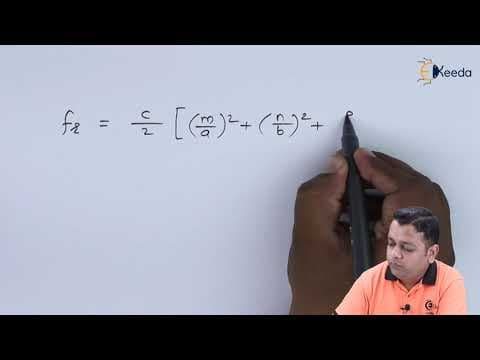
How to Calculate the Resonant Frequency of a Rectangular Cavity Resonator
Ekeeda
How to Calculate the Moment of Inertia for a Lamina thumbnail
How to Calculate the Moment of Inertia for a Lamina
Ekeeda
Temperature Control in Gravity Dam Foundation Treatment - Gravity Dams -  Water Resource Engineering thumbnail
Temperature Control in Gravity Dam Foundation Treatment - Gravity Dams - Water Resource Engineering
Ekeeda
Analyze Simply Supported Beam with Point and Uniform Moment thumbnail
Analyze Simply Supported Beam with Point and Uniform Moment
Ekeeda
Terzaghi's Theory of 1D Consolidation - Consolidation of soils - Soil Mechanics thumbnail
Terzaghi's Theory of 1D Consolidation - Consolidation of soils - Soil Mechanics
Ekeeda
Darcy's Law and Duipits Theory -  Ground Water and Well Hydraulics - Water Resource Engineering 1 thumbnail
Darcy's Law and Duipits Theory - Ground Water and Well Hydraulics - Water Resource Engineering 1
Ekeeda

Summarize YouTube Videos and Get Video Transcripts with 1-Click

Download browser extensions on:

Try YouTube Summary with ChatGPT & Claude or YouTube Transcript Generator

Apps & Extensions

  • Chrome Extension
  • Safari Extension
  • Edge Add-ons
  • Firefox Add-ons
  • iOS App
  • Android App

Key Features

  • YouTube Video Summarizer
  • Web & PDF Summarizer
  • Web & PDF Highlighter
  • Chat with PDF
  • Ask AI Clone
  • Audio Transcriber
  • Glasp Reader
  • Kindle Highlight Export
  • Idea Hatch

Integrations

  • Obsidian Plugin
  • Notion Integration
  • Pocket Integration
  • Instapaper Integration
  • Medium Integration
  • Readwise Integration
  • Snipd Integration
  • Hypothesis Integration

More Features

  • APIs
  • MCP Connector
  • Blog & Post
  • Embed Links
  • Image Highlight
  • Personality Test
  • Quote Shots

Company

  • About us
  • Blog
  • Community
  • FAQs
  • Job Board
  • Newsletter
  • Pricing
Terms

•

Privacy

•

Guidelines

© 2026 Glasp Inc. All rights reserved.