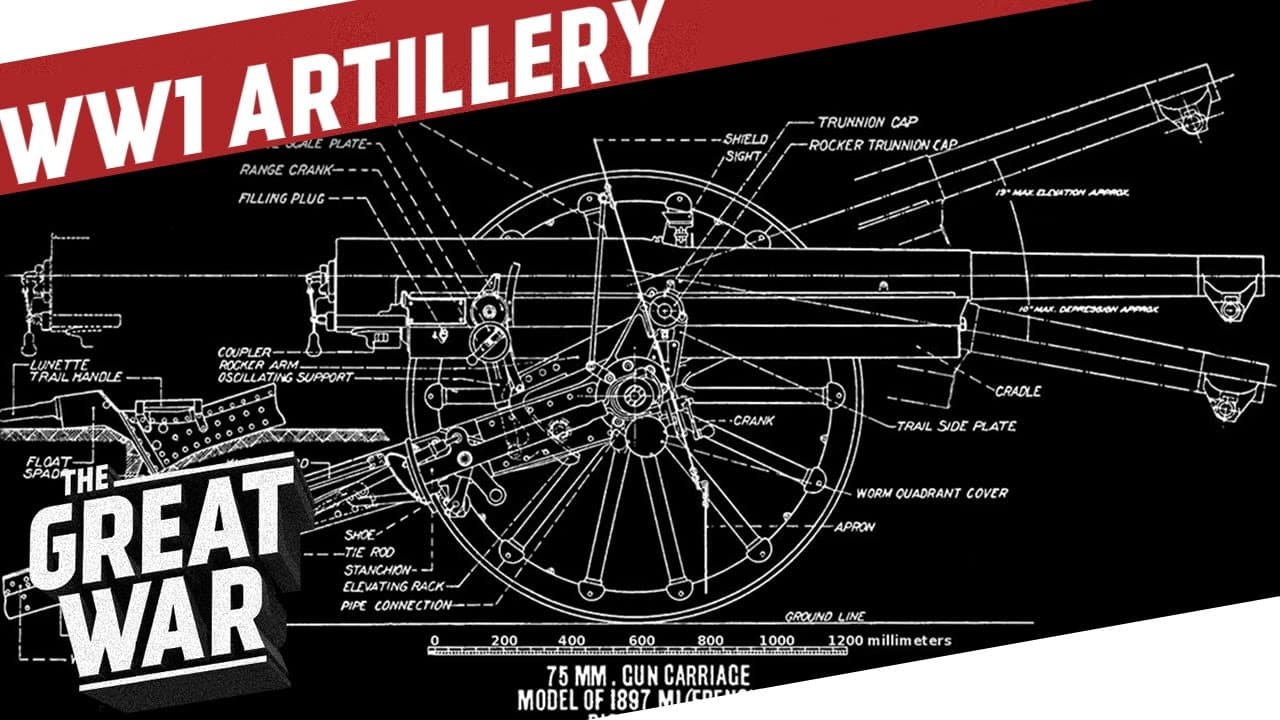
Western Front Artillery At The Outbreak of World War 1 I THE GREAT WAR Special
TL;DR
Artillery played a pivotal role in WW1, shaping warfare tactics.
Transcript
When World War One began, nobody could really have guessed the unprecedented level of destruction the war would bring. An observer might have been able to guess how the war would be fought by looking at the weaponry developed by the nations that did the fighting, though, and the most destructive of these was artillery. I’m Indy Neidell; welcome to ... Read More
Key Insights
- World War I was predominantly an artillery war, with 75% of casualties attributed to artillery fire. This highlights the crucial role of artillery in shaping the tactics and outcomes of battles during the war.
- France's reliance on the Canon de 75, a mobile field gun, was influenced by their defeat in 1870-71, prioritizing speed and mobility over heavy artillery, which later proved to be a strategic mistake.
- Germany's Schlieffen Plan required artillery capable of both rapid movement and heavy firepower. The 7.7cm Feldkanone and 10.5cm Feldhaubitze were integral to their strategy, supporting infantry and counter-battery operations.
- The British had recent experience with modern artillery from the Boer Wars, leading to the development of weapons like the Ordnance QF 18 pounder, which could provide indirect fire support from safer, rear positions.
- The French 75, although highly effective in rapid-fire operations, was limited by its inability to perform plunging fire, making it ineffective against fortifications and contributing to French casualties.
- Germany developed the 42cm Krupp siege mortars, known as Big Berthas, to penetrate Belgian fortifications. These massive weapons were among the largest artillery pieces used during the war.
- The British artillery doctrine evolved to include heavy siege howitzers like the 9.2 inch model, capable of firing large shells over long distances, which were crucial for counter-battery fire and trench warfare.
- Despite the diversity of artillery used, the war's outbreak in 1914 exposed the devastating power of modern artillery, necessitating the deployment of all available weapons and leading to significant tactical developments.
Install to Summarize YouTube Videos and Get Transcripts
Explore YouTube Video Summarizer or Get YouTube Transcript Extractor
Questions & Answers
Q: What was the primary role of artillery in World War I?
Artillery played a pivotal role in World War I, being responsible for approximately 75% of all casualties. Its destructive power significantly influenced the tactics and strategies employed by the warring nations. The development of artillery technology and tactics was a direct response to its effectiveness in causing massive destruction on the battlefield.
Q: How did France's past military experiences influence their artillery strategy?
France's defeat in the Franco-Prussian War of 1870-71 led them to prioritize speed and mobility in their artillery strategy. This resulted in the development of the Canon de 75, a rapid-fire field gun designed for mobile warfare. However, this focus on mobility came at the cost of heavy artillery, which proved to be a significant disadvantage during World War I.
Q: What was Germany's approach to artillery in the context of the Schlieffen Plan?
Germany's Schlieffen Plan required artillery that was both mobile and capable of delivering heavy firepower. To achieve this, the Germans developed the 7.7cm Feldkanone for rapid movement and the 10.5cm Feldhaubitze for counter-battery fire. Additionally, they created the 42cm Krupp siege mortars, known as Big Berthas, to breach Belgian fortifications.
Q: How did the British adapt their artillery tactics based on previous conflicts?
The British adapted their artillery tactics based on lessons learned from the Boer Wars, where they shifted from providing direct support to infantry to using indirect fire. This led to the development of weapons like the Ordnance QF 18 pounder, which could provide support from safer rear positions, minimizing exposure to enemy fire and reducing casualties.
Q: What were the limitations of the French 75 artillery piece?
The French 75 artillery piece, while effective in rapid-fire operations, had limitations due to its inability to perform plunging fire. This meant it could not effectively target fortifications or entrenched positions, as it was designed for a flat trajectory. This limitation contributed to significant French casualties when facing German artillery capable of plunging fire.
Q: What role did the German 42cm Krupp siege mortars play in the war?
The German 42cm Krupp siege mortars, known as Big Berthas, played a crucial role in breaching Belgian fortifications during the early stages of World War I. These massive artillery pieces were capable of firing 800-kilogram shells over long distances, making them effective against heavily fortified positions and contributing to Germany's initial advances.
Q: How did the British artillery strategy evolve to address trench warfare challenges?
The British artillery strategy evolved to include heavy siege howitzers like the 9.2 inch model, which were capable of firing large shells over long distances. This adaptation was crucial for counter-battery fire and effectively targeting enemy trenches, artillery batteries, and barbed wire, providing a strategic advantage in the static trench warfare environment.
Q: What impact did the outbreak of World War I have on artillery deployment?
The outbreak of World War I in 1914 revealed the devastating power of modern artillery, leading to the deployment of all available weapons by the warring nations. This necessity to utilize a wide range of artillery pieces resulted in significant tactical developments and highlighted the importance of artillery in shaping the course of the war.
Summary & Key Takeaways
-
World War I was largely defined by the use of artillery, with nations like France, Germany, and Britain developing distinct strategies and weaponry that reflected their military priorities and experiences.
-
France's focus on mobility and rapid-fire artillery like the Canon de 75 was challenged by the realities of trench warfare, while Germany's combination of field guns and heavy siege mortars supported their aggressive Schlieffen Plan.
-
The British, informed by prior conflicts, developed artillery capable of indirect fire, providing a strategic advantage in trench warfare, though all nations faced the harsh lessons of modern artillery's destructive capabilities.
Read in Other Languages (beta)
Share This Summary 📚
Summarize YouTube Videos and Get Video Transcripts with 1-Click
Try YouTube Summary with ChatGPT & Claude or YouTube Transcript Generator
Explore More Summaries from The Great War 📚

Summarize YouTube Videos and Get Video Transcripts with 1-Click
Try YouTube Summary with ChatGPT & Claude or YouTube Transcript Generator