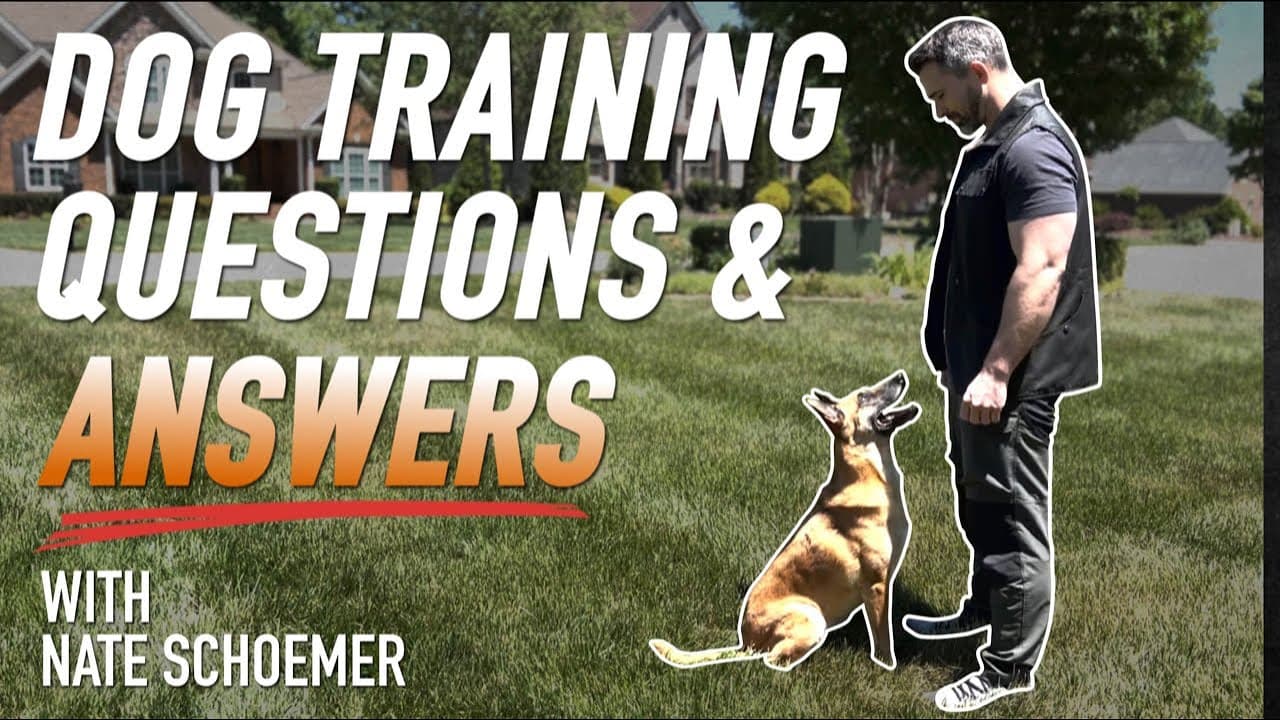
Live Q&A with Professional Dog Trainer Nate Schoemer 2
TL;DR
Professional dog trainer Nate Schoemer answers various dog training questions live.
Transcript
hey everybody welcome back to another live q a i'm going to start off with a question that was recently asked as far as building toy drive or play drive in a dog if you have a dog that just doesn't have that natural play drive that some dogs do there are a few things you can do to try to increase that play drive but there is no guarantee one of the... Read More
Key Insights
- Building play drive in dogs can be challenging; using tools like flirt poles and drive-building exercises can help, but success varies by dog.
- To stop destructive behavior like plant tearing, immediate correction is advised, using conditioned punishers to deter the dog effectively.
- Counter conditioning and desensitization are effective for dogs showing signs of anxiety or fear, gradually reducing negative reactions.
- Using verbal commands with hand signals can enhance training; dogs learn through physical communication and pattern recognition.
- Introducing new behaviors can be done by leveraging known commands, teaching dogs through pattern recognition and consistent practice.
- Addressing unwanted behaviors like jumping involves using negative reinforcement and punishment appropriately, ensuring dogs understand boundaries.
- Socializing fearful dogs requires patience and counter conditioning; genetics may play a role, but improvement is possible with time.
- Training priorities for service dogs should focus on early imprinting, ensuring positive associations with desired behaviors and environments.
Install to Summarize YouTube Videos and Get Transcripts
Explore YouTube Video Summarizer or Get YouTube Transcript Extractor
Questions & Answers
Q: How can I increase my dog's play drive?
To increase a dog's play drive, you can use tools like flirt poles or a ball on a rope to stimulate their natural instincts. If these methods are ineffective, consider drive-building exercises, which involve teasing the dog with a toy to build excitement and rewarding them when they engage.
Q: What is the best way to stop my dog from tearing up plants?
To stop a dog from tearing up plants, implement immediate corrections when the behavior occurs. Set the dog up to fail by exposing them to the situation, and use a conditioned punisher, like saying 'no,' followed by a correction, such as a leash pop, to deter the behavior.
Q: How can I help my dog with anxiety around other dogs?
To help a dog with anxiety around other dogs, use counter conditioning and desensitization techniques. Gradually expose the dog to other dogs from a distance where they don't react negatively, and pair the experience with positive reinforcement, like treats or play, to build a positive association.
Q: What is the role of verbal commands and hand signals in training?
Verbal commands and hand signals are crucial for effective dog training. Dogs learn through physical communication and pattern recognition, so pairing verbal commands with consistent hand signals helps reinforce desired behaviors. Over time, dogs respond to the hand signals alone, demonstrating their understanding.
Q: How can I stop my dog from jumping on people?
To stop a dog from jumping on people, use a combination of negative punishment and reinforcement. When the dog jumps, stop giving them attention (negative punishment), say 'wrong,' and apply leash pressure until they have all four paws on the ground (negative reinforcement), then reward them with attention.
Q: Will socializing a fearful dog help with their anxiety?
Socializing a fearful dog can help with anxiety, but it requires patience and consistent counter conditioning. Gradually expose the dog to new environments and stimuli, using positive reinforcement to create positive associations. Genetic factors may influence the dog's fearfulness, affecting the time needed for improvement.
Q: What are the training priorities for a service dog?
Training priorities for a service dog include starting early to maximize imprinting, focusing on positive associations with desired behaviors and environments. Consistent training, understanding the dog’s motivation, and patience are key. Selecting a dog with suitable genetics for service work increases the likelihood of success.
Q: How can I prevent my dog from sniffing everything on walks?
To prevent a dog from sniffing everything on walks, use leash pressure to correct the behavior. When the dog lowers their head to sniff, say 'wrong' and apply leash pressure to lift their head. Consistent correction helps the dog learn to keep their focus on walking rather than sniffing.
Summary & Key Takeaways
-
Nate Schoemer discusses methods to increase toy drive in dogs, emphasizing the use of flirt poles and drive-building exercises. He also highlights the importance of immediate correction for destructive behaviors to prevent escalation.
-
Counter conditioning and desensitization are recommended for dogs showing fear or anxiety, with examples of how to gradually reduce negative reactions to other dogs. Schoemer also explains the use of verbal commands and hand signals in training.
-
The Q&A covers various training techniques, including the importance of understanding a dog's motivation, using negative reinforcement, and setting clear boundaries for behaviors like jumping. Schoemer also discusses training service dogs and the role of genetics in behavior.
Read in Other Languages (beta)
Share This Summary 📚
Summarize YouTube Videos and Get Video Transcripts with 1-Click
Try YouTube Summary with ChatGPT & Claude or YouTube Transcript Generator
Explore More Summaries from Nate Schoemer 📚
Summarize YouTube Videos and Get Video Transcripts with 1-Click
Try YouTube Summary with ChatGPT & Claude or YouTube Transcript Generator