The Andromeda-Milky Way Collision
TL;DR
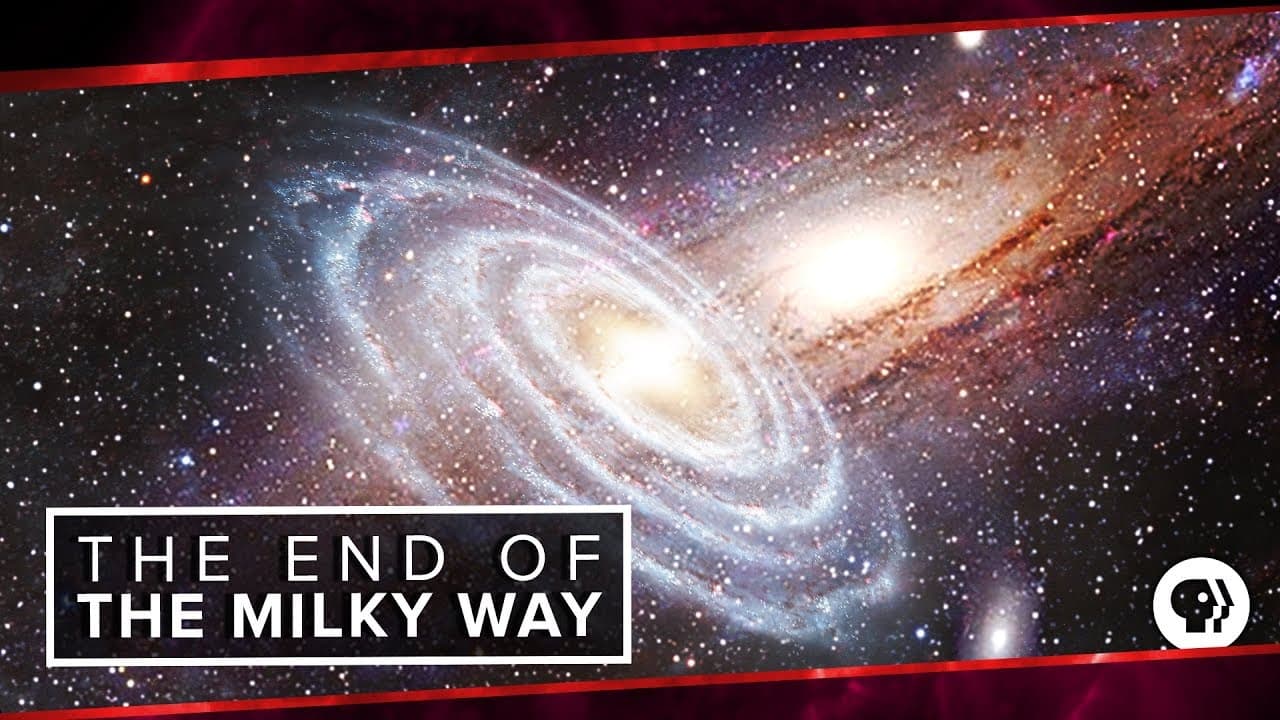
Andromeda will collide with the Milky Way in 4 billion years.
Transcript
In four billion years, anyone left in our solar system will witness the most spectacular event to take place in the history of the night sky as the Andromeda Galaxy plows headlong into our own Milky Way. But will that be the very last night sky our solar system witnesses? See that fuzzy blob on the sky, the one just left of the Milky Way center in ... Read More
Key Insights
- The Andromeda Galaxy, known as M31, is on a collision course with the Milky Way, expected to occur in about 4 billion years.
- Andromeda is currently 2.5 million light years away and is moving towards the Milky Way at 110 kilometers per second.
- Despite the collision, the vast distances between stars mean that direct star collisions are unlikely, though gravitational disruptions might occur.
- The collision will result in a new elliptical galaxy, often referred to as 'Milkdromeda', which will form over several billion years.
- Edwin Hubble's measurements of Cepheid variables in Andromeda helped prove that it was a separate galaxy, leading to the discovery of the universe's expansion.
- The transverse velocity of Andromeda was measured using the Hubble Space Telescope, confirming a head-on collision with the Milky Way.
- The collision will disrupt the spiral structures of both galaxies, creating tidal tails similar to those observed in other colliding galaxies.
- The sun and Earth are unlikely to be directly affected by star collisions, but the sun will have become a red giant by the time of the collision.
Install to Summarize YouTube Videos and Get Transcripts
Explore YouTube Video Summarizer or Get YouTube Transcript Extractor
Questions & Answers
Q: What will happen when Andromeda collides with the Milky Way?
When Andromeda collides with the Milky Way, the two galaxies will merge over several billion years, forming a new elliptical galaxy known as 'Milkdromeda'. The spiral structures of both galaxies will be disrupted, and tidal tails will form. Despite the collision, the vast distances between stars mean that direct star collisions are unlikely.
Q: How was the distance to Andromeda first determined?
The distance to Andromeda was first determined by Edwin Hubble, who observed Cepheid variables within the galaxy. These stars have a known relationship between their pulsation rate and luminosity. By measuring their pulsation rate and apparent brightness, Hubble calculated their distance, proving that Andromeda was a separate galaxy and not a part of the Milky Way.
Q: What role did the Hubble Space Telescope play in understanding the collision?
The Hubble Space Telescope was crucial in measuring Andromeda's transverse velocity. Researchers used it to track the motion of stars in Andromeda relative to background galaxies over several years. This data, combined with line-of-sight velocity measurements, confirmed that a head-on collision with the Milky Way is inevitable.
Q: Will the collision affect the sun and Earth?
While the collision is unlikely to cause direct star collisions due to the vast distances between stars, it may cause gravitational disruptions. However, by the time of the collision, the sun will have expanded into a red giant, affecting Earth's habitability. The solar system may end up in different parts of the new galaxy or even be ejected into intergalactic space.
Q: What evidence supports the idea that Andromeda is a separate galaxy?
The evidence supporting Andromeda as a separate galaxy comes from Edwin Hubble's observations of Cepheid variables, which allowed him to calculate its distance. This distance, far greater than any within the Milky Way, confirmed it as an 'island universe'. Additionally, its spiral structure and size further support it being a separate galaxy.
Q: What are the chances of star collisions during the galactic merger?
The chances of direct star collisions during the merger are extremely low due to the vast distances between stars, which are about 100 billion times greater than the size of a star. However, gravitational interactions may cause some stars to be ejected from the galaxy or alter their orbits significantly.
Q: How will the merger affect future astronomical observations?
After the merger, future astronomers will see a single elliptical galaxy instead of distinct spiral galaxies. This will limit the ability to study separate galactic structures and dynamics. Additionally, as the universe continues to expand, other galaxies will become more distant, making it harder to observe and study them.
Q: What is the significance of the Triangulum Galaxy in the collision?
The Triangulum Galaxy, the third-largest member of the Local Group, may also be involved in the collision. It could join the merger, contributing to the formation of the new elliptical galaxy. The simulations suggest that it might be absorbed into the resulting structure, further altering the dynamics and composition of the new galaxy.
Summary & Key Takeaways
-
The Andromeda Galaxy is on a path to collide with the Milky Way in approximately 4 billion years. Despite the vast distances between stars, the gravitational interactions will cause significant disruptions, forming a new elliptical galaxy.
-
Edwin Hubble's work on Cepheid variables in Andromeda confirmed it as a separate galaxy, leading to the discovery of the universe's expansion. The collision with the Milky Way will create a new galaxy, 'Milkdromeda'.
-
The collision will not result in direct star collisions due to vast distances, but gravitational disruptions are possible. The sun, however, will have expanded into a red giant, affecting Earth's habitability.
Read in Other Languages (beta)
Share This Summary 📚
Summarize YouTube Videos and Get Video Transcripts with 1-Click
Try YouTube Summary with ChatGPT & Claude or YouTube Transcript Generator
Explore More Summaries from PBS Space Time 📚
Summarize YouTube Videos and Get Video Transcripts with 1-Click
Try YouTube Summary with ChatGPT & Claude or YouTube Transcript Generator