How Magnetism Shapes The Universe
TL;DR
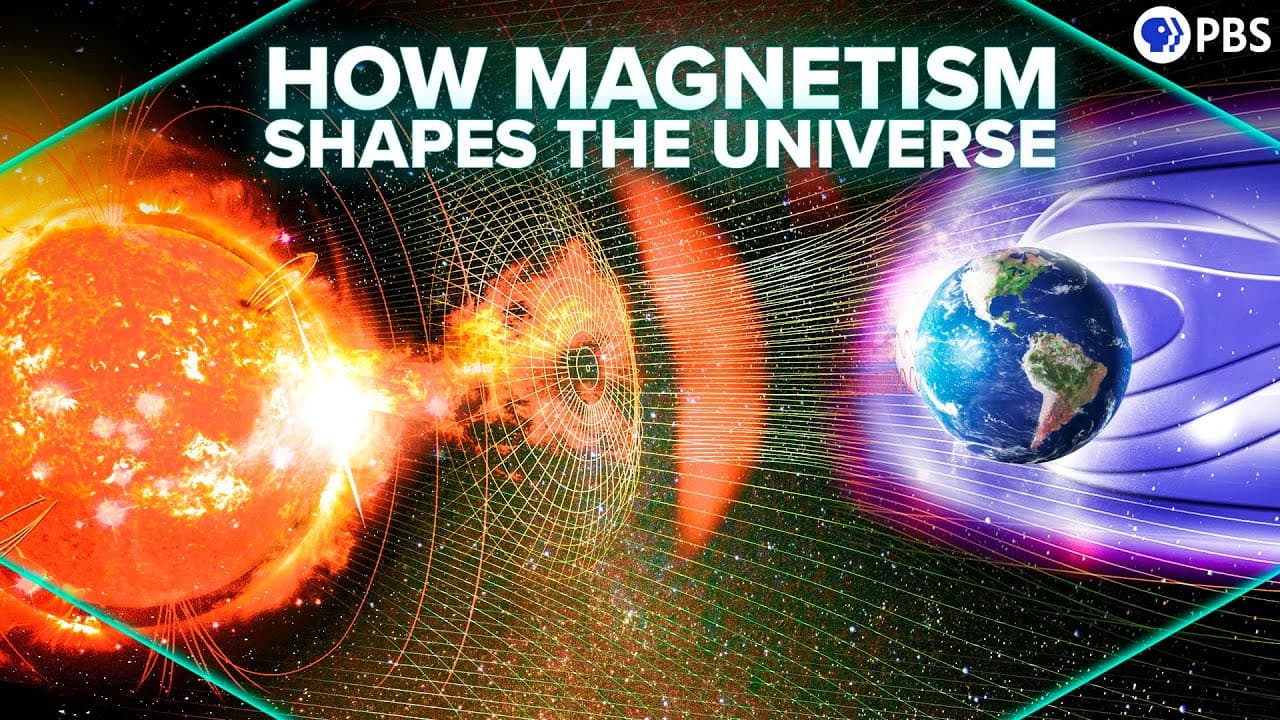
Magnetic fields shape cosmic structures and influence astrophysical phenomena.
Transcript
How far can you follow a compass needle? As far as the north magnetic pole, where the needle starts spinning wildly? Compass needles align with magnetic field lines, and on the precise spot of magnetic north, those field lines are vertical. So just tilt your compass 90 degrees and you can continue your journey - either down to the molten iron dynam... Read More
Key Insights
- Magnetic fields, unlike gravitational fields, manifest on enormous scales and have a significant influence on the universe's structure.
- Magnetic fields are generated by moving charged particles, and even neutral substances can create fields if charges move in opposite directions.
- The Earth's magnetic field connects to the Sun's field, which is generated by electrical currents in its plasma, leading to phenomena like coronal mass ejections.
- The heliopause marks the boundary of the Sun's influence, where the solar magnetic field interacts with the galaxy's field.
- Astronomers map galactic magnetic fields using polarization of light, revealing complex structures like those in the Milky Way.
- Magnetic fields play a crucial role in star formation by slowing gas cloud rotation and aiding in supernova-triggered star formation.
- Galactic magnetic fields act as colossal particle accelerators, creating cosmic rays and influencing phenomena near supermassive black holes.
- The Milky Way's magnetic field, possibly originating from supernovae, helps shape the galaxy by facilitating star formation and controlling galactic fountains.
Install to Summarize YouTube Videos and Get Transcripts
Explore YouTube Video Summarizer or Get YouTube Transcript Extractor
Questions & Answers
Q: How do magnetic fields influence the universe's structure?
Magnetic fields, unlike gravitational fields, manifest on large scales and play a crucial role in shaping cosmic structures. They influence the formation and dynamics of stars, galaxies, and other celestial bodies by interacting with charged particles, facilitating processes like star formation and cosmic ray acceleration.
Q: What generates magnetic fields in celestial bodies?
Magnetic fields in celestial bodies are generated by the movement of charged particles. For instance, Earth's magnetic field is produced by the flow of molten iron in its outer core, while the Sun's field results from electrical currents in its plasma. These fields can extend and connect with larger galactic fields.
Q: How do astronomers map galactic magnetic fields?
Astronomers map galactic magnetic fields by analyzing the polarization of light. As light passes through the interstellar medium, it gets scattered by dust grains aligned with magnetic fields, resulting in polarized light. By measuring this polarization, astronomers can map the direction and structure of magnetic fields in galaxies.
Q: What role do magnetic fields play in star formation?
Magnetic fields are crucial in star formation as they help slow the rotation of collapsing gas clouds, allowing them to collapse fully into stars. Additionally, magnetic fields associated with supernovae compress surrounding gas, triggering new star formation and aiding in the recycling of materials within galaxies.
Q: How do magnetic fields accelerate cosmic rays?
Galactic magnetic fields act as colossal particle accelerators, where charged particles like electrons and atomic nuclei are accelerated to high energies, becoming cosmic rays. These accelerations occur in magnetic shock fronts of supernovae or near supermassive black holes, where intense magnetic fields propel particles to incredible speeds.
Q: What is the heliopause, and why is it significant?
The heliopause is the boundary marking the limit of the Sun's influence in the galaxy, where the solar magnetic field meets the galaxy's field. It is significant because it defines the extent of the heliosphere, a region dominated by solar wind and magnetic fields, and is crucial for understanding the Sun's interaction with the interstellar medium.
Q: How do magnetic fields affect the motion of charged particles?
Magnetic fields exert a force on moving charged particles, causing them to spiral around field lines. This force is perpendicular to both the particle's motion and the field lines, influencing the trajectory of particles and playing a critical role in phenomena like the auroras and particle acceleration in cosmic environments.
Q: What are galactic fountains, and how are they formed?
Galactic fountains are flows of material ejected from galaxies, often propelled by supernovae and constrained by magnetic fields. These fountains transport enriched material from star explosions, which eventually rains back into the galaxy, contributing to new star formation and the overall galactic cycle of matter.
Summary & Key Takeaways
-
Magnetic fields are pivotal in shaping the universe's structures, from stars to galaxies. Their influence extends from the Earth's core to the galaxy's edges, connecting celestial bodies and impacting cosmic phenomena.
-
The Earth's magnetic field is part of a larger cosmic network, interacting with the Sun's field and the galaxy's field, influencing phenomena like solar winds and coronal mass ejections.
-
Galactic magnetic fields, mapped through light polarization, play a crucial role in star formation and cosmic ray acceleration, showcasing their importance in astrophysical processes.
Read in Other Languages (beta)
Share This Summary 📚
Summarize YouTube Videos and Get Video Transcripts with 1-Click
Try YouTube Summary with ChatGPT & Claude or YouTube Transcript Generator
Explore More Summaries from PBS Space Time 📚



Summarize YouTube Videos and Get Video Transcripts with 1-Click
Try YouTube Summary with ChatGPT & Claude or YouTube Transcript Generator