Scientific Notation - Basic Introduction
TL;DR
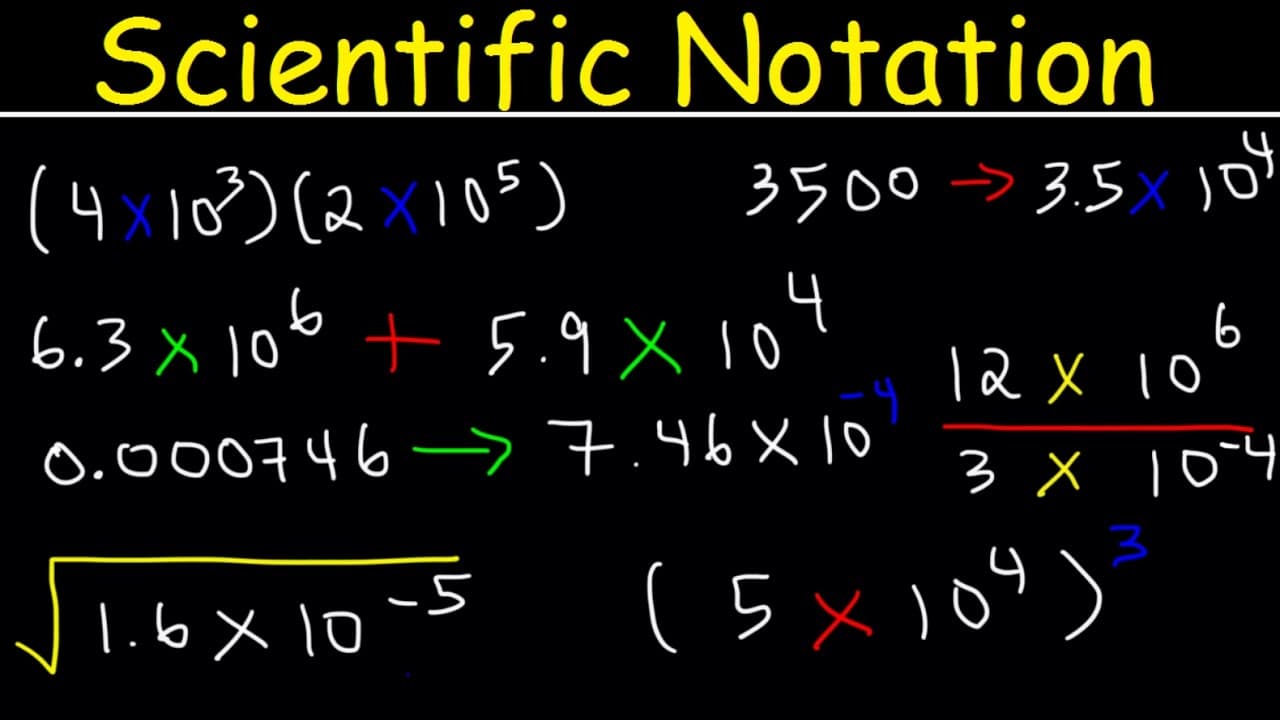
Scientific notation is a useful way of representing very large or small numbers by using powers of 10.
Transcript
in this video we're going to review scientific notation so what is it and why do we use it scientific notation is a simple way to write very large numbers or very small numbers for example instead of writing the number one billion which has a lot of zeros you could simply represent that value by writing one times ten to the nine instead of writing ... Read More
Key Insights
- 🛩️ Scientific notation simplifies the representation of very large or small numbers.
- 😥 Converting between scientific notation and decimal notation involves moving the decimal point and adjusting the exponent.
- 🪜 Adding or subtracting numbers in scientific notation requires matching exponents.
- ✖️ Multiplying numbers in scientific notation involves multiplying the coefficients and adding the exponents.
- 🗂️ Dividing numbers in scientific notation requires dividing the coefficients and subtracting the exponents.
- 👻 Understanding the rules for each operation allows for efficient calculations.
- #️⃣ It is important to convert numbers to proper scientific notation to ensure accurate representation.
Install to Summarize YouTube Videos and Get Transcripts
Explore YouTube Video Summarizer or Get YouTube Transcript Extractor
Questions & Answers
Q: What is scientific notation?
Scientific notation is a way of writing very large or very small numbers by using powers of 10. It simplifies the representation of these numbers.
Q: How do you convert a number from scientific notation to decimal notation?
To convert from scientific notation to decimal notation, you need to adjust the decimal point and the exponent. Move the decimal point to the right if the exponent is positive, and to the left if the exponent is negative.
Q: What is the process for converting a number from decimal notation to scientific notation?
To convert from decimal notation to scientific notation, move the decimal point to create a number between 1 and 10. Count the number of spaces you moved the decimal point and adjust the exponent accordingly.
Q: How do you add or subtract numbers in scientific notation?
To add or subtract numbers in scientific notation, the exponents must be the same. Combine the coefficients while keeping the exponent the same.
Q: What is the rule for multiplying numbers in scientific notation?
To multiply numbers in scientific notation, multiply the coefficients together and add the exponents of 10.
Q: How do you divide numbers in scientific notation?
When dividing numbers in scientific notation, divide the coefficients and subtract the exponents of 10.
Summary & Key Takeaways
-
Scientific notation is a simplified way of writing numbers that are very large or very small.
-
Converting from scientific notation to decimal notation involves moving the decimal point and adjusting the exponent.
-
Converting from decimal notation to scientific notation involves moving the decimal point and adjusting the exponent as well.
-
Adding, subtracting, multiplying, and dividing numbers in scientific notation follows specific rules based on exponents and coefficients.
Read in Other Languages (beta)
Share This Summary 📚
Summarize YouTube Videos and Get Video Transcripts with 1-Click
Try YouTube Summary with ChatGPT & Claude or YouTube Transcript Generator
Explore More Summaries from The Organic Chemistry Tutor 📚



Summarize YouTube Videos and Get Video Transcripts with 1-Click
Try YouTube Summary with ChatGPT & Claude or YouTube Transcript Generator