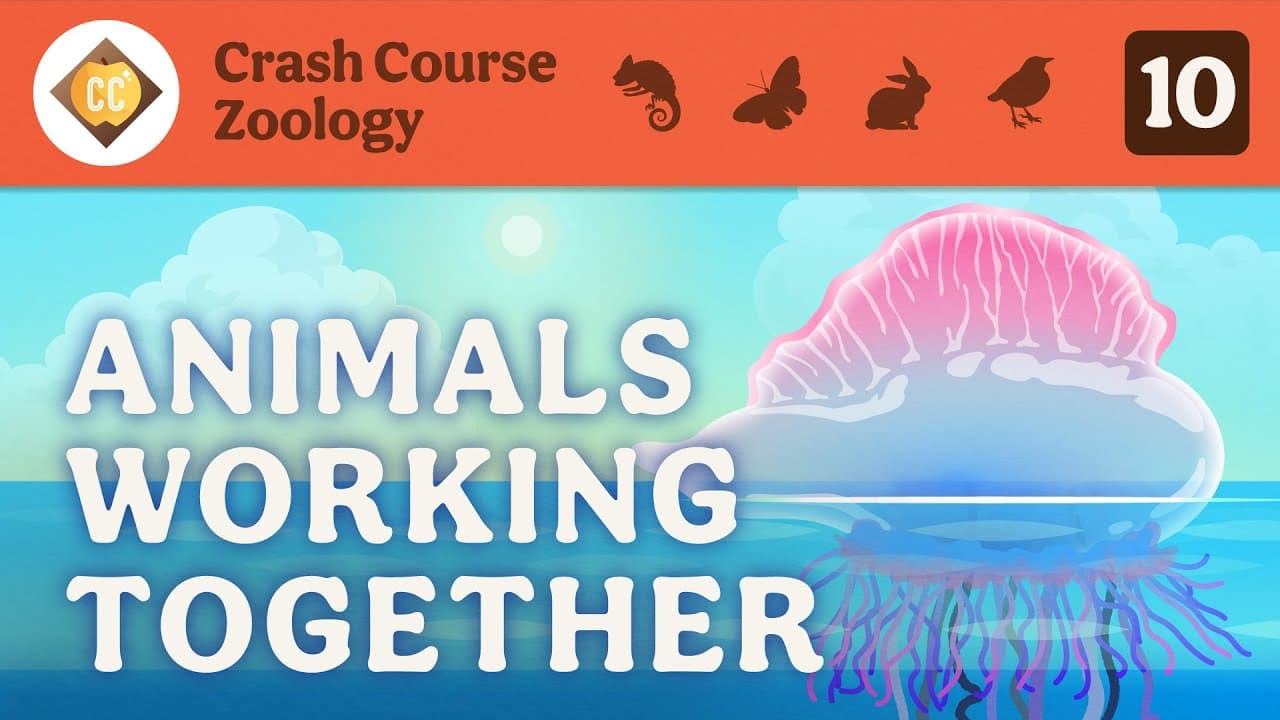
Animals Working Together: Crash Course Zoology #10
TL;DR
Animals, including humans, exhibit various levels of social behavior, from presociality to eusociality and coloniality, which has led to complex social structures and raises philosophical questions about individuality and culture.
Transcript
Like most people, I hate having a cold or the flu. But being sick gets slightly better when a friend drops off some classic movies or goes out for a snack and comes back to throw it up all over me. Wait, that’s bats. Feeling cared for makes me feel better, even if I’m still sick. And vampire bats cheer up their sick friends by going out, drinking s... Read More
Key Insights
- 🛟 Sociality is a common trait among animals and influences various aspects of their lives, including reproduction, foraging, and defense.
- 😨 Eusociality represents an extreme level of sociality, characterized by long-lived individuals, specialized roles, and cooperative care of offspring.
- 🧡 Presociality is more common and covers a wide range of behaviors, including family relationships and cooperative parenting.
- 💦 Colonial organisms are an extreme example of sociality, with physically connected clones that work together to form a single superorganism.
- 🤨 The boundaries between individual animals in colonial organisms are blurry, raising questions about individuality and evolution.
- 👥 Animals can exhibit culture, which is the transmission of behaviors, customs, and knowledge within a group, extending beyond humans.
- 🧑🏭 Evolutionary factors, such as inclusive fitness and reciprocal altruism, can drive the development of social behaviors.
Install to Summarize YouTube Videos and Get Transcripts
Explore YouTube Video Summarizer or Get YouTube Transcript Extractor
Questions & Answers
Q: What is sociality and how does it impact animal behavior?
Sociality refers to the degree to which individual animals interact and cooperate with others in their species. It influences various aspects of animal behavior, such as raising offspring, hunting for food, and protecting territory.
Q: What is eusociality and how is it different from other forms of sociality?
Eusociality is the most extreme form of sociality, characterized by many generations of individuals living together, an extreme division of labor, and cooperative raising of offspring. It is seen in bees, some crustaceans, and a few mammals like naked mole rats.
Q: What is the difference between presociality and eusociality?
Presocial animals, including many mammals, maintain close family relationships and sometimes cooperate to raise young. However, their social behavior is generally less dramatic than eusocial animals, which exhibit extreme division of labor and cooperative care of offspring.
Q: How do colonial organisms differ from other social animals?
Colonial organisms, such as the Portuguese Man O'War and corals, consist of physically connected clones known as zooids. They work together as a single superorganism, with different zooids performing specialized tasks. This extreme form of sociality allows for efficient resource allocation and growth.
Summary & Key Takeaways
-
Sociality, or the extent to which individual animals associate and cooperate with others, is a fundamental aspect of animal behavior and affects how they interact with members of their species.
-
Animals can exhibit different levels of sociality, including eusociality (seen in bees and a few mammals) where there is an extreme division of labor and cooperative raising of offspring, and presociality (common in mammals) where individuals maintain family relationships and sometimes cooperate to raise young.
-
Colonial organisms, such as the Portuguese Man O'War and corals, represent extreme forms of sociality, with physically connected and interdependent clones working together as a single superorganism.
Read in Other Languages (beta)
Share This Summary 📚
Summarize YouTube Videos and Get Video Transcripts with 1-Click
Try YouTube Summary with ChatGPT & Claude or YouTube Transcript Generator
Explore More Summaries from CrashCourse 📚


Summarize YouTube Videos and Get Video Transcripts with 1-Click
Try YouTube Summary with ChatGPT & Claude or YouTube Transcript Generator