16. Philosophical Puzzles
TL;DR
Different scenarios and outcomes highlight the complexities of moral responsibility and the role of luck in determining blame or praise.
Transcript
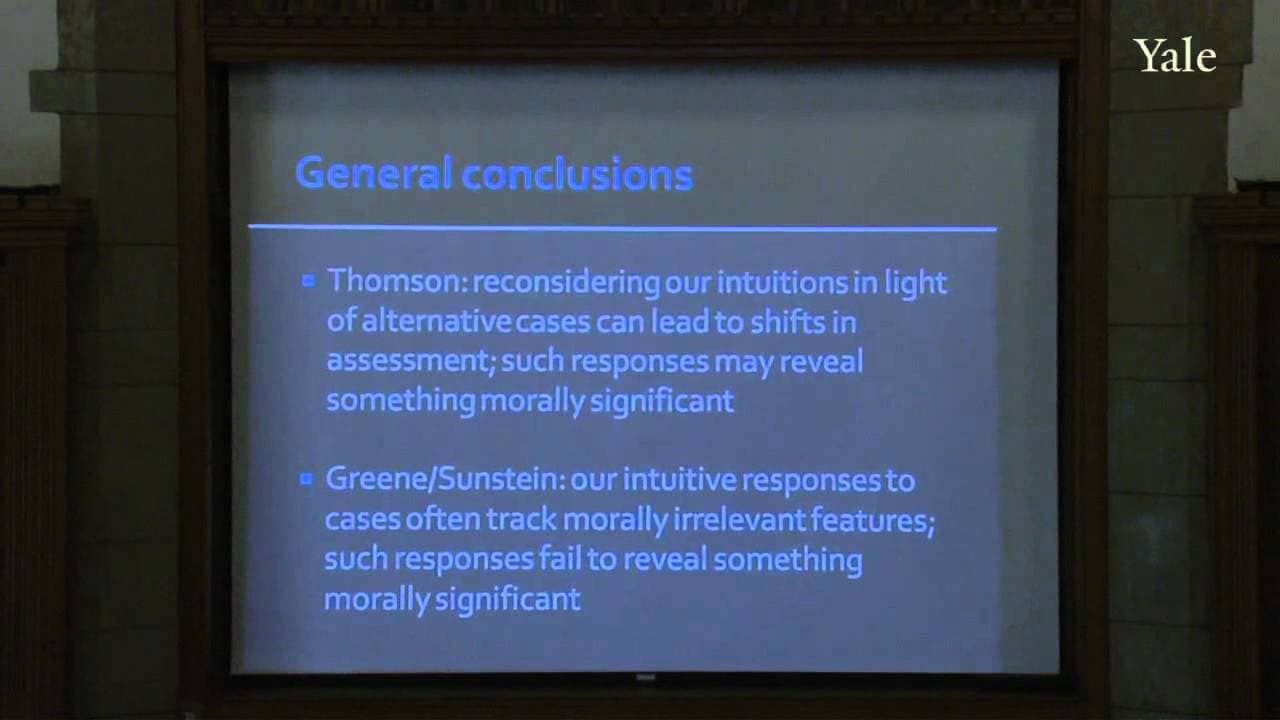
PROFESSOR: OK. So I want to start out by finishing off the discussion that we began last class about ways of thinking about the perplexity that the trolley case gives rise to. And you'll remember that the perplexities that the trolley case gives rise to is that there's an apparent asymmetry in our responses to the bystander case and the fat man cas... Read More
Key Insights
- 🚎 Examining the trolley cases and moral dilemmas reveals perplexities and differing responses, highlighting the complexity of moral judgments.
- 🤞 Luck plays a significant role in moral responsibility, as demonstrated through resultant luck, constitutive luck, and circumstantial luck.
- 🤞 The control principle, which emphasizes factors under an agent's control, and the moral luck principle, which considers the role of luck in moral judgments, can create conflicting perspectives on moral responsibility.
Install to Summarize YouTube Videos and Get Transcripts
Explore YouTube Video Summarizer or Get YouTube Transcript Extractor
Questions & Answers
Q: According to Thomson's response, what is the key factor that eliminates the asymmetry between the bystander case and the fat man case?
Thomson argues that the additional hypothetical case where the decision-maker is on a third track helps us recognize that both actions are morally unacceptable, highlighting the absence of moral asymmetry.
Q: How does Greene explain the emotional response and differential judgments in the fat man case?
Greene suggests that the emotional part of our brain is more activated in the up-close and personal fat man case, leading to unjustified moral judgments compared to the more detached bystander case.
Q: What does Sunstein propose to address the differing responses to the trolley cases?
Sunstein argues that while our responses may differ, the core aspects of the cases are the same. He suggests that the application of heuristics can explain the framing effects and moral judgments in these cases.
Q: How does Sunstein use the heuristics and biases literature to support his argument?
Sunstein suggests that the literature on heuristics and biases demonstrates that framing can affect our responses and judgments in both moral and non-moral cases. He provides examples from Jonathan Haidt's work to illustrate this point.
Summary & Key Takeaways
-
The discussion explores the perplexity caused by the differential responses to similar moral dilemmas, such as the bystander case and the fat man case.
-
Different perspectives, such as Thomson's, Greene's, and Sunstein's, are examined, each offering their own explanations for the moral asymmetry.
-
The concept of moral luck is introduced through examples that demonstrate how luck can influence our moral judgments, both in terms of outcomes and circumstances.
Read in Other Languages (beta)
Share This Summary 📚
Summarize YouTube Videos and Get Video Transcripts with 1-Click
Try YouTube Summary with ChatGPT & Claude or YouTube Transcript Generator
Explore More Summaries from YaleCourses 📚



Summarize YouTube Videos and Get Video Transcripts with 1-Click
Try YouTube Summary with ChatGPT & Claude or YouTube Transcript Generator