Products
Features
YouTube Video Summarizer
Summarize YouTube videos
Web & PDF Highlighter
Highlight web pages & PDFs
Chat with PDF
Ask any PDF questions with AI
Ask AI Clone
Chat with your highlights & memories
Audio Transcriber
Transcribe audio files to text
Glasp Reader
Read and highlight articles
Kindle Highlight Export
Export your Kindle highlights
Idea Hatch
Hatch ideas from your highlights
Integrations
Obsidian Plugin
Notion Integration
Pocket Integration
Instapaper Integration
Medium Integration
Readwise Integration
Snipd Integration
Hypothesis Integration
Apps & Extensions
Chrome Extension
Safari Extension
Edge Add-ons
Firefox Add-ons
iOS App
Android App
Discover
Discover
Ideas
Discover new ideas and insights
Articles
Curated articles and insights
Books
Book recommendations by great minds
Posts
Essays and notes from readers
Quotes
Inspiring quotes collection
Videos
Curated videos and summaries
Explore Glasp
Glasp Newsletter
Weekly insights and updates
Glasp Talk
Interview series with great minds
Glasp Blog
Latest news and articles
Glasp Use Cases
Learn how others use Glasp
Build & Support
Glasp API
Access Glasp's API for developers
MCP Connector
Connect Glasp to Claude & ChatGPT
Community
Glasp Reddit Community
Students
Student discount and benefits
FAQs
Frequently Asked Questions
AboutPricing
DashboardLog inSign up

How Many Galaxies Are Moving Away From Us Faster Than Light?
27.2K views
•
April 5, 2020
by
Domain of Science
YouTube video player
How Many Galaxies Are Moving Away From Us Faster Than Light?

TL;DR

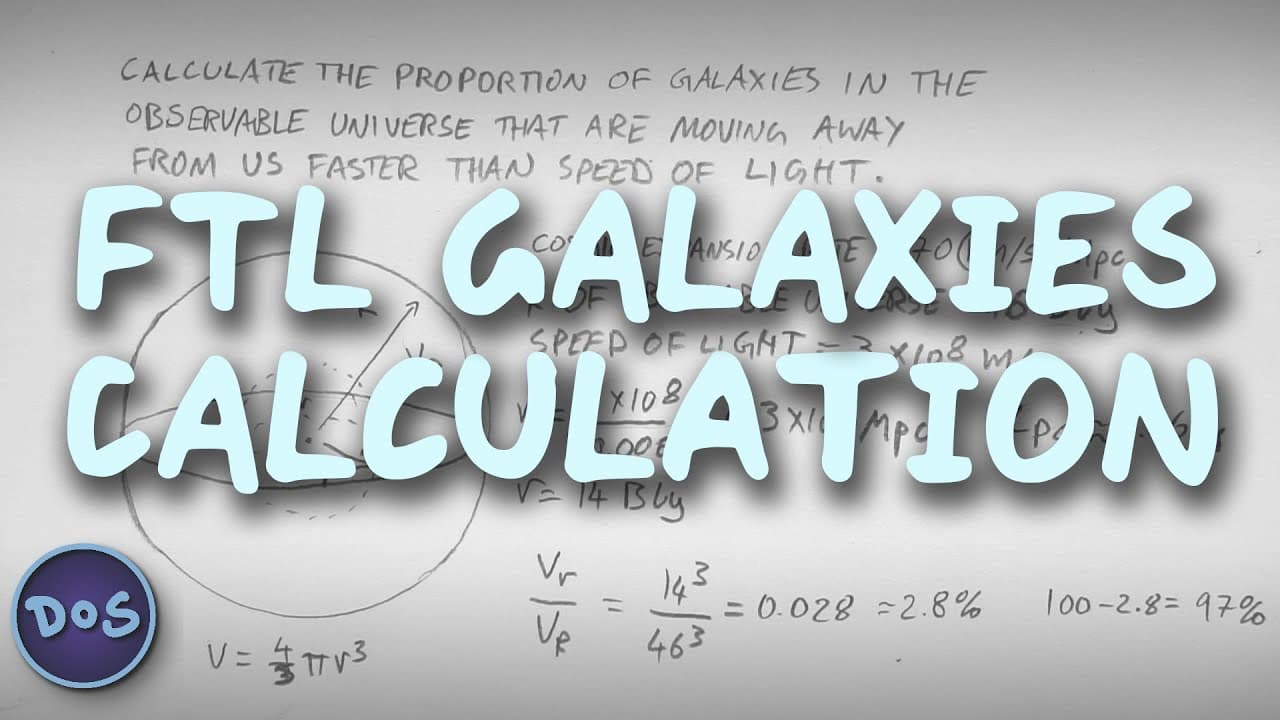
Determine that 97% of galaxies move away from us slower than light.

Transcript

okay this is the solution to the problem I posed in the last video you haven't seen that video yet click here to go watch it these questions about the calculating the proportion of galaxies in the observable universe that's moving away from us faster than the speed of light and to solve this we need a few numbers so first of all this is a diagram o... Read More

Key Insights

  • 🙂 The observable universe has a radius of 46 billion light-years.
  • ☠️ The cosmic expansion rate is 70 kilometers per second per megaparsec.
  • 🙂 The speed of light is crucial in determining the limit at which galaxies move away.
  • 🔇 Calculating proportions requires converting distance measures and comparing volumes.
  • 🙂 Only 2.8% of galaxies in the observable universe move faster than light.
  • 👮 Understanding the speed limit of galaxies provides insights into the laws governing the universe.
  • 🆘 Accurate calculations help clarify the distribution of galaxies and their movement patterns.

Install to Summarize YouTube Videos and Get Transcripts

Explore YouTube Video Summarizer or Get YouTube Transcript Extractor

Questions & Answers

Q: How is the radius where galaxies move faster than light calculated?

The radius is found by dividing the speed of light by the cosmic expansion rate and converting it to light-years for comparison, demonstrating the speed limit effect.

Q: What is the significance of finding the proportion of galaxies moving faster than light?

It shows that only 2.8% of galaxies in the observable universe are moving away from us faster than light, reinforcing the laws of physics.

Q: Why is it essential to consider volumes when comparing the proportion of galaxies?

Comparing volumes rather than areas accounts for the true distribution of galaxies, providing a more accurate representation of the cosmic expansion.

Q: How does the calculation methodology impact our understanding of the universe?

By showing that the vast majority of galaxies adhere to the laws of physics, it supports our understanding of how the universe functions and expands.

Summary & Key Takeaways

  • Explained how to calculate the proportion of galaxies moving faster than the speed of light.

  • Steps detailed include finding the radius and converting it into light-years.

  • Found that 97% of galaxies in the observable universe move slower than the speed of light.


Read in Other Languages (beta)

English

Share This Summary 📚

Summarize YouTube Videos and Get Video Transcripts with 1-Click

Download browser extensions on:

Try YouTube Summary with ChatGPT & Claude or YouTube Transcript Generator

Explore More Summaries from Domain of Science 📚

The Fascinating Map of Fungi thumbnail
The Fascinating Map of Fungi
Domain of Science
VIRUSES Explained in 9 Slides thumbnail
VIRUSES Explained in 9 Slides
Domain of Science
Gravitational Waves Are Awesome thumbnail
Gravitational Waves Are Awesome
Domain of Science
The Map of Doom | Apocalypses Ranked thumbnail
The Map of Doom | Apocalypses Ranked
Domain of Science
The Comprehensive Map of Medicine thumbnail
The Comprehensive Map of Medicine
Domain of Science
How to Read Math thumbnail
How to Read Math
Domain of Science

Summarize YouTube Videos and Get Video Transcripts with 1-Click

Download browser extensions on:

Try YouTube Summary with ChatGPT & Claude or YouTube Transcript Generator

Apps & Extensions

  • Chrome Extension
  • Safari Extension
  • Edge Add-ons
  • Firefox Add-ons
  • iOS App
  • Android App

Key Features

  • YouTube Video Summarizer
  • Web & PDF Summarizer
  • Web & PDF Highlighter
  • Chat with PDF
  • Ask AI Clone
  • Audio Transcriber
  • Glasp Reader
  • Kindle Highlight Export
  • Idea Hatch

Integrations

  • Obsidian Plugin
  • Notion Integration
  • Pocket Integration
  • Instapaper Integration
  • Medium Integration
  • Readwise Integration
  • Snipd Integration
  • Hypothesis Integration

More Features

  • APIs
  • MCP Connector
  • Blog & Post
  • Embed Links
  • Image Highlight
  • Personality Test
  • Quote Shots

Company

  • About us
  • Blog
  • Community
  • FAQs
  • Job Board
  • Newsletter
  • Pricing
Terms

•

Privacy

•

Guidelines

© 2026 Glasp Inc. All rights reserved.