What Is the Conservation of Mechanical Energy?
TL;DR
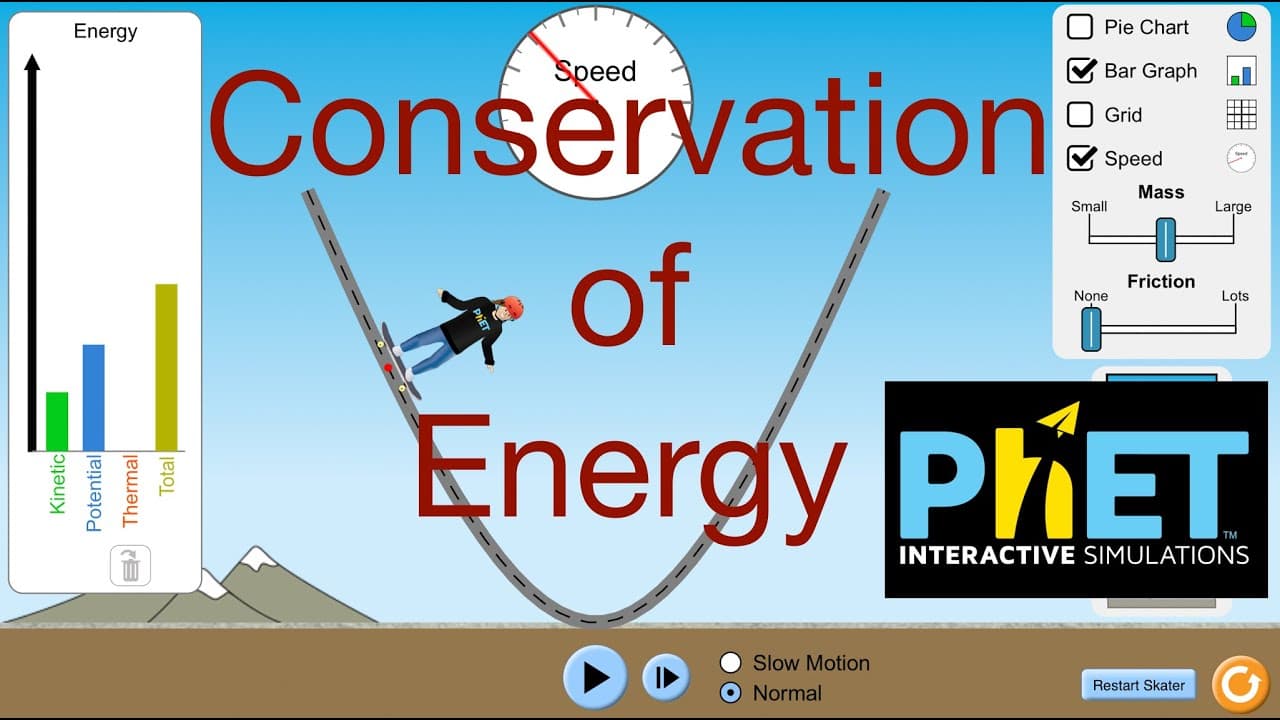
The conservation of mechanical energy states that the total energy in an isolated system remains constant, which means kinetic energy (energy of motion) and potential energy (stored energy due to position) can transform into one another without loss. The PhET Energy Skate Park simulation effectively demonstrates this principle through various scenarios, showing how energy is conserved and how friction affects that conservation.
Transcript
in today's video we're going to be going over conservation of energy and we're going to be doing this using one of the excellent simulations from phet interactive simulations this simulation is entitled energy skate park Basics before we get started please don't forget to subscribe to our Channel step-by-step science Please Subscribe click the noti... Read More
Key Insights
- ❓ Kinetic energy is the energy of motion, determined by an object's velocity.
- 🧘 Potential energy is stored energy due to an object's position above a surface.
- 🦾 Total mechanical energy is the sum of kinetic and potential energy in a system.
- ❓ Conservation of energy implies the total energy of an isolated system remains constant.
- 👣 The Energy Skate Park simulation illustrates conservation of energy principles using different tracks and scenarios.
- 🥵 Friction in the simulation results in the loss of mechanical energy converted to heat.
- 👻 Calculations involving kinetic and potential energy allow for understanding energy transformations.
Install to Summarize YouTube Videos and Get Transcripts
Explore YouTube Video Summarizer or Get YouTube Transcript Extractor
Questions & Answers
Q: What is kinetic energy and how is it calculated?
Kinetic energy is the energy of motion, calculated using the equation KE = 1/2 * m * V^2, where m is mass and V is velocity.
Q: Explain potential energy and its relation to an object's position.
Potential energy is stored energy due to an object's position above a surface, calculated as PE = m * g * h, where m is mass, g is acceleration due to gravity, and h is height.
Q: How is total mechanical energy calculated and what does conservation of energy imply?
Total mechanical energy is the sum of kinetic and potential energies. Conservation of energy states that the total energy of an isolated system remains constant, transforming from one form to another.
Q: How does the Energy Skate Park simulation demonstrate conservation of energy?
The simulation shows how, with no friction, the total mechanical energy of a skater remains constant at different points on the track, showcasing conservation of energy principles.
Summary & Key Takeaways
-
Conservation of energy explained using a simulation from PhET Interactive Simulations.
-
Kinetic energy is the energy of motion, symbolized as KE, while potential energy is stored energy due to an object's position above a surface.
-
Total mechanical energy is the sum of kinetic and potential energy, and conservation of energy states that the total energy of an isolated system remains constant.
Read in Other Languages (beta)
Share This Summary 📚
Summarize YouTube Videos and Get Video Transcripts with 1-Click
Try YouTube Summary with ChatGPT & Claude or YouTube Transcript Generator
Explore More Summaries from Step by Step Science 📚
Summarize YouTube Videos and Get Video Transcripts with 1-Click
Try YouTube Summary with ChatGPT & Claude or YouTube Transcript Generator