Impulse Formula - Definite Integral - Physics and Calculus
TL;DR
Use calculus to calculate the impulse applied to a block by a variable force over a three-second interval.
Transcript
a variable Force defined by the function f of T is equal to 2T ^2 - 4T + 5 is applied on a block across a horizontal frictional surface calculate the impulse applied to the block by this force during the first 3 seconds so how can we do this if you want to try this problem feel free to pause the video and work on it now impulse typically represente... Read More
Key Insights
- ⌛ Impulse can be calculated by multiplying force and time or by finding the change in momentum.
- 🤝 When dealing with a variable force, calculus is used to calculate the impulse.
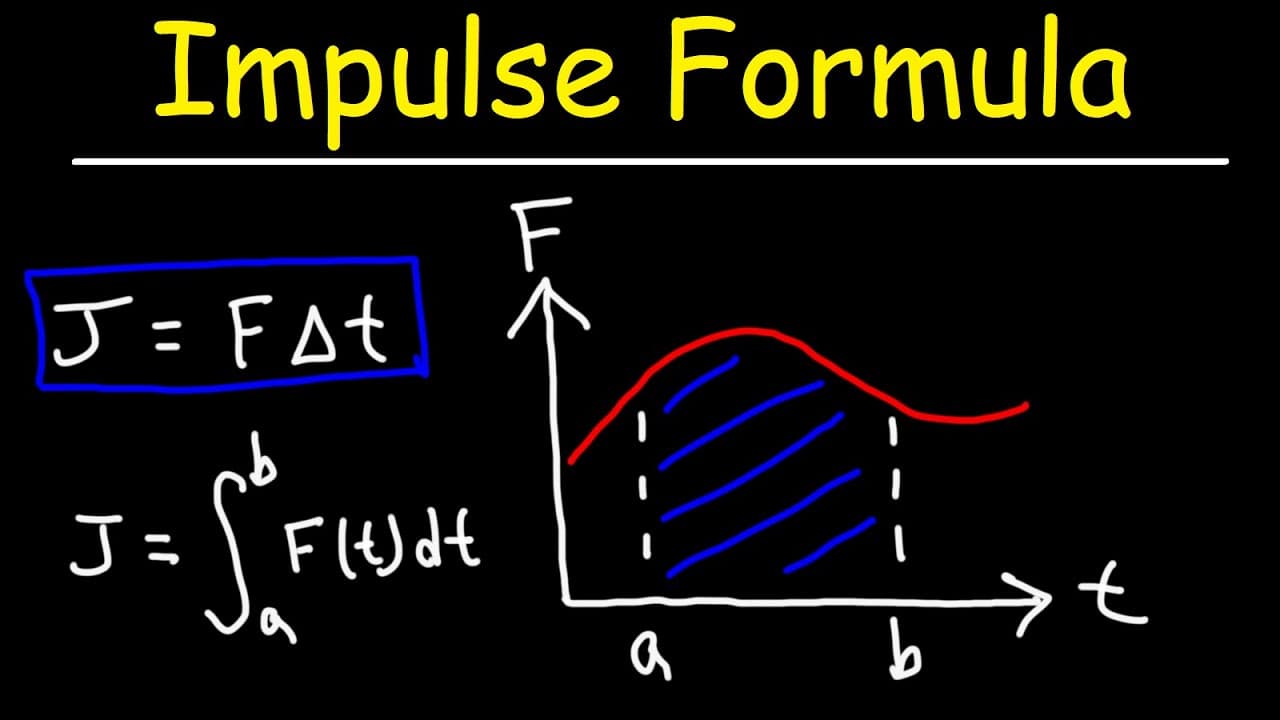
- 🫡 The impulse is equal to the definite integral of the force function with respect to time.
- ⌛ The area under the curve of a force-time graph represents the impulse applied to an object.
- 🚫 In this specific problem, the impulse applied to a block by the variable force is found to be 15 Newton seconds.
- 🇦🇪 The units of impulse are Newton seconds or Ns.
- ✊ The power rule is used to find the anti-derivatives of variable raised to a constant.
- 0️⃣ Zero times any value is zero, so when plugging in zero for the force function, the result is zero.
Install to Summarize YouTube Videos and Get Transcripts
Explore YouTube Video Summarizer or Get YouTube Transcript Extractor
Questions & Answers
Q: How is impulse typically represented and calculated?
Impulse is typically represented by the symbol J or sometimes I and can be calculated by multiplying the force applied by the time or by finding the change in momentum.
Q: How is impulse calculated when dealing with a variable force?
When dealing with a variable force, calculus is used. The impulse is equal to the definite integral of the force function with respect to time over the desired interval.
Q: What is the force function in this specific problem?
The force function in this problem is represented by the equation 2T^2 - 4T + 5, where T is time.
Q: How is the impulse calculated for the first three seconds in this problem?
To calculate the impulse for the first three seconds, the definite integral of the force function from 0 to 3 is calculated. This results in an impulse of 15 Newton seconds.
Summary & Key Takeaways
-
Impulse is equal to the force multiplied by time or the change in momentum, but in the case of a variable force, calculus must be used to find the impulse.
-
To find the impulse for a specific time interval, the definite integral of the force function with respect to time should be calculated.
-
In this problem, the impulse applied to a block by a variable force defined by the equation 2T^2 - 4T + 5 over the first three seconds is found to be 15 Newton seconds.
Read in Other Languages (beta)
Share This Summary 📚
Summarize YouTube Videos and Get Video Transcripts with 1-Click
Try YouTube Summary with ChatGPT & Claude or YouTube Transcript Generator
Explore More Summaries from The Organic Chemistry Tutor 📚
Summarize YouTube Videos and Get Video Transcripts with 1-Click
Try YouTube Summary with ChatGPT & Claude or YouTube Transcript Generator