What Are the Tests for Series Convergence and Divergence?
TL;DR
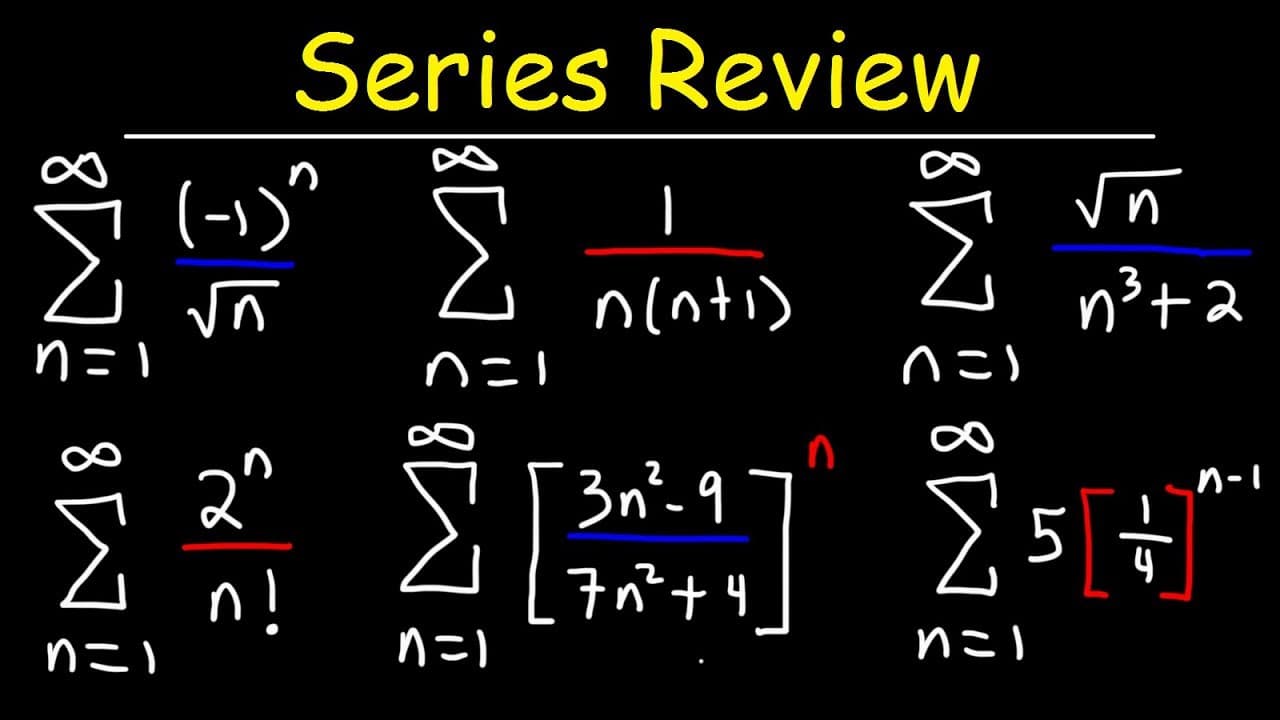
To determine if a series converges or diverges, use various tests: the divergence test checks if the limit equals zero; the geometric series test looks at the common ratio; the p-series test examines the exponent; the telescoping series test simplifies terms; the integral test compares integrals; the ratio and root tests analyze term ratios; and comparison tests assess relative convergence. Each test has specific criteria to validate results.
Transcript
in this video i'm going to give you a review of the different tests that you need to know in order to determine if a series is going to converge or if it's going to diverge so the first test we're going to talk about is the divergence test now what you need to do is take the limit as n approaches infinity of the sequence a sub n if this limit does ... Read More
Key Insights
- 🏆 There are various tests available to determine if a series converges or diverges, including the divergence test, geometric series test, p-series test, telescoping series test, integral test, ratio test, root test, direct comparison test, and limit comparison test.
- 🏆 Each test has its own criteria and requirements, such as the need for certain limits, exponents, or comparison to other series.
- 🏆 The tests provide different methods to analyze the behavior of series and make predictions about their convergence or divergence.
Install to Summarize YouTube Videos and Get Transcripts
Explore YouTube Video Summarizer or Get YouTube Transcript Extractor
Questions & Answers
Q: What is the divergence test?
The divergence test is a method to determine if a series diverges. It involves taking the limit as n approaches infinity of the sequence. If the limit is not zero, the series diverges.
Q: How does the geometric series test work?
The geometric series test determines if a series converges by identifying the common ratio. If the absolute value of the common ratio is less than one, the series converges. If it is greater than or equal to one, the series diverges.
Q: What is the p-series test?
The p-series test determines if a series converges based on the exponent of 1/n. If the exponent is greater than 1, the series converges. If it is less than or equal to 1, the series diverges.
Q: How does the telescoping series test work?
The telescoping series test involves cancelling terms in a series to simplify it. Then, the sum of the series is evaluated as n approaches infinity. If the sum is a finite value, the series converges. If it is infinity or doesn't exist, the series diverges.
Q: What is the integral test?
The integral test compares a series to the integral of a function. If the integral converges, the series converges. If it diverges, the series diverges.
Q: How does the ratio test work?
The ratio test compares the absolute values of consecutive terms in a series. If the limit of the ratio is less than 1, the series converges. If it is greater than or equal to 1, the series diverges.
Q: What is the root test?
The root test determines convergence or divergence by taking the limit of the nth root of the absolute value of the terms. If the limit is less than 1, the series converges. If it is greater than or equal to 1, the series diverges.
Q: How do the direct comparison and limit comparison tests work?
The direct comparison test compares a series to another series. If the big series converges, the small series converges as well, and if the small series diverges, the big series diverges. The limit comparison test involves taking the limit of the ratio of terms in two series to determine their convergence or divergence.
Summary & Key Takeaways
-
The divergence test determines if a series diverges by taking the limit as n approaches infinity of the sequence. If the limit is not zero, the series diverges.
-
The geometric series test determines if a series converges by identifying the common ratio. If the absolute value of the common ratio is less than one, the series converges. If it is greater than or equal to one, the series diverges.
-
The p-series test determines if a series converges based on the exponent of 1/n. If the exponent is greater than 1, the series converges. If it is less than or equal to 1, the series diverges.
-
The telescoping series test involves cancelling terms to simplify the series and then evaluating the sum as n approaches infinity. If the sum is a finite value, the series converges. If it is infinity or doesn't exist, the series diverges.
-
The integral test involves comparing a series to the integral of a function. If the integral converges, the series converges. If it diverges, the series diverges.
-
The ratio test compares the absolute values of consecutive terms in a series to determine convergence or divergence. If the limit is less than 1, the series converges. If it is greater than or equal to 1, the series diverges.
-
The root test determines convergence or divergence by taking the limit of the nth root of the absolute value of the terms. If the limit is less than 1, the series converges. If it is greater than or equal to 1, the series diverges.
-
The direct comparison and limit comparison tests involve comparing a series to another series. If the big series converges, the small series converges as well, and if the small series diverges, the big series diverges.
-
The alternating series test is used for series with alternating signs. It checks conditions of divergence, decreasing sequence, and absolute convergence to determine convergence or divergence.
Read in Other Languages (beta)
Share This Summary 📚
Summarize YouTube Videos and Get Video Transcripts with 1-Click
Try YouTube Summary with ChatGPT & Claude or YouTube Transcript Generator
Explore More Summaries from The Organic Chemistry Tutor 📚

Summarize YouTube Videos and Get Video Transcripts with 1-Click
Try YouTube Summary with ChatGPT & Claude or YouTube Transcript Generator