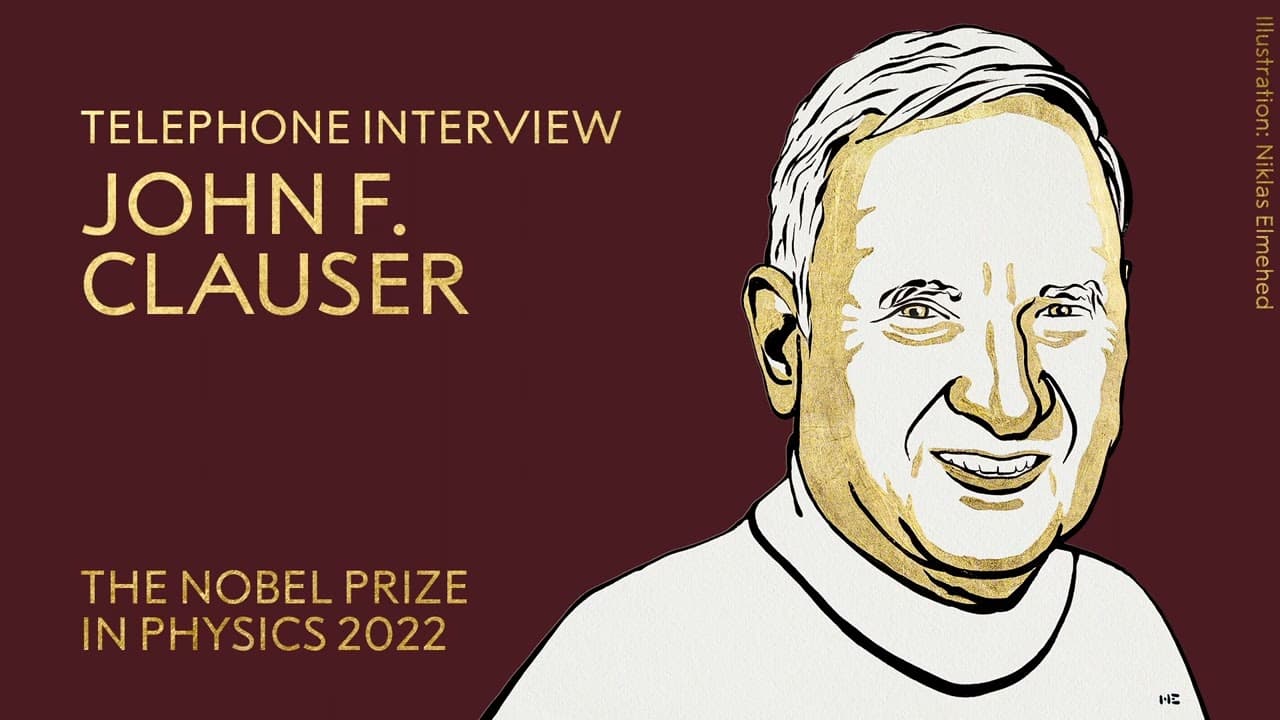
John Clauser: “What a waste of time, now start doing some real physics!”
TL;DR
John Clauser helped propose and perform an experimental test of Bell's theorem despite strong resistance from prominent physicists and his Columbia faculty. Working with limited funding, he and Stuart Freedman built equipment from scratch and repurposed unused laboratory materials, pursuing research that Clauser believed was important even though it damaged his academic career.
Transcript
John clauser please zooming right now with England okay I understand that but you should be off in a second okay hang on thank you I'll call back in a few minutes maybe that would work uh the only thing I worry about is if I hang up then I might never be able to get back in touch again you know because your phone's going to be ringing off the hook ... Read More
Key Insights
- Clauser's Nobel Prize morning began at three in the morning, when calls from reporters interrupted his sleep and ordinary routine. He said the volume of calls delayed his coffee and even made getting dressed take more than an hour.
- The CHSH proposal emerged after Clauser independently developed an experimental idea similar to work by Abner Shimony, Michael Horne, and John Holt. They met at an American Physical Society meeting, combined their resources, and published their joint paper in 1969.
- The first experimental test of Bell's theorem became Stuart Freedman's doctoral thesis at Cal Berkeley. Clauser collaborated with Freedman after earning his degree at Columbia and moving to Berkeley, turning the earlier proposal into a laboratory experiment.
- Opposition to the experiment came from prominent physicists and Clauser's Columbia faculty. Richard Feynman was offended by the possibility that quantum mechanics might not make the correct predictions and, according to Clauser, effectively threw him out of his office.
- Support from Charlie Townes and Howard Shugart enabled Clauser to conduct the experiments at Cal Berkeley. Their assistance mattered because Clauser faced institutional skepticism and lacked substantial funding for the challenging experimental work he wanted to pursue.
- Limited funding forced Clauser and Freedman to build their experimental apparatus from scratch. They spent considerable time cutting metal in the shop and repurposed old equipment or scrap found within the University of California physics department.
- Clauser's research choice damaged his conventional academic career even though he considered the work important and enjoyable. He said that he never became a professor, had great difficulty finding employment, and was told the project could ruin his career.
- Clauser continued performing experiments after Freedman completed his degree and left for Princeton. He conducted three more experiments, again building the necessary equipment from scratch, before later going to Livermore laboratory to work on controlled-fusion plasma physics experiments.
Install to Summarize YouTube Videos and Get Transcripts
Explore YouTube Video Summarizer or Get YouTube Transcript Extractor
Questions & Answers
Q: How did John Clauser begin testing Bell's theorem?
John Clauser independently developed the idea that Bell's theorem might be tested experimentally. At an American Physical Society meeting, he connected with Abner Shimony, Michael Horne, and John Holt, who had related ideas. They decided to combine their resources and published the 1969 CHSH paper, which Clauser described as the first proposal for carrying out the experiment.
Q: Who performed the first experimental test of Bell's theorem?
John Clauser and Stuart Freedman performed what Clauser described as the first experimental test of Bell's theorem at Cal Berkeley. Freedman was a graduate student, and the project became his doctoral thesis. Clauser had moved to Berkeley after receiving his degree at Columbia, where he had already faced strong resistance to investigating whether quantum mechanics made the correct predictions.
Q: Why did physicists oppose John Clauser's experiment?
Many physicists believed the experiment would merely confirm the predictions everyone already expected from quantum mechanics. Clauser recalled that Richard Feynman was offended that he would even consider the possibility that quantum mechanics might not predict correctly. After the experiment, members of Clauser's Columbia faculty still called it a waste of time and urged him to pursue what they considered real physics.
Q: How did John Clauser build experiments with little money?
John Clauser and Stuart Freedman built their equipment from scratch because very little money was available. They spent substantial time in the shop cutting metal and assembled apparatus from old items or scrap belonging to the University of California physics department. Clauser also searched storage rooms for unused equipment that others had set aside but that he recognized as useful.
Q: Who helped John Clauser conduct his Berkeley experiments?
Charlie Townes and Howard Shugart provided the support that allowed John Clauser to conduct the experiments at Cal Berkeley. Clauser described their efforts as very kind and contrasted that assistance with the skepticism he encountered from his Columbia faculty and Richard Feynman. Their support helped him proceed despite professional opposition, scarce funding, and the need to construct equipment himself.
Q: Did testing Bell's theorem affect John Clauser's career?
John Clauser said the decision harmed his conventional academic career. Colleagues warned that the work could ruin his career, and he stated that, in one respect, it did because he never became a professor. He also had great difficulty finding a job. Even so, he regarded the research as important and said he enjoyed doing challenging experimental physics.
Q: What did John Clauser do after the first Bell experiment?
After Stuart Freedman received his degree and left for Princeton, John Clauser continued the research and conducted three more experiments. He said every project required him to build the equipment from scratch. Later, difficulty finding an academic position led him to Livermore laboratory, where he worked on controlled-fusion plasma physics experiments and continued demonstrating his abilities as an experimentalist.
Q: How did John Clauser react to receiving the Nobel Prize?
John Clauser reacted with surprise, humor, and visible excitement while reporters repeatedly contacted him. He said he had been awakened at three in the morning and had spoken with Swedish, European, and American news organizations. The calls delayed simple tasks, including getting coffee and dressing. During the interview, he willingly reflected on his research, career difficulties, and enjoyment of experimental work.
Summary
In this video, John Clauser, a Nobel laureate, is interviewed about his work on testing Bell's theorems in the laboratory. He shares insights into his journey, including the challenges he faced and the skepticism he encountered from fellow physicists like Feynman. Despite the initial doubts, Clauser persevered and conducted successful experiments, albeit with limited resources. He also discusses the tradition of scavenging equipment and materials to make the most out of what was available. Overall, Clauser's story is a testament to the importance of curiosity, determination, and resourcefulness in scientific research.
Questions & Answers
Q: How did John Clauser get the idea to test Bell's theorems in the laboratory?
John Clauser had the idea independently, but it was inspired by the work of Adirushimon and Michael Horne. He wrote an abstract and gave a talk at a physical society meeting, where he met Stuart Friedman and collaborated with him on the first experimental proposal to test Bell's theorems.
Q: How did Feynman and Clauser's faculty at Columbia react to his proposal?
Feynman and Clauser's faculty at Columbia were initially dismissive and skeptical of the idea. In fact, Feynman even threw Clauser out of his office, as he was offended by the suggestion that quantum mechanics might not provide accurate predictions. Despite the discouragement, Clauser found support from Charlie Townes and Howard Shugart at Cal Berkeley, who helped him conduct the experiments.
Q: Why did Clauser struggle to find a job after his groundbreaking experiments?
Clauser had difficulty finding a job because his groundbreaking experiments in testing Bell's theorems had not yet been widely recognized or valued by the scientific community. As a result, many institutions were not interested in hiring him. He eventually ended up working at Livermore Lab, conducting controlled fusion plasma physics experiments.
Q: Did Clauser face financial challenges while conducting his experiments?
Yes, Clauser faced financial challenges while conducting his experiments. He had very little funding and had to build everything from scratch. Lack of resources led Clauser and his colleague, Stuart Friedman, to scavenge materials and equipment from storerooms. They had to be resourceful and creative to make the most out of what was available.
Q: Were other famous physicists also known for scavenging equipment and materials?
Yes, other famous physicists, such as Oppenheimer and Lawrence, were also known for scavenging equipment and materials. Clauser mentions that it was a great tradition and even recalls seeing equipment labeled "no bloody good" by Oliver Smithies, a medicine laureate. This tradition of making use of unused items in storerooms is a testament to the resourcefulness and ingenuity of scientists.
Takeaways
John Clauser's journey from testing Bell's theorems to becoming a Nobel laureate showcases the importance of perseverance, curiosity, and resourcefulness in scientific research. Despite initial skepticism and limited resources, Clauser pursued his groundbreaking experiments and made significant contributions to the field. His story serves as an inspiration for aspiring scientists, highlighting the need to challenge established beliefs, overcome obstacles, and make the most out of the available resources.
Summary & Key Takeaways
-
John Clauser received the Nobel Prize news amid continuous calls from Swedish, European, and American media. Awakened at three in the morning, he struggled to complete ordinary tasks or even get coffee. During a brief telephone interview, he reflected on the unconventional experiments behind the award and their personal consequences.
-
Clauser independently developed an idea for experimentally testing Bell's theorem, then joined Abner Shimony, Michael Horne, and John Holt. Their combined work produced the 1969 CHSH paper, described by Clauser as the first proposal for the experiment. He later collaborated with graduate student Stuart Freedman at Berkeley on the first experimental test.
-
Many physicists opposed Clauser's project because they expected quantum mechanics to produce the correct predictions. Richard Feynman dismissed him, and Columbia faculty called the completed work a waste of time. With support at Berkeley, Clauser persisted, built apparatus from scratch, conducted additional experiments, and demonstrated his capabilities as an experimental physicist.
Read in Other Languages (beta)
Share This Summary 📚
Summarize YouTube Videos and Get Video Transcripts with 1-Click
Try YouTube Summary with ChatGPT & Claude or YouTube Transcript Generator
Explore More Summaries from Nobel Prize Conversations 📚
Summarize YouTube Videos and Get Video Transcripts with 1-Click
Try YouTube Summary with ChatGPT & Claude or YouTube Transcript Generator