Lecture 25
TL;DR
Explores financial market structures, efficiency, and investor risk preferences.
Transcript
thank you one needs financial markets to channelize the savings of her economy towards productive and efficient sectors this is often referred to as Financial intermediation conventionally banks have played this role however Financial intermediation by Banks is fraught with issues such as bureaucratic hassles and principal agent problems in contras... Read More
Key Insights
- Financial intermediation channels savings to productive sectors, traditionally done by banks, now increasingly by financial markets.
- Efficient and liquid markets allow direct investor participation, reducing principal-agent problems and improving investment choices.
- Market efficiency types include weak form, semi-strong form, and strong form, each with different implications for trading strategies.
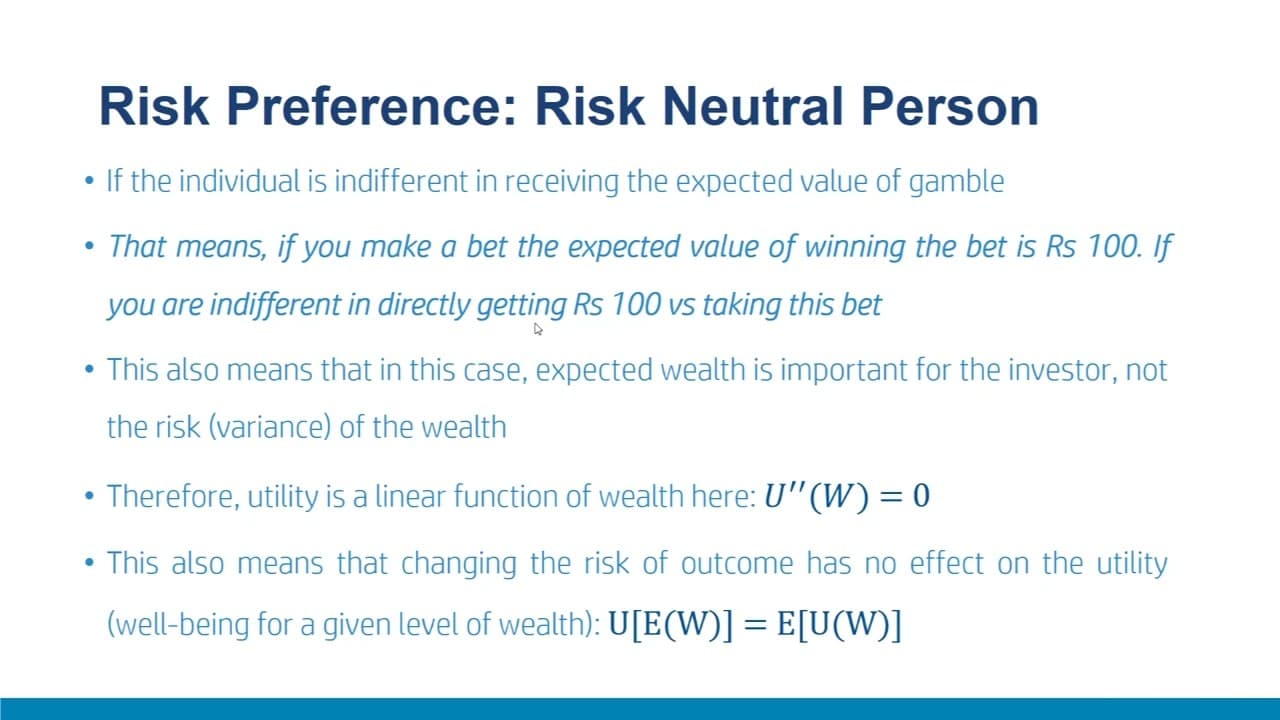
- Risk preferences categorize investors into risk-averse, risk-neutral, and risk-seeking, affecting their investment decisions.
- Market microstructures like limit order books and broker-dealer markets facilitate trade execution and liquidity provision.
- Arbitrage opportunities arise from inefficiencies when prices deviate significantly from fundamental values, though limited by transaction costs.
- Market makers maintain inventory to provide liquidity, adjusting spreads based on inventory levels and information asymmetry.
- Algorithmic trading in electronic markets can enhance market efficiency by rapidly exploiting price inefficiencies.
Install to Summarize YouTube Videos and Get Transcripts
Explore YouTube Video Summarizer or Get YouTube Transcript Extractor
Questions & Answers
Q: What role do financial markets play in an economy?
Financial markets channel savings into productive sectors, facilitating efficient allocation of resources. They enable investors to directly engage in the investment process, reducing reliance on banks and mitigating principal-agent problems. Efficient and liquid markets are crucial for optimal functioning, allowing for better investment choices and economic growth.
Q: How are market efficiencies categorized?
Market efficiencies are categorized into three types: weak form, where past prices do not yield abnormal profits; semi-strong form, where public information is also factored in, preventing profits from public and historical data; and strong form, where even private information does not allow for abnormal profits. Each form reflects the level of information incorporated into prices.
Q: What are the different risk preferences among investors?
Investors are categorized based on risk preferences into three types: risk-averse, who prefer certainty and require a premium for risk; risk-neutral, who are indifferent to risk and focus on expected outcomes; and risk-seeking, who prefer riskier investments for potentially higher returns. These preferences influence their investment strategies and decision-making.
Q: What are limit order books in financial markets?
Limit order books are electronic systems used in financial markets to manage buy and sell orders. They consist of limit orders, which specify the worst acceptable terms, and market orders, which are executed immediately at the best available prices. Limit order books facilitate liquidity provision and efficient trade execution, often utilizing algorithmic trading for rapid processing.
Q: How do market makers contribute to market stability?
Market makers provide liquidity by offering continuous buy and sell quotes, ensuring smooth market operations. They maintain optimal inventory levels to manage price fluctuations and adjust spreads based on inventory and information asymmetry. This role is crucial in both traditional broker-dealer markets and modern electronic markets with limit order books.
Q: What is the impact of algorithmic trading on market efficiency?
Algorithmic trading enhances market efficiency by rapidly exploiting price inefficiencies, often at microsecond speeds. This technology-driven approach reduces the window of inefficiency, leading to prices that more accurately reflect available information. However, it raises concerns about fairness for human traders competing against high-frequency trading algorithms.
Q: What are the challenges of arbitrage in financial markets?
Arbitrage involves exploiting price inefficiencies across markets, but it is limited by transaction costs, taxes, and liquidity constraints. Arbitrage opportunities are more prevalent when prices deviate significantly from fundamental values, but they must be substantial enough to cover associated costs. Market efficiency and liquidity also influence the feasibility of arbitrage.
Q: What is the significance of spread in financial markets?
Spread, the difference between bid and ask prices, is a key measure of market liquidity. It represents the cost of immediate trade execution and reflects the profit margin for market makers. Lower spreads indicate higher liquidity and more efficient markets, while higher spreads suggest less liquidity and potential inefficiencies. Spread is crucial for assessing market conditions and trading costs.
Summary & Key Takeaways
-
Financial markets enable direct investment, bypassing traditional banks, and require efficiency and liquidity for optimal function. This lesson discusses market structures, efficiency, and investor risk preferences, emphasizing the role of arbitrage and market makers in maintaining market stability.
-
Three types of market efficiency—weak, semi-strong, and strong—define how information affects prices. Investors are categorized by risk preferences: risk-averse, risk-neutral, and risk-seeking. Efficient markets minimize arbitrage opportunities, while inefficiencies can be exploited by informed traders.
-
Modern markets utilize electronic limit order books and algorithmic trading to enhance liquidity and efficiency. Market makers, both traditional and electronic, play a crucial role in ensuring smooth trading operations by providing continuous buy and sell quotes.
Read in Other Languages (beta)
Share This Summary 📚
Summarize YouTube Videos and Get Video Transcripts with 1-Click
Try YouTube Summary with ChatGPT & Claude or YouTube Transcript Generator
Explore More Summaries from IIT KANPUR-NPTEL 📚
Summarize YouTube Videos and Get Video Transcripts with 1-Click
Try YouTube Summary with ChatGPT & Claude or YouTube Transcript Generator