Lecture 24
TL;DR
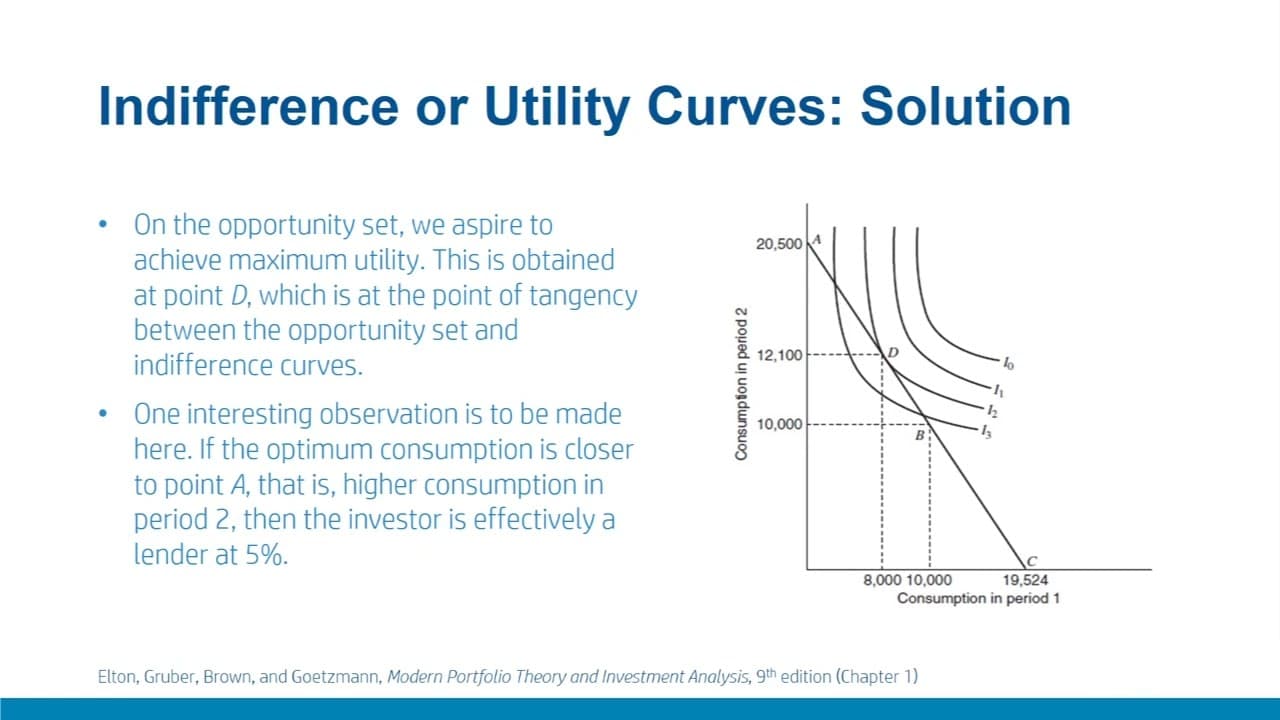
Introduction to economic choice under certainty and risk in finance.
Transcript
thank you in this lesson we'll introduce the economic theory of choice under certainty individuals behave according to their risk preferences with determines their duty of wealth in this backdrop we'll discuss the indifference curves for investors and how these Concepts help us in arriving at the risk written framework in financial ... Read More
Key Insights
- Individuals make economic choices based on risk preferences, impacting their wealth distribution and consumption patterns.
- Opportunity sets and indifference curves help investors maximize utility, influencing borrowing and lending decisions.
- Expected returns differ from actual returns due to varying risk levels associated with different financial instruments.
- Risk in financial markets is measured using variance and standard deviation, indicating the spread of returns around the mean.
- Interest rates and their compounding frequency significantly affect the effective interest rate and investment returns.
- Normal distribution is often used in financial modeling due to its ability to describe security returns with mean and variance.
- The equilibrium interest rate in financial markets is determined by the demand and supply of funds.
- Continuous compounding is a common method in finance, providing a more accurate measure of returns over time.
Install to Summarize YouTube Videos and Get Transcripts
Explore YouTube Video Summarizer or Get YouTube Transcript Extractor
Questions & Answers
Q: What is the economic theory of choice under certainty?
The economic theory of choice under certainty examines how individuals make consumption and investment decisions based on their risk preferences and available financial instruments. It involves understanding opportunity sets and indifference curves, which help in maximizing utility and determining optimal consumption patterns in financial markets.
Q: How do opportunity sets and indifference curves affect investment decisions?
Opportunity sets represent all possible consumption and investment choices available to an individual, while indifference curves show points where the consumer derives equal utility. By analyzing these, investors can determine optimal points on the opportunity set to maximize utility, influencing whether they become borrowers or lenders at given interest rates.
Q: What is the difference between expected returns and actual returns?
Expected returns are the average returns anticipated based on probabilities of various outcomes, while actual returns are the realized returns from an investment. The difference arises due to the risk associated with the investment, with expected returns considering potential variations in outcomes that actual returns may not reflect.
Q: How is risk measured in financial markets?
Risk in financial markets is measured using variance and standard deviation, which indicate the spread or dispersion of returns around the mean. A higher variance or standard deviation signifies greater risk, reflecting more uncertainty and wider possible outcomes in the returns of a financial instrument.
Q: What is the significance of compounding frequency on interest rates?
Compounding frequency significantly impacts the effective interest rate of an investment. The more frequently interest is compounded, the higher the effective interest rate becomes, leading to greater returns. Continuous compounding represents the maximum frequency, where interest is compounded constantly, providing the most accurate measure of returns.
Q: Why is normal distribution important in financial modeling?
Normal distribution is important in financial modeling because it closely aligns with the properties of security returns, allowing for predictions and risk management. It is defined by mean and variance, making it convenient for modeling and forecasting financial market returns, including interval estimation and hypothesis testing.
Q: How are equilibrium interest rates determined in financial markets?
Equilibrium interest rates in financial markets are determined by the interaction of demand and supply of funds. Investors' income and risk preferences influence their borrowing and lending decisions, which in turn affect the overall demand and supply curves, leading to a market-clearing interest rate where demand equals supply.
Q: What is continuous compounding and its application in finance?
Continuous compounding refers to the process of calculating interest by compounding it an infinite number of times per year. In finance, it is used to provide a more accurate measure of returns over time, especially in research and analysis, as it accounts for the smallest possible compounding intervals, reflecting true investment growth.
Summary & Key Takeaways
-
This content introduces the economic theory of choice under certainty, focusing on how individuals optimize consumption using financial markets. It examines opportunity sets and indifference curves to explain utility maximization and the determination of interest rates.
-
The discussion extends to expected and actual returns, highlighting the role of risk and various measures of risk such as variance and standard deviation. The content also explains the computation of returns using arithmetic and compounded averages.
-
Finally, the content covers the effect of compounding on interest rates, explaining how compounding frequency influences effective interest rates. The importance of normal distribution in financial modeling is also discussed, emphasizing its application in predicting security returns.
Read in Other Languages (beta)
Share This Summary 📚
Summarize YouTube Videos and Get Video Transcripts with 1-Click
Try YouTube Summary with ChatGPT & Claude or YouTube Transcript Generator
Explore More Summaries from IIT KANPUR-NPTEL 📚



Summarize YouTube Videos and Get Video Transcripts with 1-Click
Try YouTube Summary with ChatGPT & Claude or YouTube Transcript Generator